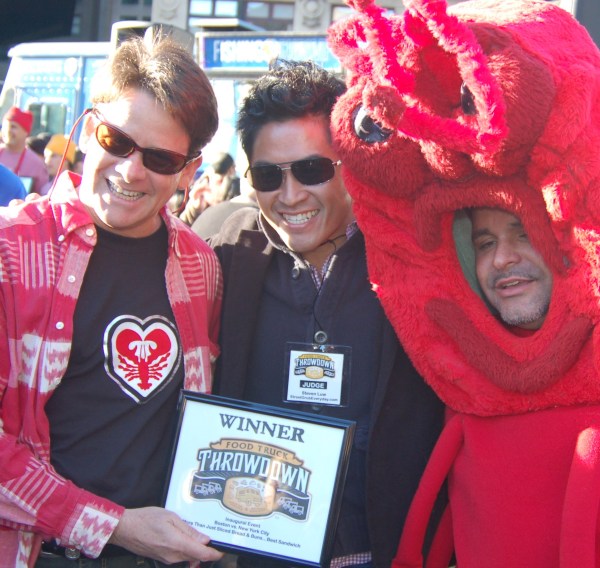
Boston-NYC Food Truck Throwdown: And the winner is….

 by John J. Kochevar

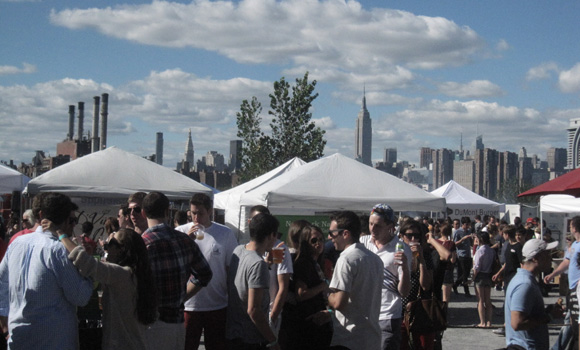
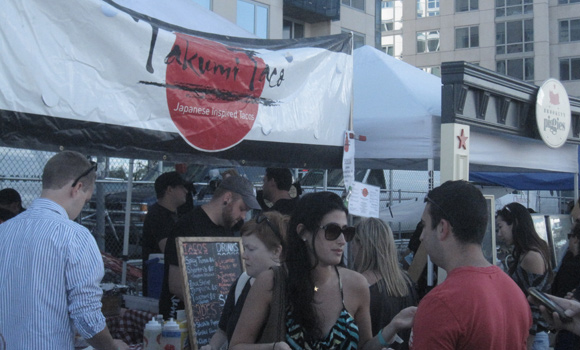
Throwndown sponsored by jetBlueTHERE ARE 3000 FOOD TRUCKS IN THE NAKED CITY – 3000 permit-carrying food trucks, that is, and countless illegals. Last Saturday seven of New York’s finest rumbled north to go dumpling to dumpling with seven of Boston’s best in the first annual NYC- Boston Food Truck Throw-Down. Food trucks, long time purveyors to construction workers and late evening drunks, have become an obsession of the food focused. My assignment was to be Brooklyn Artisan’s taster on record and to plumb the sources of this, to me,  unlikely fashion trend. Never mind that my last experience with New York Street food was a dirty-water hot dog on East 28th Street in 1972. It was a sunny, cold day, a fitting start to the eating season.
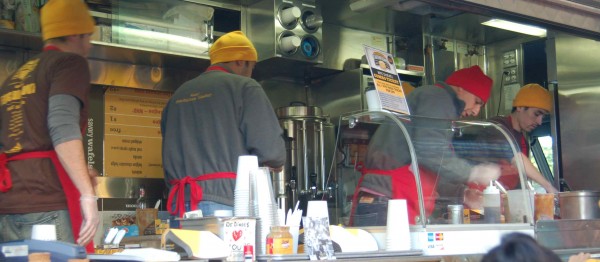
Wafels Well Rehearsed Production Line

Wafels and Dinges puts on quite a show making the Belgian waffles.
(Photos for Brooklyn Artisan by John J. Kochevar)

Boston was definitely the underdog. Long smothered under a deep rooted puritanical impulse we came late to the food-truck fashion parade. Still, I had hopes that our scrappy innovators and home-town spirit would give us a modest advantage. Boston had several contenders:  Staff Meal, chef-driven foodie enthusiasms; Roxy’s, a grilled cheese specialist;  Lobsta Love,  cheap lobster on good rolls;  Kickass Cupcakes, name says it all. In the other corner, New York fielded a more conventional lineup:  Mike N Willies tacos; Fishing Shrimp, a chipper; Wafels and Dinges, Belgian waffles, etc.

I show up at 3:00 hoping to miss the lunchtime rush. But the social media elves had been busy. Huge, long lines snaked from each truck. The fans were mostly young, chatting, talking on their phones, texting,  eternally texting. My calls, “Anyone here from New York?,” [Read more…]
Maker Faire Exploding (in the Good Sense)

Faire Marketing Director Bridgette Vanderlaan just gave Brooklyn Artisan the official attendance count: An astonishing 55,000 people visited World Maker Faire/New York in Queens last weekend, a stunning 57% growth over last year. With 650 vendors this time, the vitality of the event is clear. See Brooklyn Artisan Contributor Bruce Campbell’s reports,  Making Space for Makers in Brooklyn and Brooklyn Makes It…to Queens at World Maker Faire 2012. (Remember to come back – he has more good stuff to report.)

Also see Joanna Beltowska‘s report on the packed-auditorium talks by “Seth Godin, and Chris Anderson, both authors and entrepreneurs, the latter also editor-in-chief of Wired Magazine  and co-founder of robotic manufacturing company 3D Robotics,” she writes. “Anderson is accompanied by Bre Pettis , co-founder and CEO of MakerBot Industries; the two are giving a talk on how the Maker Movement, and 3-D printing in particular, might spark a new age of manufacturing in the US.” Provocative phrase of the day: “the democratization of creation.”

Understanding the Hollywood Smoke

I WAS REMINDED by John J. Kochevar’s comments in An Artisanal Author Confronts His Pencils of how many traditional skills are fast disappearing these days. Here is another.

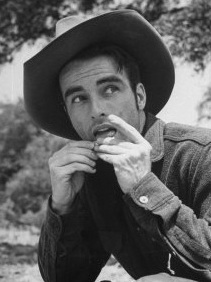
Montgomery Clift shows the classic cowboy roll on the set of Red River.

How to Roll a – uh, a Cigarette like a Pro.

The intent here is not to skirt Mayor Bloomberg’s efforts to ban public smoking in New York City , but rather to address the high cost of a pack of cigarettes as well as record some ways of working with one’s hands once glamorized by Hollywood. 

Rolling  a smoke is a two-handed operation (see inset). Remove the cigarette rolling paper from its pack. Gently spread the paper horizontally,  and delicately grasp it between the tips of both index fingers and thumbs, roughly at the paper’s midpoint. The gummy strip should run along the top facing you. Carefully—yet  confidently—roll the paper back and forth three or four times with your thumbs and index fingers until it forms a U, with the gummy strip higher than the un-gummy side.

Gently now, gently, very gently, grasp the paper by one end. Remove one hand and take a pinch of tobacco. The tobacco should not be lumpy (and chewing tobacco should not be substituted. Nor should hamster food or your grandmother’s loose black tea—you will be discovered and publicly humiliated). [Read more…]

The Cutest Little Library in All of Prospect Heights

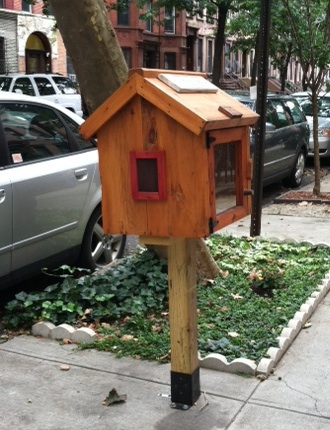
Is it for the birds? Or the bees? No, it’s a super-small library.

WITH BROOKLYN LATELY ABUZZ ABOUT BEEKEEPING, at first I thought this was a hive mounted on a post. Then I read the signs and was charmed [Read more…]

How to Shave with a Brush and Soap in Today’s World

EVER NOTICE HOW some people can smuggle an AK-47 in their checked luggage but you can’t sneak a can of shaving cream past alert Transportation Security Agents without them tossing that and your toothpaste in a large plastic garbage can? Well, I have. Also, and this is more important, I’m so cheap I won’t even pay attention.

That’s why, after wasting my third can or so in the TSA trash, I’ve taken to shaving with the old-fashioned brush and shaving soap. Not only have I never been wrestled to the ground and handcuffed by alert agents trying to confiscate my beaver-hair shaving brush, but past the initial investment I’m pretty much home free.

Plus – and this is a big plus – I’ve found it gets my day off to the proper artisanal start, taking this time to work with my hands. So here’s how you pull off that close shave the authentic, old-fashioned way.

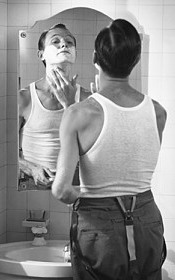
BB00 96.tif

The man seen shaving here is not Phil Scott, nor does he play him on TV.

1. You’re going to need a shaving brush, a ceramic mug of some sort, and a bar of soap. I prefer a thick china mug with an old Air Force logo, but you can maybe find one with a Brooklyn Dodgers logo or a Yogi Berra quote. Whatever you choose, the majority of the mug must be a light color.

And don’t forget the razor. That’s really the most important part, the razor. I prefer the triple-blade types. Disposables blow. Straight razors are dangerous and scary and you’ll never get one through an airport anyway.

2. Place the soap inside the mug somehow. I prefer to nuke the combination in the microwave (no need to carry this authenticity thing too far) for maybe 20 seconds until the soap gets a little soft, then flatten it with my thumbs into what is called a soap puck. You’ll have to do this each time you add a new bar of soap, which means maybe twice a year. (See, it’s already less expensive than canned shaving cream.)

Even toss in soap scraps from the sink or shower. If your mug’s dark (see no 1. above) it will block the magic hot rays that are supposed to turn the soap into a soft goo. Same with metallic elements, like gold rims. I’m not sure why, just take my word for it.

Now you’re ready to shave! Fill the mug to the top with hot water, and work up a lather with the brush. Brush the lather all over the area destined for shaving. Really work it in there, too – coating those whiskers makes for a smooth shave.

3. It is not strictly necessary to don long pants, a dirty wifebeater, and suspenders that you can drop off your shoulders while you lather up, like in those early episodes of Mad Men. Today you can do this in boxers, briefs, boxer-briefs, or a towel, or less.

4. Scrape all the soap lather off with the razor. And there you have it! You’re done! And your face is smoother than if you’d used shaving cream, or an electric razor.

NOTE: A styptic pencil is what you need to control the bleeding.

Executive Editor Phil Scott has written seven book and numerous articles for national magazines.

Business Is Cooking at Smorgasburg

ImageTHE LAST DAYS OF THIS YEAR’S SMORGASBURG food fair are going to be here before we can possibly get our fill (November 17 at the original Williamsburg site, November 18 in DUMBO) so we thought we’d head over while the weather was still beautiful. What better excuse than a houseful of guests last weekend (from France! from Canada!) hungry to sample the wares of Brooklyn food artisans they’d heard so much about. (The New York Times has famously called it the “Woodstock of Eating.”)

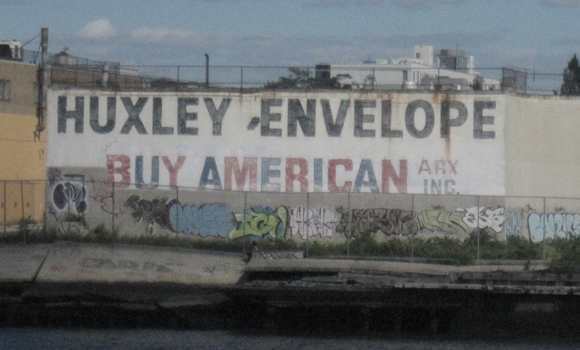
To avoid going underground on such a sunny fall day, we took the East River Ferry from Manhattan and looped our way to the Brooklyn side of the river, past the Long Island City and Greenpoint stops, down to Williamsburg, getting a few peeks at old industrial Brooklyn along the way.

Once we landed at Smorgasburg, we were hit by irresistible smells and sizzles, but before diving in, we paused a moment to take in the stunning Manhattan backdrop to this outdoor market. Location, location, location indeed.

The 75+ vendors at Smorgasburg are wildly diverse—and not just from a culinary point of view. For some, the food fair, started by Brooklyn Flea last year, is a launch pad for bringing a new product to market. In the beginning, it may be a business’s sole distribution point. For a brick-and mortar establishment like Porchetta, the East Village shop where Chef Sara Jenkins sells her “drop-dead delicious” Italian street-food sandwich, it’s an additional sales outlet and marketing vehicle. For others, it’s one of several distribution points: You’ll find Kelso of Brooklyn beers at Smorgasbar (a roped- off drinks area introduced in the middle of the food fair this year) as well as at bars around NYC (especially Brooklyn). Grady’s Cold Brew coffee, available at Smorgasburg, is also sold online and at Whole Foods in NYC and beyond.

How does this distribution puzzle fit together? Finding the right channels—and getting access to them—is always a challenge for small food producers. We look forward to talking more to Brooklyn artisans about what works, what doesn’t and hearing about lessons learned they’d like to share.

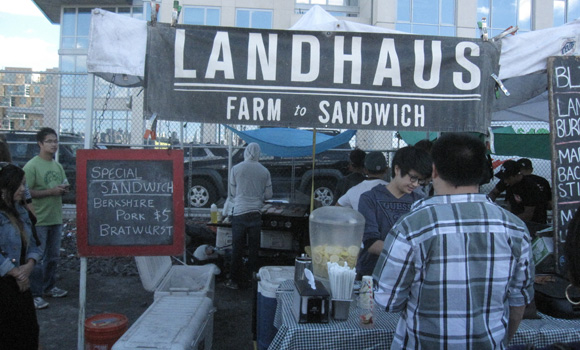
Oh, and the funny thing: After circling the market and winding back and forth, all five of us landed up on line at Landhaus.

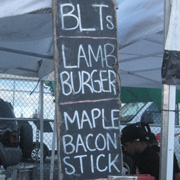
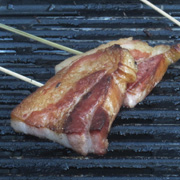
ImageMaple bacon on a stick—how could my Canadian heart resist?—and a juicy lamb burger, perfectly cooked. It was BLTs for the boys (maple bacon slab included). Plus Kelso’s Belgian Pale Ale and Sixpoint’s Crisp Lager, capped off by BiteMe mini cheesecakes and Alchemy’s Dark Chocolate vegan frozen dessert.

Even after the November closing dates, Brooklyn Flea assures us that 10 hot/prepared food vendors and about 7 to 8 packaged food vendors will be at Skylight One Hanson, Brooklyn Flea’s winter home. They’ll all be on the lower level of the market toward the back.

Smorgasburg: 8 Weekends Left!
11 am to 6 pm
Saturdays on the Williamsburg waterfront between North 6th and North 7th St., at the East River
Sundays (except September 30) on the DUMBO waterfront at the historic Tobacco Warehouse in Brooklyn Bridge Park
 
                                        Basia Hellwig curates the Food/Drink category for Brooklyn Artisan.

Are We Ready for a Craft Economy?

RECENTLY BROOKLYN ARTISAN sent a New York Times article by Adam Davidson about artisanal pickle making and the rebirth of a craft economy  to an old friend writing here as the Skeptic from Boston.

SfB: You bait me… I bite.  Theoretically a craft product is made by hand and involves skill.  I don’t think making a “craft cocktail,” even if the bartender has an untrimmed beard and a stingy brim, requires so much skill that it is worth $12.00.  I recently read about a couple with wheat and gluten allergies  starting a business to package “natural” artisanal wheat-like foods without wheat. Let’s hope they didn’t quit their day jobs to do it.

The economy in Boston is okay but not great, so there are some underemployed smart young people looking for high returns in niche markets. For example, last year there were two recent college graduates at the Cambridgeport Farmers Market locations with a folding table and a set of brochures for organically grown oyster mushrooms, but no mushrooms. The mushrooms were nearing harvest somewhere on Cape Cod, they said, so they were selling impregnated do-it-yourself mushroom logs, but no mushrooms. They showed up for six weeks straight, May to June, and talked to people about their plans, conceived in their dorm room, supported by a business plan and product descriptions, but no mushrooms. Then they disappeared.  The other farmers figured they moved to Brooklyn.

BA: True, many artisanal entrepreneurs here are starting micro businesses for lifestyle reasons – some to supplement their unemployment checks or because their jobs have stagnated in large corporations or they’re selling coffee at Starbucks. They’re frustrated by this economy and trying to create their own jobs. Or they’re the stay-at-home spouse whose child is old enough now for nursery school. They need to make money, they seek some creative satisfactions, they enjoy the sport of a start-up, and they like to feel some control.

Also, they welcome a chance to express their values—very likely they believe in fair trade, organic farming, local foods, reclaimed or sustainable materials, non-polluting and natural ingredients, high quality, and putting their hearts into their work. These ideas are not empty clichés. Many artisanal entrepreneurs are hoping to create soul-satisfying livelihoods. Yoga teaches its disciples to live the change they believe in, to be the change. It’s a very similar impulse.

SfB:  Yada, yada.  I wanted mushrooms, not mushroom marketing.  It is difficult to make really good bread, cheese and pasta. They take years of training and practice. Good bakers take years to “find their own bread.”

Some old Boston-area warehouse and factory buildings have been converted to artists’ workspaces. I visit the Radcliffe and Mudflat pottery shows every year. They are doing okay. Mostly part-timers and hobbyists. It may be quite some time before we see the beginning of a new Arts and Crafts movement with significant impact on the economy.

The Boston Globe has been paying more attention to good food, but we don’t have many centralized specialty markets here. I usually have to drive to Brighton, Watertown or Somerville to check in on the craft food makers. Only the hard cases, like European educated bakers, seem to be making real money.  We have few craft butchers left in the city, but some of the farmers are offering humanely raised, good-quality meats from coolers during the summer months. It is not easy work and they have supply problems because there are not enough small slaughterhouses in Massachusetts anymore. Most of the work is done in N.Y., N.H. and Vermont. Kate from Stillman’s Turkey Farm was thinking aloud last week, about what it would take to open her own small USDA facility: proposals, architectural plans, grant writing and spread sheets. Then finding someone to build the facility, and local workers with slaughterhouse and custom butchering skills. My grandfather was a small butcher in Minnesota because being a butcher was easier than working in the mines. But it is killing work in many ways and my father moved to Detroit to work in factory as soon as he could. I think when people say the word artisanal, they conjure painting and sculpture and poetry. Unless they grew up on a small farm, they don’t know the 12-hour days, the stench or the insecurity of running a nonindustrial food operation. It will take a while to bring it back.

Real craft is taught by journeymen, raised in a craft tradition, to apprentices. If you grow up doing a craft, you are used to it and can sustain it, particularly when you don’t have alternatives. But now we are highly mobile. The families and whole towns which made great hams and sausages, specialty breads and pastries, have vanished, wandered off to easier jobs. Starting new, skilled craft operations is doubly difficult because we don’t have the traditions or the concentration of people with multiple skills that fuel and support a living craft.

BA: Many of these urban artisanal entrepreneurs are working out ways to give community support and market guarantees to the small farms and the sustainable fisheries, to preserve the traditional ways and honor the skills as well as shorten the distribution chain in order to get superior goods. These are serious people.

As for the mushroomers you described: Are they wrong to dream and explore? Perhaps after harvest, they discovered they didn’t enjoy mushrooms, or they landed big-bucks Wall Street jobs, or they moved on to some land of bigger basements with a better mushroom-growing climate. False starts are nothing to be ashamed of.

SfB: I see some hope in the people who are developing new supply chains with the remaining small fishermen and farmers (who are hardly making it). And I am desperate for their products. I want those mushrooms. But there is only a small market for premium-priced, high-quality, true-artisanal products in Boston. Yankees don’t spend money on food or clothes.

And I’m happy the gluten-allergy people are selling alternatives. Some of my friends need to find carbohydrate and dairy substitutes or they will end up like holy anorexics from the Middle Ages. But I don’t know how well that business can scale up.

What fires my skepticism most are the trendy charlatans calling their various products natural, artisanal-life affirming, authentic. Am I to believe in Domino’s artisan pizza? I am looking for skillfully made, anchored-in-a-tradition, sustainable products. I don’t want them over elucidated and over packaged. That does not give me warm feelings of authenticity. So, I worry about the good people of Brooklyn like I worried about the blissed out hippies who occupied San Francisco: This may not end well.

To show you I am not just a cranky old guy talking to an empty chair, I am not blind to Brooklyn restaurant life.  Somehow you guys have managed to attain a critical mass of cooks and epicures. If life is a table you have at least two good legs.

The Skeptic from Boston is expected to be contributing to this team blog from time to time.