The Comforts of Tea

Day Nine 12 Sips of Brooklyn
Michael Shannon of Bellocq Tea Atelier

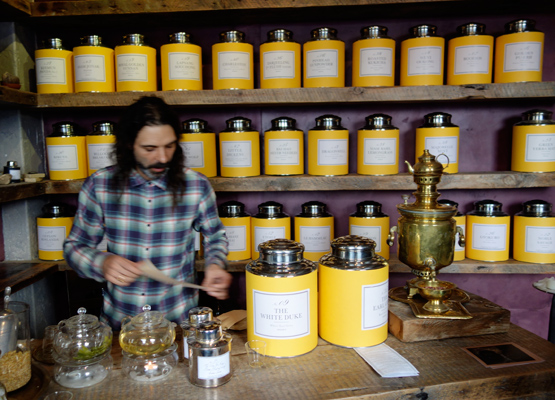
Michael Shannon of Bellocq Tea Atelier brewing tea so visitors can taste.

dec14TAXONOMY, CLADISTICS, SYSTEMATICS, PHYLOGENETICS—so many ways to group and divide living things. Darwin famously sundered the world into “lumpers and splitters”: those who are happy with the general gist, and those who are obsessed with specifics.

The tea trade is one where splitters can run riot: green or black, white or yellow, oolong or pu-erh—all the varieties of Camellia sinensis that have descended through 3,000 years of recorded history. But even within those broad categories, there are nuances piled on subtleties, geography and climate, blends and additives, methods and styles of preparation. Japan and China have elaborate and precise rituals of preparing and serving tea that can last for hours. Even the pragmatic English have woven the drink into their culture and mythology.
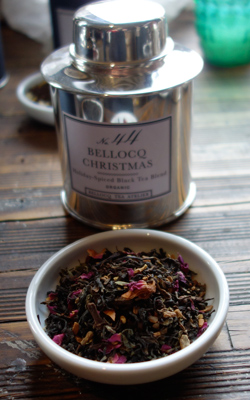
bellocq-christmas-1422

Bellocq Christmas blend in its silver plate caddy

Visit Bellocq in Greenpoint during their limited shop hours and you immediately recognize that here be tea splitters. The neat rows of silver containers with the bold yellow and white labels signal that tea is taken very seriously in these precincts. Yes, you think, this is what a tea shop should be. It is a transport to a quiet and calm that seems centuries and leagues away from the busy streets of North Brooklyn 2012.

It can be a bit daunting. I admit I remain a bit of a lumper and my knowledge of tea is an inch deep and an inch wide, but I stand in awe of the level of awareness and sophistication about the product that is evident at an emporium like Bellocq.

On the day we visited, co-owner Michael Shannon presided in an unhurried manner that was helpful and deeply informative. He brewed tea and explored the intricacies of sourcing teas to avoid the hucksters and scams that abound in that market. He methodically poured samples while revealing a refined sense of the aesthetics of his product. He cracked open canisters to appreciate the aromas while speaking in the same calm fashion about the frenzy the business endured when it was recently cited in O, The Oprah Magazine as one of Oprah’s favorite things. An hour at Bellocq is as warming and refreshing to the spirit as the product they sell.
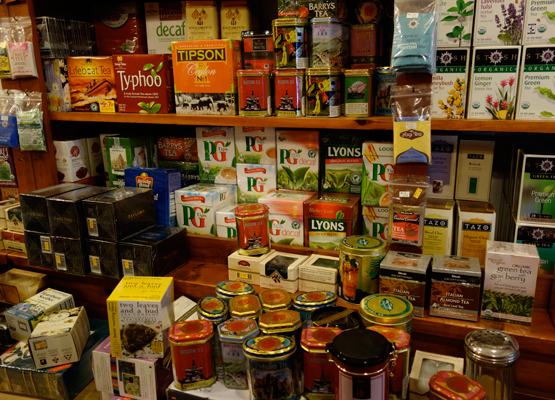
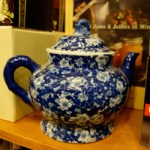
P-and-S-Teas-1197PS Coffee Tea N Spices in Park Slope is a different cup of tea. This store might appeal more to the lumpers among us. Stacks of boxes, cans and jars filled with teas and tisanes and infusions jostle for attention with spices and coffees. Here you feel awed less by the depth of tea esoterica and more by the breadth of stock in a little space. When asked how many teas the store carries, the manager responds, “Two hundred”, which I suspect is a conservative guesstimate. This is a diverse collection, with the old-fashioned packaging of Ty-phoo hard by the elegant boxes of Republic of Tea.tea-pot-p-and-s-1201 I am certain you can find your heart’s desire, a tea for every condition of the spirit. But I like it because most of the time I remain a lumper: “Tea. Earl Grey. Hot.”
Bellocq Tea Atelier
104 West Street, Greenpoint

800-495-5416

PS Coffee Tea N Spices
368 5th Avenue, Park Slope
718-768-5561

Photographs by Basia Hellwig. Date stamp typographic design by Joy Makon Design. The font is Rockwell, by Morris Fuller Benton and Frank Pierpont, Monotype, 1934.
Kwanzaa: A Journey with Queen Nur; A Documentary Airs

Kwanzaa-The Black Candle logoBROOKLYN OBSERVES KAWANZAA IN MANY WAYS,  both public and private. Since interest in  the new celebration peaked in the 1990s, it remains a part of Brooklyn’s holiday season. Starting Dec. 26, many Brooklyn families set out a special table at home and light the kinsara candles to commemorate the seven principles of Kwanzaa.

Professional storyteller Queen Nur

Professional storyteller Queen Nur

On Monday, Dec.17, at Long Island University’s Kumble Theater, in morning and afternoon programs master storyteller Queen Nur will take her audiences on a journey through the seven principles of Kwanzaa in story, song, call and response, dance and drumming. Queen Nur (that is her professional name: privately, she is Karen Abdul-Malik) has practiced her storytelling arts at the Kennedy Center in Washington, D.C., in the New York City parks programs, and many places around the country, including the Walt Whitman Cultural Arts Center in Camden, NJ. She received her B.S.from Northeastern University and has taken post-graduate courses in African-American Studies and Folklore at Temple University and the University of Pennsylvania. She now teaches Storytelling at Rutgers Camden’s Artist/Teacher Institute.

The Black Candle, Kwanzaa documentary.

The Black Candle Kwanzaa documentary

Kwanzaa, a secular celebration of African heritage intended to codify and strengthen values for the American black community, was established in 1966 by Maulana Karenga, a black nationalist activist-turned-scholar who earned a Ph.D. from the University of California/Los Angeles, with a dissertation titled Maat, the Moral Ideal in Ancient Egypt: A Study in Classical African Ethics. Dr. Karenga now chairs the Africana Studies Department at California State University, in Long Beach.

Karenga figures in The Black Candle, a documentary about the origins of Kwanzaa narrated by Maya Angelou that was premiered last month on the Starz  channel (on-demand TV) and will be shown again on Dec. 26 and 30.

Flavors from Afar, Right Next Door

Day Nine 12 Tastes of Brooklyn
sahadis1816

Sahadi’s has been on Atlantic Avenue for 64 years.

dec14SO MANY OF THE TASTES OF BROOKLYN—and we haven’t even scratched the surface here—have arrived with the waves of immigrants that grew the city into what it is today. Irish and Germans escaping famine or revolution at home—along with Brits and more than a few New England merchants and makers—had already made Brooklyn the third largest city in the U.S. by 1860. Then in the late 1880s came Russian Jews, Italians, Poles and Scandinavians, exploding the population and adding to its diversity again. By then, Brooklyn manufactured more goods than almost anywhere in the nation. The Great Migration brought Southern Blacks; Puerto Ricans arrived to work in the needle trades and cigar factories. Today, there are vital Caribbean and African-American and Chinese and Arab and Italian communities, just to mention a few. So you know where to go—right?— to get the very best patties or black cake or sufganiyot or sweet potato pie or dim sum or baba ganoush. Just head to a neighborhood and ask a local.

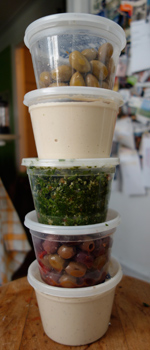
tower-of-takeout

Tower of Takeout: makings of a party for less than $20

As times and economics change, ethnic enclaves blossom in a neighborhood and then fade and reappear in new neighborhoods. And always, they bring with them, and leave behind, the tastes of home—grocery stores, restaurants, food trucks. In more than a few cases, the grocers, of necessity, become importers—how else to get the beloved artisanal ingredients their customers need to make the handcrafted recipes that have been passed from generation to generation?

Sahadi’s Importing Co., with its retail grocery on Atlantic Avenue and a warehouse in Sunset Park, is just such a place. Charlie Sahadi’s father, Wade, came from Lebanon in 1919 to work in his uncle’s food business, established in 1895 in Little Syria (or Little Lebanon—Syria and Lebanon were part of the same country at the time) in lower Manhattan. In 1941 Wade decided to start his own business in Brooklyn, moving to the Atlantic Avenue location in 1948. “So I can’t take any credit,” says Charlie, far too modestly.  “I was four at the time. But my brother and I, and now my children also, have kept it going. We’re in our 64th year.” Much of the Atlantic Avenue Arab-American community has moved to Bay Ridge or beyond now, and a thriving Sahadi’s welcomes crowds of multi-ethnic lovers of nuts, dried fruits, spices, olives, cheeses, breads, prepared foods (see above), olive oils and shelves and shelves of Mediterranean and Middle Eastern delicacies.

sahadis-olives-bab-ganoush1854

Olives and baba ganoush from Sahadi’s, in bowls by potter Claire Weissberg of Claireware.

This is the perfect place to go foraging if you’re pulling together drinks and bites for a crowd. The tower of takeout pictured above—from bottom: baba ganoush, Mediterranean olives, tabouleh, hummus, Moroccan picholine olives—came to all of $17.65. The baba ganoush is made with nothing but eggplant, tahini, garlic and lemon juice; the hummus with chick peas, tahini, garlic, lemon juice and water, the chef tells me. Yes, they have chefs because the food is prepared in their kitchens. The tabouleh is more parsley than bulgur, as it should be, and comes out of the kitchen bright green, freshly made.

Since I recently visited Claire Weissberg of Claireware: Urban Folk Pottery in her studio in Gowanus and purchased two beautiful little bowls, seen above, with olives and baba ganoush, I’m ready for my crowds. Well, I may need a few more bowls.

Sahadi’s
187 Atlantic Avenue, Brooklyn Heights
718-624-4550

Claireware
543 Union Street, Gowanus
718-875-3977 (call before making the trip)

Photographs by Basia Hellwig. Date stamp typographic design by Joy Makon Design. The font is Rockwell, by Morris Fuller Benton and Frank Pierpont, Monotype, 1934.
Wednesday Night at the Movies: Soda Fountain Series

OUR GANGNEIGHBORHOOD MOVIES DISAPPEARED FROM THE BIG APPLE in the 90s, bankrupted by mega-Loews showing this week’s poorly acted action films in eye-splitting 3D. Forget about finding old-timey silent movies that have stood the test of time and reached across language  barriers, except late at night on Turner Movie Classics. And except at the Brooklyn Farmacy & Soda Fountain.

Strange? Maybe not. Ben Model, silent film curator and accompanist and the evening’s host, says the earliest movie theaters were converted storefronts like the wonderfully preserved turn-of-the-last-century Farmacy. Wednesday night was the last in the Farmacy’s 2012 soda-fountain film festival, and by the time the show was about to begin, the place was packed with people in their 20s, begging one another for their tables’ empty chairs, sitting on the step where the almighty pharmacist used to hold court, leaning against the soda fountain, and slurping down their famous chocolate egg creams and hot chocolate.

The show Model assembled consisted of four comedy shorts, each 20 minutes in length (or 2 reels long), each converted from flammable acetate to 16 millimeter film (which, he explained, once were mailed to private homes, shown in parlors, then returned—a service much like Netflix). Then decades later each was converted from 16 millimeters to DVDs like the kind sent out by Netflix, and exactly what we would be watching. Before the movies started the Farmacy’s Gia Giasullo warned everyone that fountain service would be suspended during the movies, and then the lights went down.

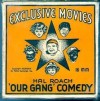
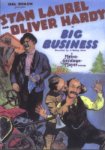
big business posterCharlie Chaplin’s silent short Behind the Screen kicked off the festival. The print, crisp and clear, shows the hero’s antics as an assistant at a movie production company, with typical Chaplin slapstick. The next, Buster Keaton—the Human Medicine Ball, Model labeled him—was up with The Goat, featuring a mistaken identity and police chases galore. Then it was Good Cheer, a sentimental Hal Roach comedy featuring The Gang (sort of a prototype of Our Gang), an archetypical bunch of tenement-dwelling kids who wonder if Santa Claus really exists. This print was poor, but it was a lesson in film preservation, and how acetate film stock decays when the original is not copied to a more permanent material. A huge percentage of silent films have been lost, mostly because there’s no profit motive. (By the way, according to Good Cheer, Santa’s the real deal.) The last on the bill was arguably the most hilarious: Big Business, a rare Laurel and Hardy silent two-reeler (most of their movies were talkies), and a portrayal of Reciprocal Destruction: The pair’s attempt to sell a Christmas tree starts with an irate would-be customer clipping the tree’s top and ends with his house and their car reduced to rubble.

After the show Model took a couple of questions from the audience, and said that like most accompanists back in the day, he doesn’t play by a score. Fascinating stuff for the film buff, and a cheap date for the twentysomethings: the night at the movies was free. If you’re lucky, you can get to go next year.

Executive Editor Phil Scott often writes about travel and aviation.

12 DAYS OF BROOKLYN: Reflecting on the Gowanus

Day Nine • 12 Views of Brooklyn
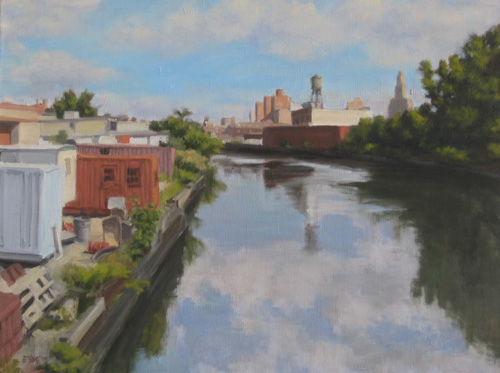
Painting by Ella Yang. See Who's Who

Painting by Ella Yang. See Who’s Who


dec14TWO KEY WORDS ASSOCIATED WITH THE GOWANUS  CREEK CANAL are “toxic” and “sky.” Extra emphasis on the first came with reports of the woman’s body pulled out of the canal on Tuesday and immediately whisked off to Methodist Hospital, no more said about her condition. News accounts recapped the well-deserved EPA Superfund rating of one of the nation’s most extensively contaminated water bodies. True, all true, enough to make you gag . But the – literally – upside of our canal is the amount of open sky over both the waterway and the low-rise, mostly industrial buildings that line it. That is just how the light over the old downtown (in what we call Outer Brooklyn) Gansevoort Meatpacking District  used to be, before high-rise development began to – again, literally – cast its shadows over what had become a “hot” area. The eternal urban tradeoff. While the debate over canal clean-up continues, it’s good to take some time before change comes to Gowanus to admire the big sky and its reflections. The landmarked Carroll Street bridge is a possible vantage. Help in seeing what you’re looking at comes from Ella Yang, whose painting is surely one of the most appealing representations of a Gowanus water scene since Henry Gritten‘s in 1851.

Joy’s Best of Brooklyn, December 14, 15, 16

caption goes here

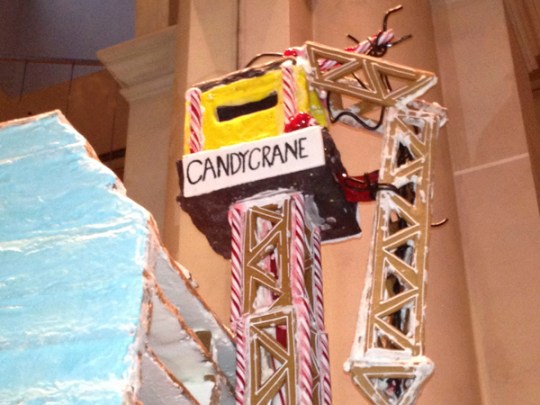
The bakers at famed breakfast haunt Norma’s, of Le Parker Meridien in
Outer Brooklyn, created the Hurri-Crane for the Gingerbread Extragavanza.
See Play With Your Food, below. (photograph by the Brooklyn Artisan photo pool.)

Shopping Opps Play With Your Food The Gift of Classes

bizmapSIX SHOPPING OPPS
1. Shop at a business struggling since Sandy. With the launch of the Support NYC Small Business campaign, New Yorkers and visitors can easily find ways to support places impacted by Sandy. At the campaign’s website, businesses that have reopened are indicated on the interactive map and include restaurants and bars, food and drink purveyors, shops, companies, as well as services. Just pick a neighborhood and go.

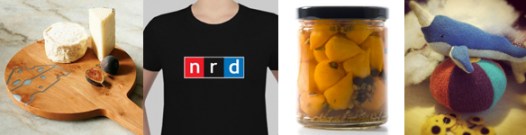
Two weekends worth of goods at Brooklyn Craft Central include Noble Goods wood and resin housewares, MissWit ironic tees, Sour Puss Pickles, and SweaterToys animals.

Two weekends worth of goods at Brooklyn Craft Central include Noble Goods wood and
resin housewares, MissWit ironic tees, Sour Puss Pickles, and SweaterToys animals.

2. Saturday and Sunday (and next weekend too): Brooklyn Craft Central Annual Holiday Market at Littlefield Performance & Art Space. Interesting roster of vendors include: Sour Puss Pickles, a small-batch pickling company; SweaterToys, stuffed animals made from recycled sweaters; MissWit, whimsical, satirical tees; Noble Goods, home objects created from solid wood and cast resin. Beware the drink specials: Woolly Knit (hot cider with bourbon), Hot Glue (coffee and Kahlua), and Shopaholic (gin, lemon, simple syrup, grenadine). Park Slope. 11am-5pm.

Barney3. Saturday: South Slope Holiday Craft Fair, benefiting art, music and science programs at PS10. The PTA fair has come a long way. PS10’s selection of upmarket, original art, jewelry, clothing and more makes this event a worthwhile stop. >>At right, one-of-a-kind sculpture Barney, from exhibitor What the Folk Art. Free workshops for kids from Brooklyn Craft Workshop, a raffle and Kimchi Taco Truck snacks complete the afternoon. Park Slope. 11am-5pm.

4. Saturday and Sunday: The Degenerate Craft Fair, created for artists, by artists, as a sort of anti-art fair. Over 50 artists and designers have work for sale, most costing less than $50. On Sunday, the first 50 guests receive a tote bag of goodies. At The DUMBO Loft, DUMBO. Saturday, 12pm-9pm. Sunday, 11am-6pm.
3W_CRAFTFAIR5. Saturday: 6th annual 3rd Ward Handmade Holiday Craft Fair. Over 100 Bklyn-based vendors will offer handmade gifts to customize one’s iPad, along with kitchenwares, food and other interesting stuff. First 200 visitors will receive a 3rd Ward tote bag filled with goodies. Boerum Hill Northern Italian restaurant Rucola will offer up drinks and snacks. Williamsburg. 12pm-6pm.

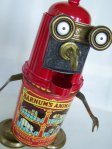
robot_shopping26. Sunday: Kids Play, You Shop at Brooklyn Robot Foundry. Register, and drop off your 5 to 10 year old for three hours of open play time. They will be guided by Robot Foundry staffers and will get to design and build robotic projects using educational materials and toys. In return, parents will get a 10% discount on neighboring shops and cafes and a chance to have some grown-up time while the kids are entertained. Gowanus. Two sessions at 11am-2pm and 2:30pm-5:30pm.


PLAY WITH YOUR FOOD

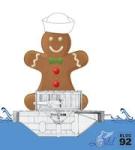
gingerShip_92Saturday: Gingerbread Ships! A very tasty Tools & Talent workshop at BLDG92, Brooklyn Navy Yard. The Brooklyn-built USS Monitor will be recreated in gingerbread by model shipwright Dan Pariser and the bakers from Fort Greene’s Le Petit Bakery. Participants will help assemble, decorate and “commission” in the atrium, and all kids will receive a gingerbread ship cookie to decorate. Bound to be popular, so advanced ticket purchase is advised, via website. Vinegar Hill. 1pm.

nationaltourlogoSunday: 2nd annual Food Experiments National Championship presented by Brooklyn Brewery. Touted on the website as “The World Series, Super Bowl, Stanley Cup of amateur cooking competitions,” this event is the finale of 12 months of national food competitions in search of the ultimate home chef. Judges include Noah Bermanoff, owner Mile End Delicatessen and Coleman Andrews, editorial director, The Daily Meal. Advanced ticket purchase advised; admission includes food samplings and unlimited Brooklyn Brewery beer. At The Brooklyn Brewery, Williamsburg. 1pm-4pm.

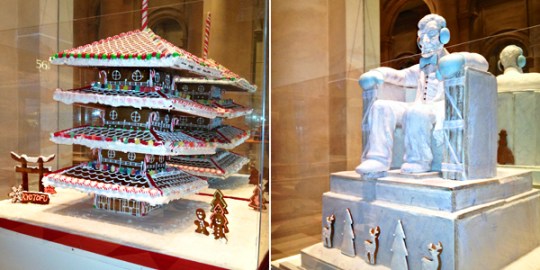
On display through January 3, Le Parker Meridien’s Gingerbread Extravaganza in the 56th Street atrium. These are no ordinary gingerbread houses, as the theme of Landmarks Around the World inspired NYC-based bakers to erect monuments to Loch Ness and the Urquhart Castle, Chichen Itza, Toji Tower, The Lincoln Memorial, The Sphinx, and my favorite, Hurri-Crane [Le Parker Meridien is located across the street from the infamous 57th Street Sandy-damaged crane and was closed until the crane could be secured.] Vote for your favorite by purchasing a ballot for $1 with proceeds benefitting City Harvest. Outer Brooklyn, Manhattan.

More from the Gingerbread Extravaganza: Toji Tower, created by Kyotofu, a Hell's KitchenJapanese dessert bar; The Lincoln Memorial, crafted by Baked Ideas, a custom baker.

More from the Gingerbread Extravaganza: Toji Tower, created by Kyotofu, a Hell’s Kitchen
Japanese dessert bar; The Lincoln Memorial, keeping Abe warm with baby-blue mittens,
earmuffs (or Beats?) and bowtie, created by Baked Ideas, a custom baker.

GIVE THE GIFT OF CLASSES
Many businesses share their love of community and technique through classes. A gift certificate for a single or group of sessions would make a unique gift. Act soon, as classes often sell out quickly, and space is limited at most events. Four suggestions to get you thinking:

• Brooklyn Homebrew, Gowanus
A retailer devoted to all things necessary to produce and learn about making beer.
Discovering Yeast, a hands-on 2-hour session on the basics of brewing with yeast. Starting January 8.
Homebrew 101: A Beginner’s Class, will guide students through all the steps to making beer at home. January 10.

174x148xsinger_model_30_sewing_machine_sewalot_alex_askaroff-174x148.jpeg.pagespeed.ic.KzaDkX-6H3• Owl and Thistle General Store, Crown Heights
This urban mercantile specializes in local, sustainable and fair trade items and is run by Keri Cavanaugh, an independent clothing designer and former Peace Corps volunteer.
Meet Your Sewing Machine, a 2-hour introductory class. Starting January 5.
Introduction to Home Sewing, 3 sessions concentrated on working with patterns to create a tote bag, drawstring skirt or pajama pant. Starting January 7.

• Gowanus Furniture, Gowanus
A producer of well-designed, locally-made innovative products.
Custom Cutting Board Class, during 2 evenings, students will make a wood cutting board and enjoy wine and local snacks. Starting January 18.

• SideTour, various locations in Brooklyn and Outer Brooklyn
An online marketplace of classes and events that are hosted by locals experienced in topics ranging from individualized tours, chef techniques, wine tastings, and other unique opportunities—all vetted by the SideTour team. Gift certificates can be used toward any class or event on the site.
DIY Jewelry Making Session, 2-hours, 3 bracelets. DUMBO location. January 20.
Create Your Own Handmade Soda at Brooklyn Soda Works, January 16.

FOR YOUR SPRING LINE?
pantoneEMERALD. Pantone 17-5641 has been designated as the color of the year for 2013, allowing Tangerine Tango, Pantone 17-1463 to retire as 2012’s color. “The most abundant hue in nature, the human eye sees more green than any other color in the spectrum,” said Leatrice Eiseman, executive director of the Pantone Color Institute®.

Joy Makon curates Brooklyn Artisan’s Craft & Design coverage and creates the weekly Best of Brooklyn lists.
Send items for listings to brooklynartisan@joymakondesign.com

12 DAYS OF BROOKLYN … And Some Are Rainy

Day Seven  12 Views of Brooklyn
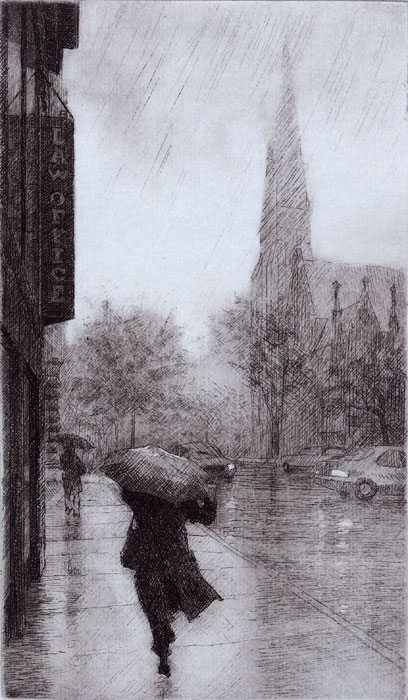
Etching by Eric March in an edition of 25, at the Park Slope Gallery.

Etching by Eric March. Edition of 25, at the Park Slope Gallery.

OF COURSE THE STEEPLE IS FAMILIAR. If you’ve ever commuted out of Brooklyn and back to the Seventh Avenue stop on the B/Q line, then you know this view looking south on the avenue. But it takes the artist’s eye and the etcher’s touch of Eric March to show the delicate beauty of a moment when you or I would likely be preoccupied by wet shoes. Even if this particular spire is not on your route home, then almost surely you have one of your own, or two, for Brooklyn lives its nickname as “the city of churches.” How horrifying when the tornado of 2010 attacked not just our trees but our steeples, shaking their bricks and stones, rattling their slate roofs, shackling them to scaffolds for months and months. A few were even removed rather than rebuilt – like yanking a tooth – and still others were humiliatingly reduced. Of course we personalize these losses: Thrilling as the new towers of downtown Brooklyn may be, we know in our souls they are impersonal, godless, compared to our neighborhood steeples. (See Who’s Who.)

12 DAYS OF BROOKLYN: Why ‘Chanukah House’ is Dark in 2012

Day Six   12 Views of Brooklyn
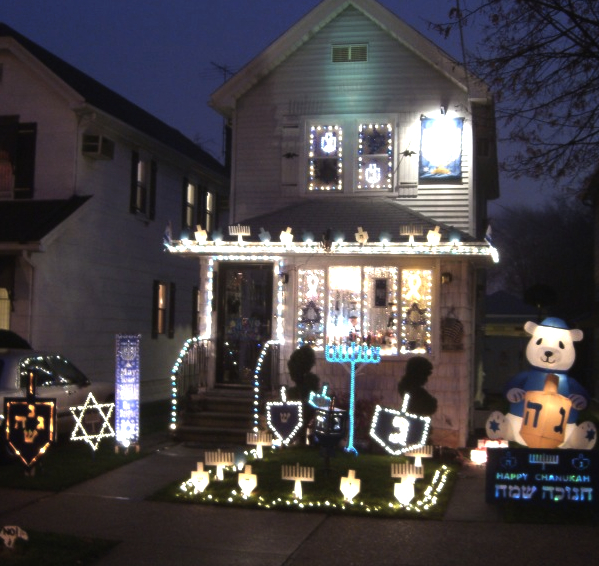
(Used by permission of the homeowner)

(Used by permission of the homeowner)

dec11DANIEL TEITELBAUM GIVES THE HISTORY of the exuberant decorations on his family’s house. “The miracle of Chanukah is supposed to be publicized. That is why Jews all over the world light their menorahs in the windows or doorways of their homes where people passing in the street can see it. We have just taken it a step further.” When their daughter was two years old, “We started with a single dreidle made out of wood and strung with white lights. We then added blue lights that we put up together with white lights around our home. From that time on we tried to add something new every year.” The renown of the house in Mill Basin has grown. “In 2006, we were presented with a proclamation from Brooklyn Borough President Marty Markowitz naming our home, the official Brooklyn Chanukah House.” (More about this in our Who’s Who.) This year is sadly different:  “Due to Hurricane Sandy the Brooklyn Chanukah House is not able to put up its display. We suffered significant damage to our home and the repairs will not be completed before Chanukah. We apologize for this and wish to thank everyone for their messages of support. We will be back next Chanukah better than ever. Chanukah Sameach.”

O Good Ale Comes

Day Five 12 Sips of Brooklyn

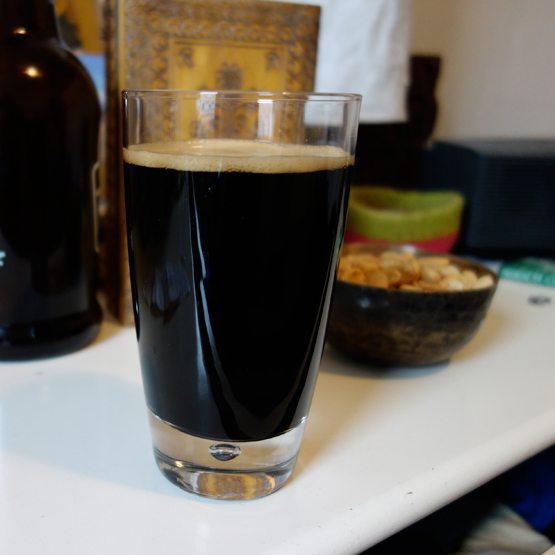
winter-ale-1785dec10TELL WHOEVER SOLD US THE CALENDAR (Pope Gregory XIII) that I demand a refund. It tells me winter is still 11 days away—beginning on the solstice. The truth is, December is full winter, the gloomiest part of year with its dark nights and fitful gray days. If we must break the year up into quarters, let’s admit we’ve been in winter for nearly six weeks. The solstice marks the low point of winter, the turning of the year, the slow return of the sun. No wonder my Highland ancestors lit their bonfires for Hogmanay: dispel the night, bring back the day. (Of course, from what I know of my ancestors, they probably also burned their neighbors’ barns and sheds for spite, but let that pass.)

To light up this darkest time of year, the craft brewers of Brooklyn are offering some nice and hearty ales, stouts and porters. Winter is the time of stouts and porters, dark and filling, not for your hefeweisens and pale lagers or (kill me now) light beers. For my taste, ale’s the thing for winter.

I’d hate for Robert Burns to be only remembered for Auld Lang Syne, the anthem of the new year, as he wrote other fine verse. The one that comes to mind here and speaks to the need for lightening the heart:

O gude ale comes and gude ale goes; 
Gude ale gars me sell my hose, 
Sell my hose, and pawn my shoon—
Gude ale keeps my heart aboon!*

Brouwerij-Lane

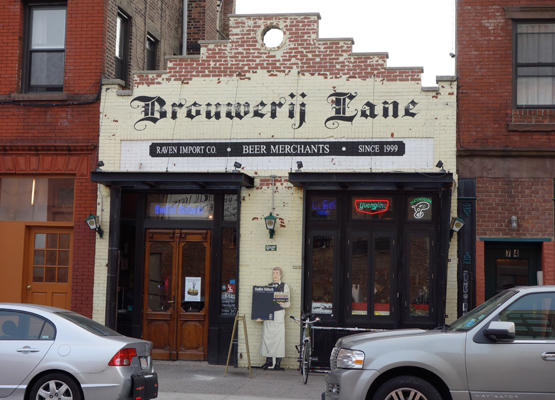
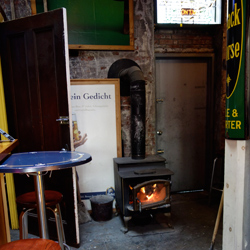
Brouwerij Lane holds back the dark of winter with a wood-burning fireplace.

Brouwerij Lane holds back the dark of winter with a wood-burning fireplace.

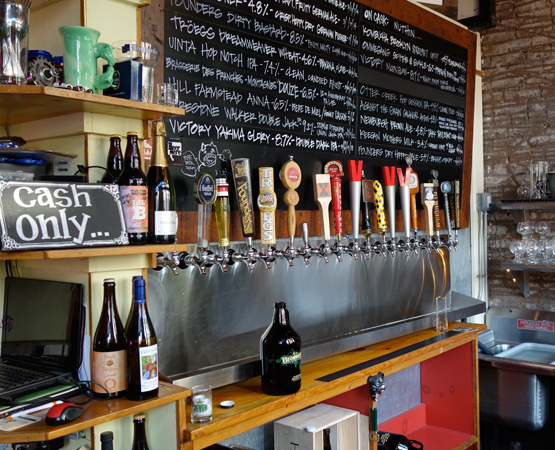
To keep our hearts aboon through winter, let’s find some Brooklyn beer. First up, the Brooklyn Brewery “There Will Be Black,” which I got to sample before a warm wood fire on a gray day at Brouwerij Lane on Greenpoint Avenue. The Lane is a lovely place to spend the winter. The 19 taps and several display cases of bottled beer should get you nicely through our shortest afternoons and longest nights.

“There Will Be Black” is a new release in the Brewmaster’s Reserve series which has, according to their publicity, “a core of black bread and dark chocolate, wrapped in a bright coat of orangey, minty hops”. If that doesn’t sound like a winter drink, nothing does. In addition to the “Black”, Brooklyn Brewery is shipping their standard range of seasonal beers in bottles, including Winter Ale and Black Chocolate Stout.

More elusive is the Sixpoint Brewery offering: Diesel. It seems to be rolling out as we go to press, and in just the last 24 hours, it has begun popping up around the city on the new Sixpoint beer finder. We’re heading out after writing this entry to hunt its “robust chocolate and roasted flavors, with thick pine hop flavor and aroma.”

Brouwerij-Lane-Taps1432

Brouwerij Lane seems to keep at least one Brooklyn brew on tap.
Its website lists the current offerings; this week There Will Be Black is on the list.

I caught up with Kelly Taylor of KelSo Beer Company at Grand Central Terminal tonight where he was offering tastings of their signature Nut Brown Lager, which is as good as an ale in my book. He suggested the KelSo Winter Lager for cold nights and also said they were brewing a Porter. Check out their Facebook page or Twitter for more information on tastings and tap availability (they don’t have a web site). They will be commandeering a number of taps for a tasting at Bierkraft tomorrow, December 11.

It’s going to be a long winter. Be careful not to sell your warm socks.

Brooklyn Brewery
79 North 11th Street, Williamsburg

718-486-7422

Sixpoint Brewery
40 Van Dyke Street, Red Hook
917-696-0438

KelSo Beer Company of Brooklyn
529 Waverly Avenue, Clinton Hill
718-398-2731

Brouwerij Lane
78 Greenpoint Avenue, Greenpoint
347-529-6133

Bierkraft
191 Fifth Avenue, Park Slope
718-230-7600

*For those who find their Broad Scots rusty:

O good ale comes and good ale goes; 
Good ale makes me sell my hose (socks), 
Sell my hose, and pawn my shoes— 
Good ale keeps my heart above (uplifted)!

Photographs by Basia Hellwig. Date stamp typographic design by Joy Makon Design. The font is Chalet Tokyo, by René Albert Chalet (a clothing designer), House Industries, 1970.