Documentary Asks a Big Question: Who’s Really Entitled to Brooklyn?

'My Brooklyn' DocumentaryI HAD A PREPAID TICKET TO SEE THE NEW DOCUMENTARY MY BROOKLYN at Dumbo’s comfortable reRun Theater, with old red-brick walls and bench car seats from the 1960s. But they’d overbooked it—must be a great date movie, I thought – and the apologetic guy at the door put my name in the computer and gave me a coupon for free food from the restaurant/bar, reBar. I’m always into free food.

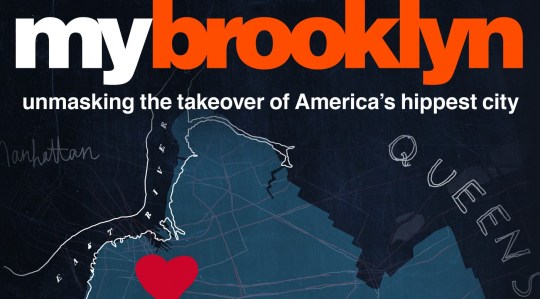
The documentary runs only through this Thursday, so the next night I returned and found my empty seat. I ordered a cheeseburger and fries fresh from reBar, just a few feet down the hall. Before the food could arrive the crowd, mostly hipsters, were taking over folding chairs set up in front and along the aisles. Despite the crowd size and innocuous title, My Brooklyn is not a date movie, nor is it a happy documentary; its subtitle is Unmasking the Takeover of America’s Hippest City. Telling the story of Downtown’s Fulton Street, filmmakers Kelly Anderson and Allison Dean convey the borough’s changes over the past few decades, from a mostly white community to a dilapidated minority community, to a restored community, to what developers are now doing their damndest to turn into bland city of ugly glass towers, chain restaurants, big-box stores, a too-big-to-fail bank on every corner. Like today’s Manhattan.

“They take culture away from the city and turn it into Disney World,” director Anderson says in the film. She interviews small business owners along Fulton Mall – the same businesses referred to as “job creators” during the last election.

Their tales aren’t so creative: Landlords have jacked up rents from around $15,000 a month to as much as $45,000; businesses have 10-year leases which in the fine print say they can be evicted with just 30 days’ notice. And many have been: the same landlords are selling the land to large developers. In footage shot during New York City Council meetings, the developers say that they’re building offices to create jobs, to prevent jobs from going to New Jersey. Instead they resell the same land for a huge profit to other companies, which construct 20-story co-ops that sell for around $400,000 each, and hotels whose rooms go for between $400 and $1,000 a night. And the jobs? A few office jobs, but mostly short-term construction work and low-wage hotel-staff and box-store “associate” positions.

While the City Council never does a follow-up, the developers do receive subsidies for bringing in jobs, and co-op buyers also receive tax subsidies. “For them it’s subsidies,” says one small business owner, Todd Jones. “For us it’s called welfare.”

“Success isn’t measured by how many jobs are created, it’s in the use of land,” Anderson explains during the question and answer session following the documentary. “It’s not keeping Mom and Pop in Brooklyn; [the profit] goes out of town.”

Jones was another guest during the Q&A. He runs Cuzin’s Duzin (“Hot Fresh Mini Donuts” reads his business card), which was evicted from Fulton Mall. Despite his hardships, “Entrepreneurship is a choice you make,” he says. “You have to be relentless.” And so he is. He moved to another location until that was closed down. Now he caters, embracing new technology like social media (Check out his Facebook page).

“Box stores are a magnet,” Jones says. “They attract business. Mom and Pop—that model is done. And not everybody eats donuts.”

True. “Let them eat cake,” Mayor Bloomberg might say – as long as it has no trans-fat.

Executive Editor Phil Scott frequently writes about travel and aviation.
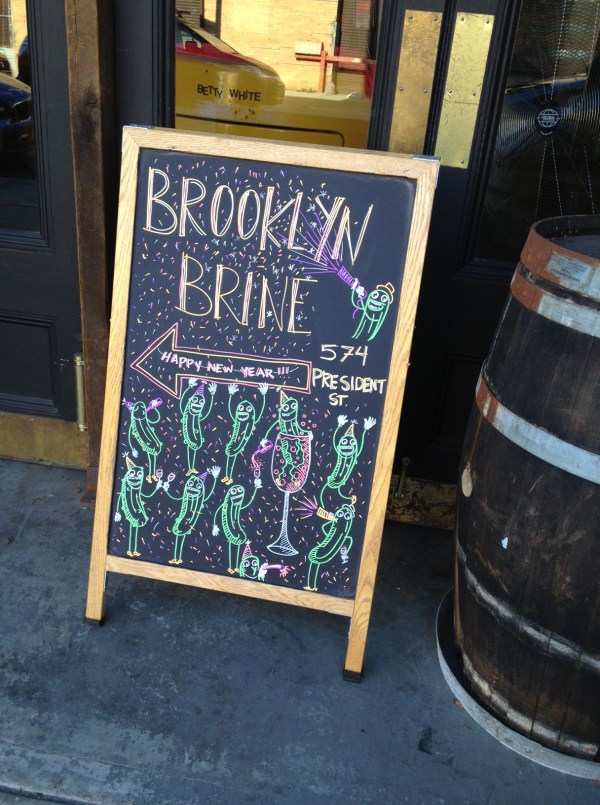
Still Stalking the Chalk: Time to Brine Those Cukes

Brooklyn Brine Dancing CukesOkay, so what would no round-up story on artisanal Brooklyn food business seem complete without?

YOU GOT IT IN ONE: Pickles, of course. Brooklyn Brine has sponsored three pickle-eating contests annually in October. Usually we think of strawberries to go with our champagne, or if it’s to be something from the briny deep, then we think of caviar with our bubbly. Nonetheless, Brooklyn Artisan admits to finding the adorable happy-looking, dancing-tooting-and-toasting, puckered-up, party-hatted pickles waving their champagne flutes a lot more inviting to identify with than the soon-to-be-sick-as-a dog in the most recent annual-pickle-packing’s poster (click for a look). Just sayin’.

(Photograph from Brooklyn Artisan Photo Pool)

A Zen Palace of Materials and Makers in Outer Brooklyn

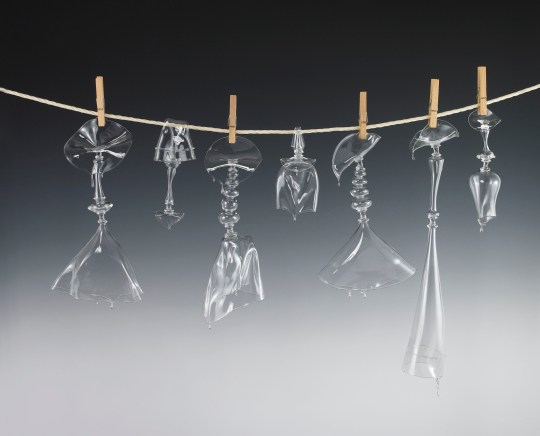
Museum of Arts and Design's mission is to honor the relationship between materials and maker, with processes ranging from the artisanal to the digital. Exhibitions, such as the current Playing with Fire: 50 Years of Contemporary Glass, blur distinctions between art, design and craft. Shown above, Tastes Like Applebees, 2007, Matt Eskuche. Flameworked glass, twine, steel, clothespins. (Photograph by David Behl). On exhibit through April 7.

Museum of Arts and Design‘s mission is to honor the relationship between materials and maker, with processes ranging from the artisanal to the digital. Exhibitions, such as the current
Playing with Fire: 50 Years of Contemporary Glass, blur distinctions between art, design
and craft. Shown above, Tastes Like Applebees, 2007, Matt Eskuche. Flameworked glass,
twine, steel, clothespins. (Photograph by David Behl.) On exhibit through April 7.

A friend lives in this cool Brooklyn loft. She decorates in a wonderfully minimalist style and I bet she can’t pass Roche Bobois without salespeople waving hello. In contrast, I’m on a first-name basis at the Stickley store. I’m jealous of Ms. Minimalist’s space as it always has a restorative zen-like appeal to me. So when I can’t visit my friend and need to reset my senses from all the dark wood and overstuffed/overpropped places I hang in, I head to The Museum of Arts and Design at Columbus Circle. The clean lines of the building’s architecture, the open and quiet exhibit spaces, and beautifully curated and installed exhibits recharge me creatively and spiritually.

The Art of Scent 1889-2012 is on display through February 24.

The Art of Scent 1889-2012 is on display through February 24.

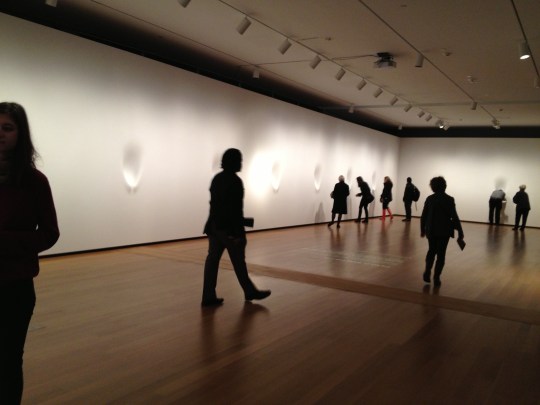
I was wowed by the design of the current exhibition, The Art of Scent 1889-2012. As shown in the photograph above, this open space is minimal, futuristic, even daunting when you first approach the exhibit. My initial reaction was that I didn’t know what to make of it until I followed others and placed my head into one of twelve carved wall spaces. Fragrance softly wafts up to your nose, and written descriptions of the scents light up next to the space. The museum states that it purposely created a space devoid of all visual indicators, such as logos and marketing materials, so that visitors would concentrate on smell only. That would explain the almost-totally white room one encounters. [Read more…]

Still Chalk-Talking: Ahoy, More New Year Notes On Board

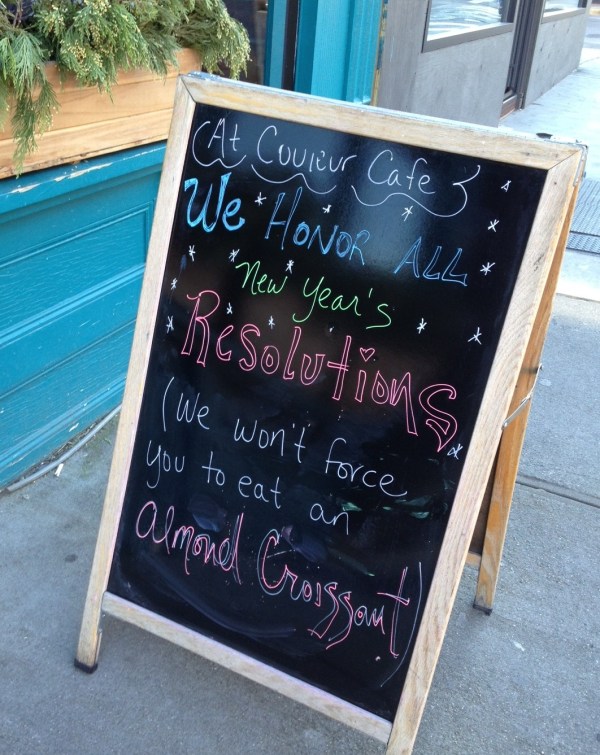
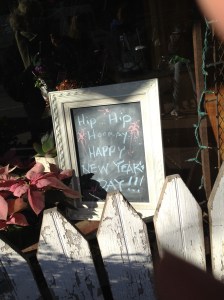
Couleur Cafe New Year's Board.ZuZu's Petals New Year's GreetingsBIG IS BOLD, BUT A CHALKBOARD DOESN’T HAVE TO BE EITHER; it certainly needn’t cover most of the wall or even the sidewalk easel’s surface to convey an eye-catching message: Look (left) at the charming sign peeking from behind the poinsettia leaves at ZuZu’s Petals window. The frame around the slate-like surface dresses it up nicely, and the Happy New Year’s Day message is friendly.

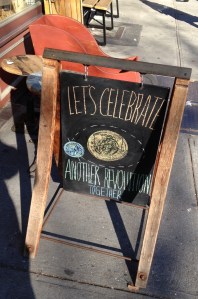
While Brooklyn Artisan is still hovering over New Year’s signs, check out the Couleur Café‘s New-Year’s-with-a-wink sign (above). A nice example of soft sell!Let's Celebrate Another Revolution.

The invocation outside the store Sterling Place on Seventh Avenue (right) gets our vote for double-take cleverness: “Let’s Celebrate Another Revolution Together,” it says, and with Emma Goldman‘s famous words in mind, we were about to start dancing in the street. But then we realized the board was showing the Big Blue Marble Earth in orbit around the Sun as a visual clue: No politics here, it’s about the passing of another year!

(Photographs from Brooklyn Artisan Photo Pool)

Coming Up Next: What a Brooklyn artisanal business round-up would hardly seem complete without at least one example of….

Sign up to follow brooklyn-artisan.net on this page or on Facebook to be sure you don’t miss it!

A Wing and a Latte: Backstory on a Visual Pun

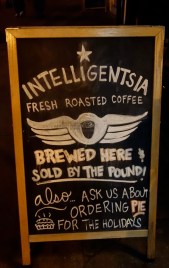
Wing and A Prayer, 1944 moviePosterADDENDUM TO CHALK TALK: Look closely at the center of the Intelligentsia winged insignia. In place of the customary propellor or star between the wings, this clever image seems to show an artisanal coffee with a curl of cream on the top. The “wing and a prayer” phrase has been kept alive in American culture – at least among old-movie buffs – by a black-and-white movie that occasionally turns up on PBS or late-night television: Starring Dana Andrews and Don Ameche, this war propaganda film won an Oscar for Best Original Screenplay in 1944. It took its title from a number-one hit song of 1943, “Coming in on a Wing and a Prayer,” sung by the Song Spinners. Other number-one songs in that year: Bing Crosby, “White Christmas”; Harry James, “I Had the Craziest Dream (Last Night)”; Glenn Miller, “That Old Black Magic”; Benny Goodman, “Taking a Chance on Love”; Dick Haymes, “You’ll Never Know (How Much I Love You)”; Tommy Dorsey, “In the Blue of the Evening”; Mills Brothers, “Paper Doll (To Call My Own)”; and Al Dexter, “Pistol Packin’ Mama.” Quite a song list for a single year!

Chalk Talk: Coffeehouses, Fuel of the Enlightenment

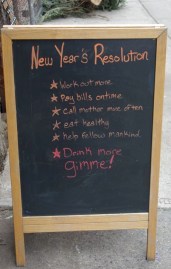
ChalkGimmeCoffeeKK.Chalkboard Easel, IntelligentsiaTHE AGE OF REASON WAS FUELED BY CAFFEINATED CHATTER in the cheap and cheerful English coffeehouses of the late 17th and 18th centuries, says historian Brian Cowan of McGill University. Unlike the brews in the alehouses, coffee sharpened thinking and revved up the exchange of ideas that led to what’s called the Enlightenment. Keep that in mind while considering these two chalkboard easels (click on the image for a larger view). The one at left was seen by Brooklyn Artisan across the East River in NoLita, outside Gimme Coffee on Mott Street; at right, along Brooklyn’s Fifth Avenue. (The Intelligentsia insignia looks like a salute to some Army Air Corps flyer who managed to make it home on a wing and a latte.)

(Photographs by Brooklyn Artisan Photo Pool)

Chalk It Up: A Union Hall That Invites You In

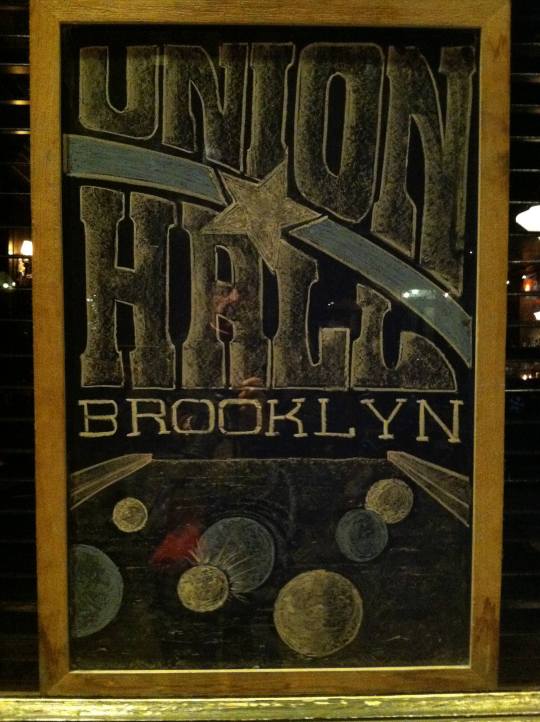
You might think that Union Hall is where labor union members turn out for job calls. But not here. This Union Hall is on Union Street, as in "Union vs. Confederacy," and as the billiards suggest, it's a place you're invited to hang out. (Brooklyn Artisan photo pool)

You might think that Union Hall is where labor turns out
for job calls or votes. But not here. This Union Hall is on Union Street,
as in “Union vs. Confederacy,” and as the colliding bocce suggest,
it’s a tavern that invites you to hang out. (Photograph by Brooklyn Artisan Photo Pool)

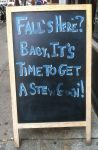
CHALKBOARDS ARE A TIME-HONORED PRACTICE IN THE FOOD BIZ. Think of bistro menus propped on bentwood chairs in Paris, think of kosher deli listings on overhead blackboards while everyone’s shouting out orders, think of chalkboard easels outside restaurants along the streets and avenues of Brooklyn. Chalkboards can be as quick ‘n’ easy or as glamorous as the establishment requires. (Starbucks, for instance.)

Union Hall handshake logoAfter all, unlike print on paper, all you need to change an entrée (or adjust the prix fixe) is a moist bar cloth, and presto! The slate is as erasable as an iPad. The original tabula rasa. A little inspiration, a little colored craie (French talc stick), and the board becomes an invitation to express yourself or your business’s image. To quote your favorite philosopher or reference your favorite comics. To DIY or yield to your betters. In general the medium is fluid rather than stiff, friendly rather than formal; compare the above with the same Union Hall‘s logo at right.

From time to time over the next few weeks, Brooklyn Artisan will be sharing what we’ve seen through our lenses, with comments or not – mostly just letting the chalkistas speak for themselves.

Moore’s Law: How the Future Came To Be Stuffed in a Stocking

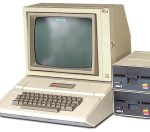
Apple II computer, 2 disc drives.By David Fay Smith  COMING UP ON 30 YEARS AGO, I WROTE A BOOK called A Computer Dictionary for Kids and Other Beginners (Ballantine, 1984), to explain bits and bytes to children and their parents. This Christmas, my wise wife gave me a copy of iPads for Seniors. And so it goes.

At Costco recently, I bought flash drives for Christmas stocking stuffers: $10 each for SanDisk 16 GB flash drives – solid state gizmos with retractable USB connections that will bayonet into practically any fairly modern PC or Mac and provide a convenient means of backing up or transporting files from one computer to another. These are about 1 ½ inches long and weigh a third of an ounce.

Just to be clear, 16 GB is 16 billion bytes (actually 16, 384,000,000, but who’s counting?) A byte is equivalent to a single character or letter, so 16 GB amounts to some 2 billion 8-letter words or about 40 typical 50,000 word novels.  [Read more…]

What’s Not Been Said a Thousand Times?

Twelfth Day or Not: When the New Year comes in, Christmas goes out. Call it the Mulch of Memory.

The New Year comes in, Christmas goes out —into the rich mulch of memory.
(Photograph by Brooklyn Artisan Photo Pool)

by Ella Wheeler Wilcox

What can be said in New Year rhymes,

That’s not been said a thousand times?

The new years come, the old years go,

We know we dream, we dream we know.

We rise up laughing with the light,

We lie down weeping with the night.

We hug the world until it stings,

We curse it then and sigh for wings.

We live, we love, we woo, we wed,

We wreathe our brides, we sheet our dead.

We laugh, we weep, we hope, we fear,

And that’s the burden of the year.

During the decades when Brownstone Brooklyn was being developed, Wisconsinite Ella Wheeler Wilcox’s poetry was appearing often in newspapers and magazines of the day.  In 1883 she sold the poem ” Solitude” to the New York Sun for $5.00. It contained her most famous lines: “Laugh, and the world laughs with you; Weep, and you weep alone.”