What Makes a Book ‘Rare’ –– And Do You Have One?

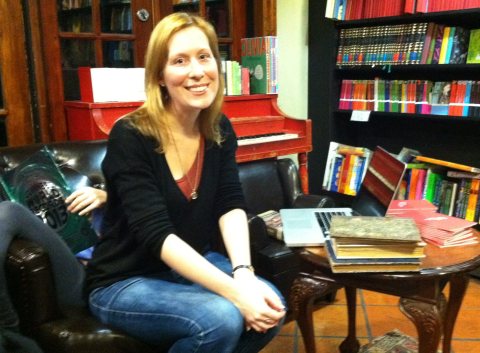
Heather O'Donnell at the Community Bookstore meeting, living-room style. Plenty of social skill goes into face-to-face book evaluations, and the rare book expert never knows what to expect. (Partially visible behind Heather is her young daughter, sitting sideways, absorbed by "The Guiness Book Of Records, 2013."

Rare-book advisor Heather O’Donnell at the Community Bookstore’s living room-style meeting. Plenty of social skill as well as professional knowledge goes into face-to-face book evaluations with the owners. (Partly visible behind Heather is her daughter, absorbed by “The Guiness Book Of Records, 2013.”) (Photograph by Brooklyn Artisan Photo Pool)

ON THURSDAY NIGHT AT THE COMMUNITY BOOKSTORE ON SEVENTH AVENUE, Heather O’Donnell set out to shine a little light on the subject of rare and collectible books for more than a dozen of her Park Slope neighbors. “Rare books are my passion,” she said, and hastened to reassure her listeners sitting with books on their laps that she also enjoyed seeing and evaluating all sorts of interesting or cherished books from personal bookshelves, no matter how modest, and hearing the stories about them. Literature is her specialty: Before founding Honey & Wax Booksellers in 2011, Heather earned a Ph.D. in English literature, taught at Princeton, and then worked for seven years for Bauman Rare Books, on Madison Avenue.

That location was open to the public, she said, and though usually she enjoyed the social contact and always cherished the occasional surprise discovery of a valuable volume, Heather allowed as how yes, as in any business, there were occasional bad days. In her business, a bad day can be opening the doors to “belligerent people with worthless books.” (Chuckles around the room.)
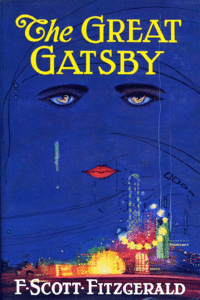
A pristine Gatsby jacket of the first edition,1925, can multiply the value 50 times over.

A pristine Gatsby jacket of the first edition, 1925, can multiply the value 50 times over.

The rarity of a book is determined by its scarcity balanced against its desirability, she said. In general, book collectors look for first printings of books of importance, in good shape and with the dust jacket intact. Ideally there would be no fading, heavy wear or tearing of the book jacket or its binding; no stains or coffee rings, please, especially not on the cover (note to self: buy more coasters); no loose or missing pages, and – god forbid! – no yellow highlighting or disfiguring scribbles on the pages. Daintily penciled notes in the margins okay? It all depends on the collector.

Heather gave the example of a first edition of F. Scott Fitzgerald’s The Great Gatsby: in pristine condition including its dust jacket, it would sell in the neighborhood of $200,000; without the jacket, not so much – in fact, probably around $4000. (A quick glance at nearby laps showed few intact jackets; Brooklyn Artisan felt a little better about the bare-naked books we’d brought.) Authentic author’s autographs may enhance value but don’t guarantee it, we learned, and inscriptions like “Happy birthday to the best boy in the whole world, Love, Grandma,” while certainly not sought after, aren’t necessarily disastrous, either. Again, it all depends.

We got some pointers on research we could do ourselves such as looking at the standard reference works by Allen and Patricia Ahearn and searching on AbeBooks, which a librarian can help with, or even using amazon.com or ebay.com just to begin to get a fix on availability and price. Looking at auction records is better yet; again, the right librarian can coach you. Once you’ve done some homework, if the signs auger well, then you may be ready for the next step: approaching a dealer.

The moment had come to show the books that had been brought. It felt just a little like an audition. There were some nice books: a first edition of The Autobiography of Alice B. Toklas, by Gertrude Stein, still wearing its jacket. [Read more…]
Brooklyn Museum Meetup: Four Bourgeois Heroes

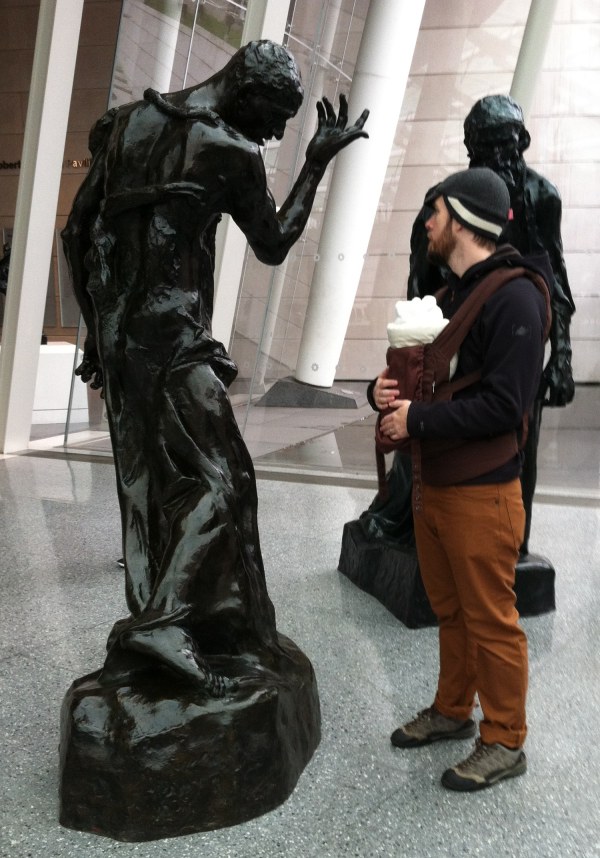
Brooklyn Museum courtyard: Brooklyn chest-pack Dad confronts Rodin statued

“THEY ARE VOLUNTARILY BOUND TO THE SAME SACRIFICE, but each of them plays the role suited to his individuality, his age and position,” Auguste Rodin said about the heroic citizens of Calais; four of his six bronzes of the  “Burghers of Calais” are currently on view in the Brooklyn Museum courtyard. The work was commissioned in 1875 by the Calais town council to commemorate events more than 500 years in the past (see Backstory, below), and Rodin’s winning proposal was solidly within the academic tradition of French Beaux Arts. Also, the story goes, he promised to deliver six statues for the price of one. But, as anyone on any side of the Atlantic Yards development can attest, what you think is approved is not necessarily how it turns out.

As delivered, the work was a major break with traditional Beaux-Arts monumental statuary. (Just a short walk from the Brooklyn Museum, an example of neo-classical Beaux-Arts style sits atop Grand Army Plaza’s Soldiers’ and  Sailors’ Arch, complete with the pyramid-shaped arrangement of figures led by the allegorical figure of Columbia who represented the Nation.) In developing his work, Rodin drew on the account of a contemporary of the historic events in Calais, Jean Froissart, and learned the personal histories and social background of the six men who volunteered as hostages to save their city. Rodin worked from carefully chosen live models – including a descendant of one of the six heroes – and then deliberately oversized the hands and feet to make gestures and stance more expressive. These figures show the suffering, humiliation and humanity of their situation. Greatness has been thrust upon them, and it is agonizing. [Read more…]

ODD CONNECTIONS: ‘Avarice’ at the Brooklyn Museum and ….

Brooklyn Museum "Avarice" Fernando Mastrangelo 2008IT’S A SHOW-STOPPING GRAND FINALE TO BROOKLYN MUSEUM’S GREAT-HALL EXHIBIT Connecting Cultures: A World in Brooklyn, and no wonder, for the piece is spectacular. To Brooklyn Artisan’s surprise, it’s even more striking in situ than Gaston Lachaise’s monumental “Standing Woman” –  which we’d gone there to have another fond look at. (That, and the bronze foursome from Rodin’s “The Burghers of Calais” who’re standing around in the covered courtyard.)
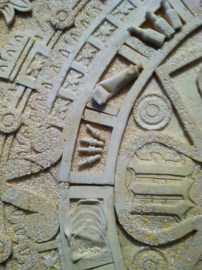
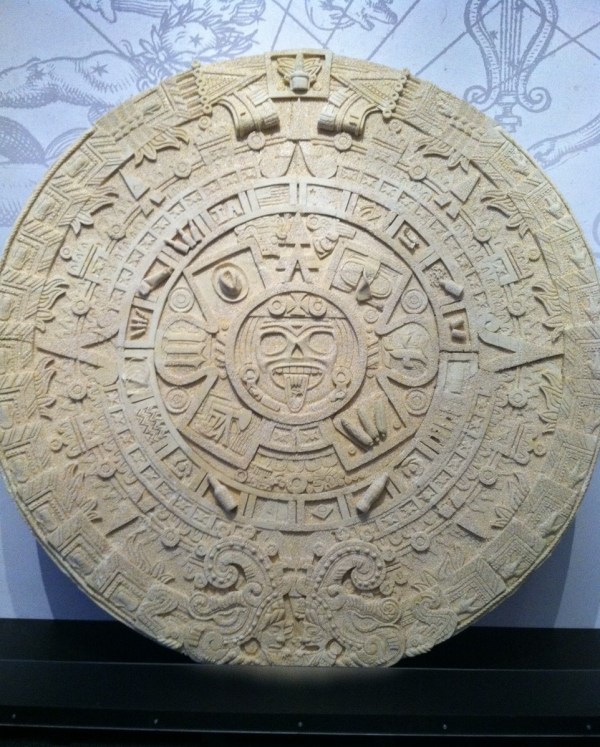
What stunned us – and won us –  is the disc-shaped piece almost ten feet in diameter that’s called “Avarice.” Part of the museum’s collection of contemporary art, it was made in 2008 by Fernando Mastrangelo, who was then 30. Mastrangelo is a Brooklyn-based artist (whose mom lives in Texas, one learns from his Facebook page). As the name suggests, “Avarice” combines art and politics. Its artistic basis is, of course, the circa-1500 Aztec Calendar Stone – which recorded the creation story of the Aztec world – with the face of Tonatiuh, the Sun God, at the center. The political statement is what it’s made of, a wry example of Marshall McCluhan’s dictum that “the medium is the message.” The media in this case are:  White corn, white and yellow corn meal, epoxy, fiberglass, wood, and metal. (And maybe just a small shovelful from the recycling bin?)

In adjacent panels, some cobs and a Coke. Sounds like a summer snack in Mississippi.

In nearby panels, some cobs and a Coke. Staples of an American summer diet.

Toothpaste, spark plug, sliced lunch meat, see anything else?

Toothpaste, spark plugs, deli sliced meat. (Photos: Brooklyn Artisan Photo Pool.)

The museum sign also tells us, “The depiction of corn-based products draws attention to Mexico’s mass cultivation of corn to meet energy needs (via ethanol) and foreign consumer demands.” The Aztec visual reference brings up the whole sordid story of the Spanish Conquest; the devil in the details, however, is the “avarice” of North American agribusiness and consumer culture. Take a look at these close-ups and the large image at top, and you’ll find some telltale items.

Political art is nothing new for Mastrangelo; his 2010 TED Talk spoke of art as an evolving way to record history, to tell the story and capture the spirit of one’s times, including in today’s digital world. Last year he had a 3-month show in Miami at the Charest-Weinberg Gallery called Black Sculpture. The gallery write-up makes clear this is not about race. “After creating exact molds based on the work of Frank Stella and Ad Reinhardt, Mastrangelo casts his reliefs out of compacted gunpowder. The pieces teeter on the precipice of annihilation.” Yikes, talk about jimmy-crack-corn. “Yet the pieces are not simply bombastic,” the gallery says; “submerged beneath the tense potential for destruction is an elegiac calm. They give form to the Existential angst that inspired their Cold War-era predecessors….The black gunpowder, coupled with the Reinhardt’s cruciform and Stella’s teleological line work, firmly suggests an end of something.” Indeed. One hopes all future shows will be firmly No-Smoking zones.

Brooklyn Artisan came across what seemed to be a clear Brooklyn influence in Mastrangelo’s other discographic work from 2008 (click through to have a look). Though our favorite was composed of “Turquoise Sugar, Red Arbol Chili, Corn, Corn meal” and titled “Xochiquetzal,” we knew at a glance its visual vocabulary was from Brownstone Brooklyn’s   ornate plaster ceiling medallions, including the hole for the chandelier.

Meanwhile, back in the Great Hall: The stated purpose of the Brooklyn Museum exhibit is to “create new ways of looking at art by making connections between cultures as well as objects…. Connecting Cultures: A World in Brooklyn was a joint effort of the Brooklyn Museum’s curators, organized by Kevin Stayton, Chief Curator. The installation was designed by Matthew Yokobosky, Chief Designer at the Brooklyn Museum” and financial support for the long-term installation came from Lisa and Dick Cashin. Brooklyn Artisan salutes them all, but as much as we enjoyed working the room, we do admire this comment shown on the museum’s own web site: “it’s a strange collection that doesn’t seem to sync with each other. reminds me more of a victorian living room than a museum exhibit.” — Posted by Tameka G.

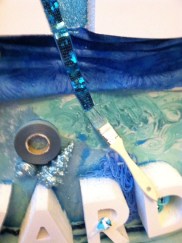
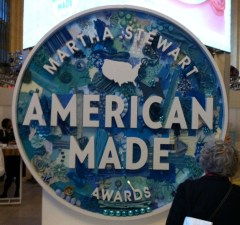
From totally outside the museum scope, there was one more odd cultural connection we couldn’t help making. Last fall Brooklyn Artisan visited another great hall exhibit, “American Made,” put on in Vanderbilt Hall at Grand Central Station by Martha Stewart. In our photos made at the time, take a look at the sign and its detail.

Painter's tape, sparkly braid and bating brush.

Painter tape, sequin braid, brush.

From the exhibit in Grand Central's Vanderbilt Hall.

From Grand Central’s Vanderbilt Hall.

Straight Chalk Express: Spreading the News

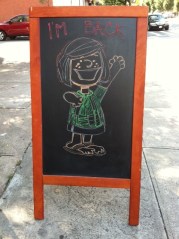
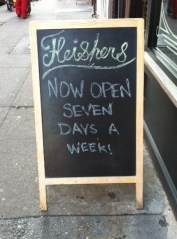
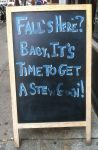
Ample Hills sidewalk signFleishers Now Open 7 daysNEWSFLASH! Expanded openings to seven days at Fleishers on Fifth Avenue called for a chalkboard bulletin. Last autumn, Ample Hills Creamery in Prospect Heights put out this board on Vanderbilt Avenue. The style – homage to Charles Schulz’s “Peanuts” – reminded all that Ample Hills is child-friendly.
(Photographs by Brooklyn Artisan Photo Pool)

Still Stalking the Chalk: Time to Brine Those Cukes

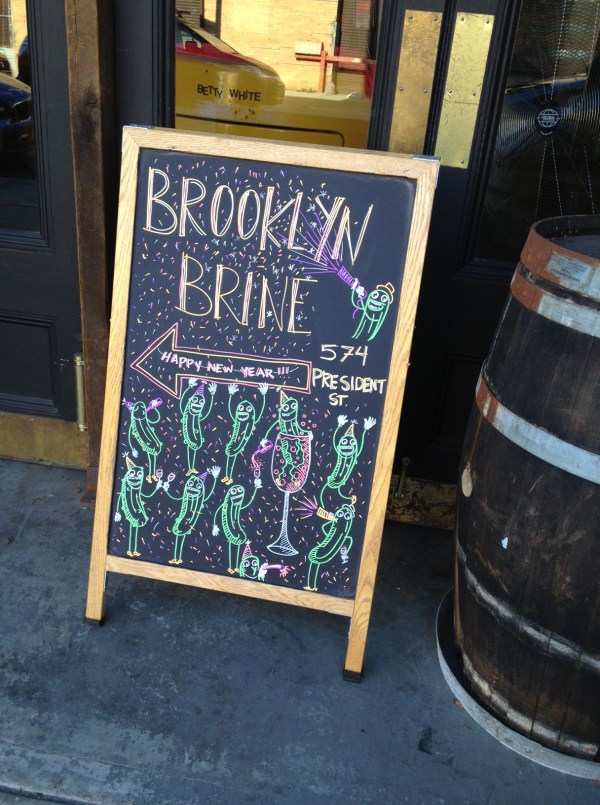
Brooklyn Brine Dancing CukesOkay, so what would no round-up story on artisanal Brooklyn food business seem complete without?

YOU GOT IT IN ONE: Pickles, of course. Brooklyn Brine has sponsored three pickle-eating contests annually in October. Usually we think of strawberries to go with our champagne, or if it’s to be something from the briny deep, then we think of caviar with our bubbly. Nonetheless, Brooklyn Artisan admits to finding the adorable happy-looking, dancing-tooting-and-toasting, puckered-up, party-hatted pickles waving their champagne flutes a lot more inviting to identify with than the soon-to-be-sick-as-a dog in the most recent annual-pickle-packing’s poster (click for a look). Just sayin’.

(Photograph from Brooklyn Artisan Photo Pool)

Plenty More Fish for the Borough, Tra-la!

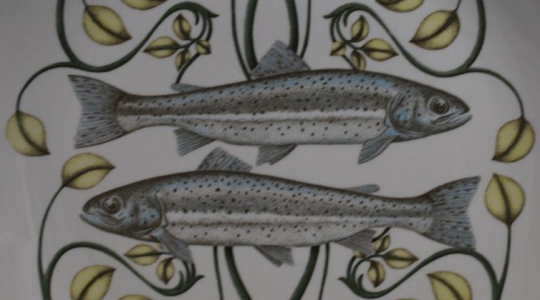
Detail of plate from a Villeroy & Boch 7-piece fish set on eBay (# 230907702410); best hurry, there's only one set.

Trout detail, Villeroy & Boch 7-pc. fish set, eBay #230907702410; best hurry, only one!

BROOKLYN’S COMMUNITY SUPPORTED FISHERY Mermaid’s Garden has just announced two new pickup points starting later this month. Adding Ditmas Park’s Sycamore Bar and Flower Shop and Williamsburg’s Urban Rustic will greatly extend Mermaid’s Garden’s coverage for more than 200 fish lovers and adventurous eaters across Brooklyn.

There are also openings for some new members in the established spots in Red Hook, Cobble Hill, Park Slope, Clinton Hill/Bed Stuy, and Bushwick (see mermaidsgardennyc.com for locations). As always, the fish offered are sustainable species responsibly fished by individuals you will often get to know by name, thanks to the weekly email from Mermaid’s Garden.

Co-founders Bianca Piccillo, a Harvard-trained marine biologist, and Mark Usewicz, a Paris-trained chef, will become your mentors in protecting sealife one delicious dinner at a time. Bianca will gently educate you about the different varieties of fish they offer, frequently introducing you to the people and naming the boats that supply them, and on Mermaid’s Garden’s Facebook page, Mark shares recipes he has developed and some guidelines for better preparation. For instance, this one – posted last November – has proved itself in one of Brooklyn Artisan’s very own test kitchens.

Bay Scallop Crudo

Simple is the best recipe for bay scallops. This crudo recipe is a quick recipe that really lets the scallops shine.

12 Bay scallops, shucked
1 Tbsp. Lemon, juice of
1 Tbsp. Extra Virgin Olive Oil
1 drop Hot Sauce, (preferably scotch bonnet or habanero based)
Salt and Pepper
A few leaves of cilantro

1. In a nonreactive bowl mix the scallops, lemon, hot sauce and oil. Season to taste with salt and pepper. Sprinkle with the cilantro before serving.

But if that Italian-style scallop sushi is not your thing, you’ll find alternatives. [Read more…]

Still Chalk-Talking: Ahoy, More New Year Notes On Board

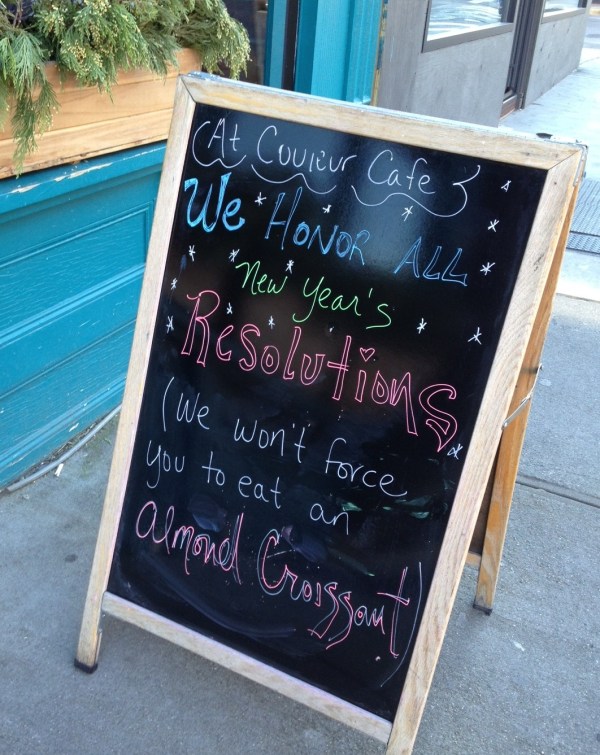
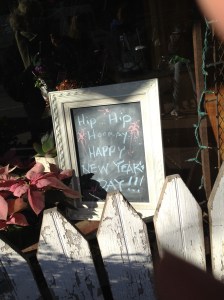
Couleur Cafe New Year's Board.ZuZu's Petals New Year's GreetingsBIG IS BOLD, BUT A CHALKBOARD DOESN’T HAVE TO BE EITHER; it certainly needn’t cover most of the wall or even the sidewalk easel’s surface to convey an eye-catching message: Look (left) at the charming sign peeking from behind the poinsettia leaves at ZuZu’s Petals window. The frame around the slate-like surface dresses it up nicely, and the Happy New Year’s Day message is friendly.

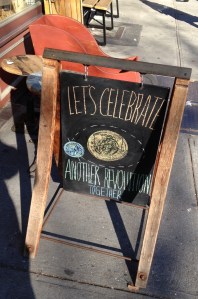
While Brooklyn Artisan is still hovering over New Year’s signs, check out the Couleur Café‘s New-Year’s-with-a-wink sign (above). A nice example of soft sell!Let's Celebrate Another Revolution.

The invocation outside the store Sterling Place on Seventh Avenue (right) gets our vote for double-take cleverness: “Let’s Celebrate Another Revolution Together,” it says, and with Emma Goldman‘s famous words in mind, we were about to start dancing in the street. But then we realized the board was showing the Big Blue Marble Earth in orbit around the Sun as a visual clue: No politics here, it’s about the passing of another year!

(Photographs from Brooklyn Artisan Photo Pool)

Coming Up Next: What a Brooklyn artisanal business round-up would hardly seem complete without at least one example of….

Sign up to follow brooklyn-artisan.net on this page or on Facebook to be sure you don’t miss it!

Chalk Talk: Coffeehouses, Fuel of the Enlightenment

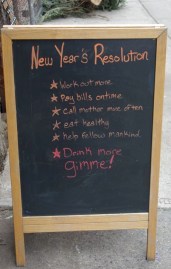
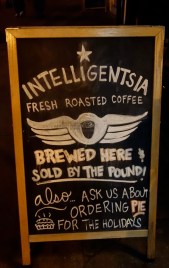
ChalkGimmeCoffeeKK.Chalkboard Easel, IntelligentsiaTHE AGE OF REASON WAS FUELED BY CAFFEINATED CHATTER in the cheap and cheerful English coffeehouses of the late 17th and 18th centuries, says historian Brian Cowan of McGill University. Unlike the brews in the alehouses, coffee sharpened thinking and revved up the exchange of ideas that led to what’s called the Enlightenment. Keep that in mind while considering these two chalkboard easels (click on the image for a larger view). The one at left was seen by Brooklyn Artisan across the East River in NoLita, outside Gimme Coffee on Mott Street; at right, along Brooklyn’s Fifth Avenue. (The Intelligentsia insignia looks like a salute to some Army Air Corps flyer who managed to make it home on a wing and a latte.)

(Photographs by Brooklyn Artisan Photo Pool)

Chalk It Up: A Union Hall That Invites You In

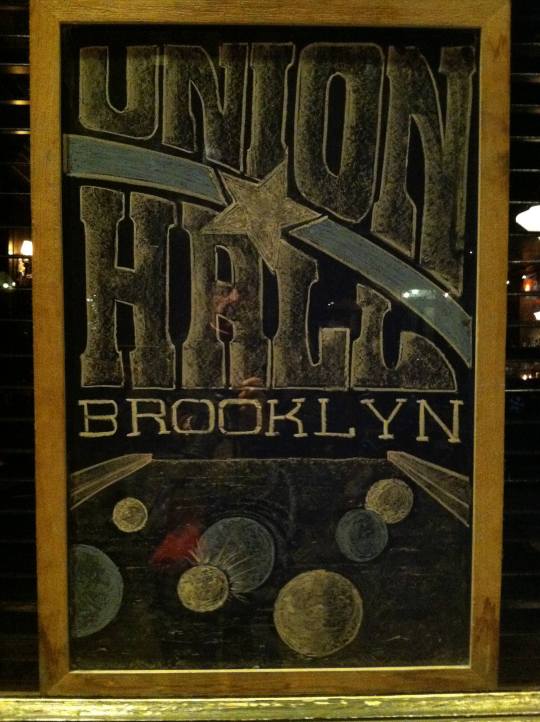
You might think that Union Hall is where labor union members turn out for job calls. But not here. This Union Hall is on Union Street, as in "Union vs. Confederacy," and as the billiards suggest, it's a place you're invited to hang out. (Brooklyn Artisan photo pool)

You might think that Union Hall is where labor turns out
for job calls or votes. But not here. This Union Hall is on Union Street,
as in “Union vs. Confederacy,” and as the colliding bocce suggest,
it’s a tavern that invites you to hang out. (Photograph by Brooklyn Artisan Photo Pool)

CHALKBOARDS ARE A TIME-HONORED PRACTICE IN THE FOOD BIZ. Think of bistro menus propped on bentwood chairs in Paris, think of kosher deli listings on overhead blackboards while everyone’s shouting out orders, think of chalkboard easels outside restaurants along the streets and avenues of Brooklyn. Chalkboards can be as quick ‘n’ easy or as glamorous as the establishment requires. (Starbucks, for instance.)

Union Hall handshake logoAfter all, unlike print on paper, all you need to change an entrée (or adjust the prix fixe) is a moist bar cloth, and presto! The slate is as erasable as an iPad. The original tabula rasa. A little inspiration, a little colored craie (French talc stick), and the board becomes an invitation to express yourself or your business’s image. To quote your favorite philosopher or reference your favorite comics. To DIY or yield to your betters. In general the medium is fluid rather than stiff, friendly rather than formal; compare the above with the same Union Hall‘s logo at right.

From time to time over the next few weeks, Brooklyn Artisan will be sharing what we’ve seen through our lenses, with comments or not – mostly just letting the chalkistas speak for themselves.