A Christmas Visit to the Rieslings of Williamsburg

Day Two • 12 Sips of Brooklyn
Brooklyn-Winery-Flight1474

dec7

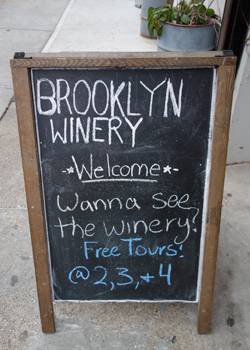
ON OUR FIRST VISIT TO BROOKLYN WINERY, the Brooklyn Artisan taste/sip squad donned hard hats and clambered around a raw construction site. In the two years since then, the winery has developed into a first class facility with a terrific wine bar integrated with the winemaking facilities. The B-A squaddies stopped by again recently to check out a flight of wines and some charcuterie. We didn’t have time for the winery tour (with 10 tasting/sipping stops that day, food journalism can be brutal, I tell you), but we are definitely going back. Brooklyn Winery takes wine very seriously and with classes and tours, they are committed to educating and informing as well as entertaining.

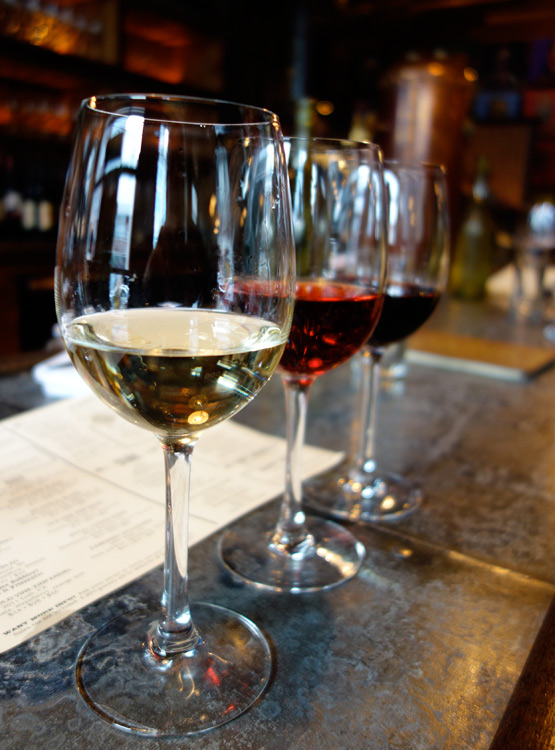
The main room is outfitted with long wooden farmhouse tables in beer garden style, with the upstairs rooms more lounge-like. Very comfortable settings for various sizes of groups, but we opted for the zinc bar, with its copper wine dispenser and proximity to Lex Kiefhaber, the knowledgeable manager. Lex helped us select our flight—the 2011 Stainless Steel Riesling for a white, the 2011 Rosé of Merlot, and the 2010 North Fork Blend red, all made with New York State grapes and all terrific young wines.

Lex then enthusiastically insisted on our comparing a glass of the 2011 Barrel Aged Riesling toe-to-toe with the same grape fermented in stainless steel. Brooklyn-Winery-ToursThe Barrel Aged, with grapes from the Finger Lakes region, is fermented and aged in old oak barrels which Lex explained allows the tart malic acid to convert to smoother lactic acid (a process logically called malolactic fermentation), providing a richer mouthfeel. The Stainless Steel has a more crisp fruit taste characteristic of a modern Riesling. Two distinctly different variations on a common theme, and either is definitely a pick for a Christmas white.
Brooklyn Winery
213 North 8th Street, Williamsburg
347-763-1506

Photographs by Bruce Campbell. Date stamp typographic design by Joy Makon Design. The font is Mrs Eaves, by Zuzana Licko, Emigre, 1996.

Danish Seamen’s Gløgg

Day One • 12 Sips of Brooklyn

Glogg-mulled-wine2

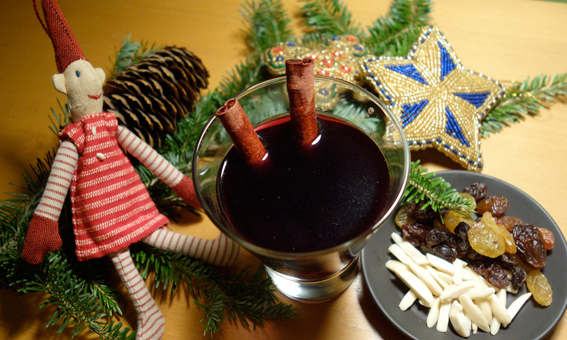
dec6THE DANISH SEAMEN’S CHURCH (Den Danske Sømandskirke), housed in a lovely brownstone with a ship’s bell in the front yard on Willow Street in Brooklyn Heights, is a religious, social and cultural center for New York’s Danes. Brooklyn Artisan’s culinary team made its way there for the smørrebrød during the church’s Traditional Christmas Fair at the end of November. In the yard behind the church, in an immense pot, we discovered Gløgg, the mulled wine that fuels Danish Christmas. It’s wonderfully warming and tastes great with spiced cookies and æbleskiver, the Danish version of the doughnut hole.

Julie Sløk, the Church’s Sømandspræst (pastor—literally “sailor priest”) has shared the recipe—although I would have thought it a closely guarded state secret. Gløgg, according to Julie, “will take about a week to make—like any good recipe it is simple but needs time. So you have to begin a week before. This is the recipe for 10 to 15 persons depending on how much you like it. Voilà and god jul!

Ingredients
5 sticks cinnamon
2-inch piece of fresh ginger, cut in thin slices
20 whole cloves
25 cardamom pods
2 tsp dried coriander
30 peppercorns
2 cups water

1 1/2 lbs raisins
2 1/2 cups rum
1 bottle port

3 bottles red wine (no need to spend a fortune on it but it should be on the fuller side)
1 lemon
1 orange
1/2 to 1 lb of almond splinters
2 cups of brandy or cognac
Sugar to taste

One week before the party
Create an extract by combining the cinnamon, ginger, cloves, cardamom pods, coriander, peppercorns and water.

Bring to a boil, then let it cool down and sit covered for 4 to 5 days.

Mix the rum and port together in another container, add the raisins and soak for 5 days. (Note: Don’t use aluminum containers for storing these parts.)

Day of the party
Strain the extract through a sieve and put it in a large pot along with the peel of one orange and the peel of one lemon. Simmer for 2 minutes.

Pour in the three bottles of red wine and heat it without boiling.

Add the cognac, the raisins with liquid and the almonds. Add sugar to taste (not too sweet but not too sour). Serve hot with spice cookies.

Danish Seamen’s Church
102 Willow Street, Brooklyn Heights

718-875-0042

Photograph by Basia Hellwig. Date stamp typographic design by Joy Makon Design. The font is Avant Garde, by Herb Lubalin and Tom Carnese, ITC, 1970.


The Littlest Makers at Maker Faire

FOR A MOVEMENT THAT THE ECONOMIST magazine has declared may “herald a new industrial revolution,” there appears to be an inordinate amount of fun in the maker world, at least in the examples on view at the recent World Maker Faire 2012. Apart from the rolling cupcake-mobiles and the explosive “science” involving Diet Coke and Mentos, there were robots dancing Gangnam Style, a range of steampunk gadgetry and clothing, and a large number of—not to put too fine a point on it—toys.

Play appears to be a central value for makers, for many it may be a blast of fresh air from the spreadsheets and word processors of “adult” worklife. Get in your garage, create a robot or an autonomous helicopter, assemble a music machine that uses sunlight to generate music, put some flashing lights on your t-shirt that advertise your heartbeat. Why not?

Robot makers engineering the future at the booth of Brooklyn Robot Foundry.

In fact, of the many perspectives on fun at Maker Faire, the one from sub-four-feet was ever-intriguing, as thousands of children can attest. Brooklyn Robot Foundry was a substantial presence at Maker Faire, winning two Educator Awards, [Read more…]

Making Space for Makers in Brooklyn

THE MARRYING OF COMPUTERS (often just teeny little processors called Arduinos) with older technologies such as lathes and milling machines means an explosion of opportunities for artisans over the next few years, whether the maker is creating for themselves or selling services to other creators. Expect to see more and more automated machines of all sorts landing in the artisan’s workspace. But here in New York, the distribution of such space is uneven. Apartments are generally small, while nearly any making requires space. How do you start garage businesses when you don’t own a garage?

The decline of New York as an industrial city has led to the conversion of much of the old work space into high-end residences in the downtown cores (SoHo, Tribeca, Dumbo). The remaining loft space in those areas is generally pricey in response to uses and users with deeper pockets. Brooklyn still has acres of old industrial spaces, though, that seem ripe for conversion to a new industrial model.

The appearance of hackerspaces and makerspaces in some of those old industrial buildings is providing an opportunity for small makers to get access to tools and expertise as they create, innovate and develop new products or businesses. Several showed up at World Maker Faire 2012 this past weekend and all are open and eager to meet people looking to connect to a creating community. Stay tuned to Brooklyn Artisan in coming months as we cover this exciting new industrial/community model.

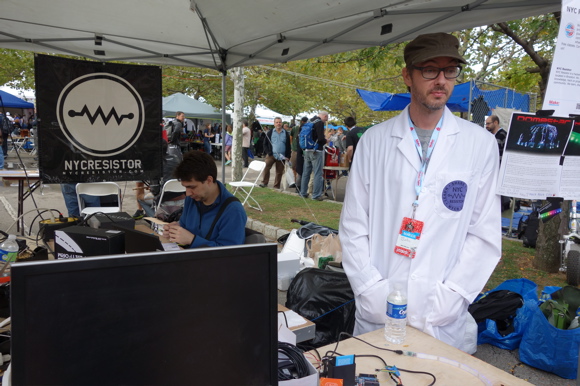
Justin of NYC Resistor brought a pile of electronic gear ideal for scavenging by itinerant robots.

NYC Resistor on 3rd Avenue at Bergen is one of the oldest hackerspaces (and the birthplace of Makerbot), represented at the Faire by an impressive pile of electronic parts threatening to become self-aware at any minute. Alpha One Labs in Greenpoint had a table but I was never quite able to catch up with their representative, Psytek (which I was assured by another hacker is not his given name). I’m looking to cover their space and efforts in future posts.

Gary Oshust, owner of Spark Workshop, started looking for studio space for his sculpture work, ended up as a part-time landlord for other makers and artists in Sunset Park

The arguably newest workspace in the borough (a mere two weeks old) is Spark Workshop in Sunset Park. Owner Gary Oshust, a sculptor looking for studio space, found himself taking on a lot of space that he is renting out to other makers along with access to power tools, photo studio and gallery space. (Warning: the Brooklyn Artisan editorial team may find themselves experiencing flashbacks of their own adventure with running shared workspaces in an ex-industrial loft not so long ago.)

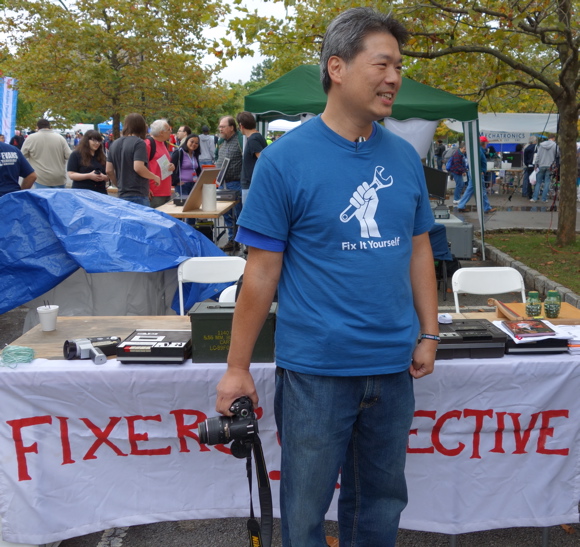
One notable approach to activating tools, expertise and craft in Brooklyn that deserves mention is  Fixers Collective, a group that gathers in Gowanus to repair broken things brought to them by others. As they say on their literature “If you can’t fix it, you don’t own it.”

Fixer Collective: bring them your tired, your broken, your wretched refuse. They will repair it or recast it for imaginative repurpose.

Brooklyn Makes It…to Queens at World Maker Faire 2012

WORLD MAKER FAIRE is a West Coast import that is becoming a huge event here every September. Now in its third annual appearance, the Faire this weekend drew massive crowds and it seems to have hit the city just at the crest of the “artisan” phenomenon.

Much of it is best described as “Geekstock,” with booth after booth of electronics gear and gadgets that whir, flash, beep, scuttle, fly, and roll. There were so many robot and science teams from MIT, Columbia, City Tech and other colleges and science high schools as well as random software and hardware aficionados packed into Flushing Meadow Park that for a few hours the average IQ per square foot must have spiked enormously. There were also squadrons of environmental activists, artists and craftspeople, and families dragging their kids around in hopes that enough science, math and engineering will seep in to improve the chance of admission in 12 years to the previously-mentioned elite schools.

Brooklyn was well represented among exhibitors and visitors, making it the ideal event for kicking off coverage of this very exciting part of the artisan movement, the convergence of science, engineering, art, and manufacturing that is best categorized as the “maker” movement.

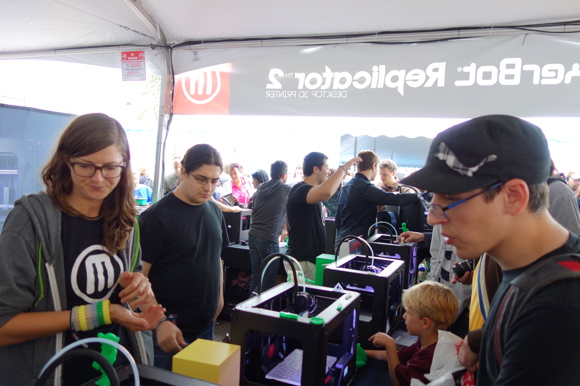
The booth for Makerbot Industries of Brooklyn was mobbed with visitors evaluating the latest version of the 3D printing machine that is on the wish list for nearly everyone.

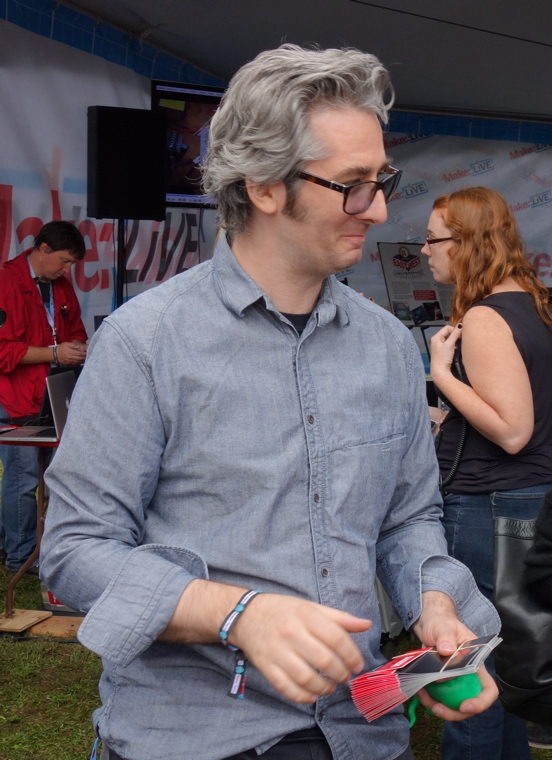
3D printing is the hot technology right now, garnering extensive interest at the Makerbot space and at many other booths showing competing printers as well as materials, software and creative output. Bre Pettis, CEO of Makerbot and coverboy of Wired magazine’s current issue, was a star attraction at the Faire.

Bre Pettis, CEO of Makerbot, presented show awards.

In coming months, Brooklyn Artisan will be covering 3D printing often as these products gain wider acceptance. At the Faire, there were clear signs that 3D has moved from the hobbyist stage. A few exhibitors in the craft area showed jewelry, small plastic vases, and even an espresso cup created using clay laid down in a printer and then fired in a kiln.

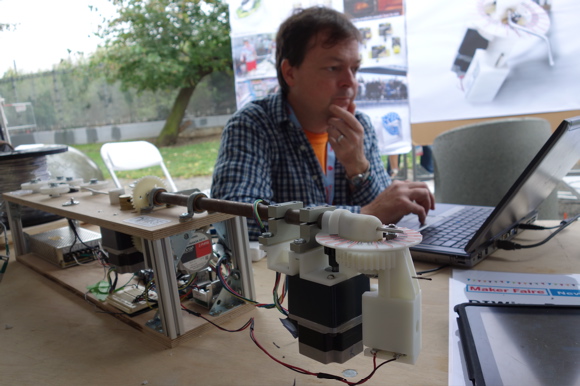
3D printing may be the cutting edge, but there were plenty of maker projects applying tech to old technologies. Brooklyn design consultancy Pensawas demonstrating a computer-driven wire bender they have been developing and releasing into the public domain. I would love some personalized wire coathangers!

The DIWire Bender bending.

Watch for more of my coverage of interesting high-, middle- and low-tech from World Maker Faire coming soon.