Stuckist Art “Against the Cult of the Ego-artist”


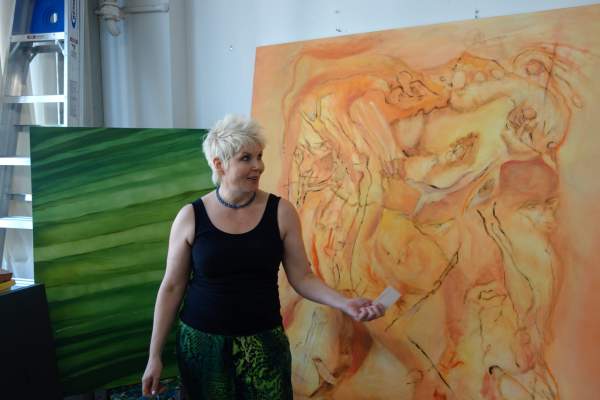
Judith Mills talks about her Stuckist painting on Open Studio day, Sunset Park (Brooklyn Artisan Photo Pool)

Judith Mills talks about her Stuckist paintings in her Brooklyn studio. (Brooklyn Artisan Photo Pool)

“I’VE ALIGNED MYSELF WITH STUCKISM FOR TWO YEARS,” says Judith Mills, on Open Studio day at Industry City late last month. “It has really helped me,” she says, with emphasis. With your art?, Brooklyn Artisan asks. “Yes. It enabled me to narrow down my focus to the realistic—what’s real, you know—and then to pull out to the expressive.” She gestures energetically toward the wide range of large canvases around her, wonderful, colorful, magnetic, different from one another — all that and more —and to Brooklyn Artisan, not remotely realistic.

“But the biggest surprise?” Judith continues. “It unstuck me in other areas of my life as well.” “You mean with money?” a studio visitor asks. Judith is nodding. “Or with friends?” More nodding. Judith adds, “I’ve been much more — well, here,” she says, pointing to a wire in-basket with printed pages. “You can read it.”

It is titled “THE STUCKISTS,” referring to a quote from Tracey Emin: “Your paintings are stuck, you are stuck! Stuck! Stuck! Stuck!” The subtitle of the manifesto is “Against conceptualism, hedonism and the cult of the ego-artist.” The manifesto dates from April 8, 1999, and is signed by Billy Childish and Charles Thomson. (“First published by The Hangman Bureau of Enquiry,” it says at the bottom, and gives an English address, in Kent.) It advocates authenticity in one’s work, one’s art, one’s life and one’s self.

"Waterfall," by Judith Mills

“Waterfall” is large and hynotic in rhythmic strips of blue, indigo, violet. It measures 60×72″

Judith Mills is one of the artist-organizers of Open Studios at Industry City, the complex of lofts and warehouses at Bush Terminal, in Sunset Park, Brooklyn. About 75 studios belonging to artists, photographers, stained-glass craftsmen, jewelers, musicians, and textile designers,were open to visitors.

And The Stuckists? Per Wikipedia: “Tracey Emin, CBERA (born 3 July 1963) is an English artist. She is part of the group known as Britartists or YBAs (Young British Artists),” and then it details a number of Bad Girl behaviors (such as being “drunk and swearing” on live TV), but not as many, apparently, as Tracey herself has revealed. For instance, in 1997 Emin showed  Everyone I Have Ever Slept With 1963–1995, a tent appliquéd with quite a list of names, at the Royal Academy in London. More lately she was appointed of the Order of the British Empire, and is one of only two female professors—ever—at the Royal Academy since it was founded in 1768.  Functioning in such a culture might make anyone behave like a Bad Girl.

Ah, but Brooklyn Artisan doth digress. Open Studio day at Industry City on April 26 was a “first annual” — that is, a pioneering experiment — meant to foster community both within and outside the circle of creative tenants at the vast Bush Terminal industrial and warehousing facility in Sunset Park. Some studio hosts offered light things to eat and drink and were happy to speak about their work. [Update from Judith Mills:The show went better than expected. I was selected to do a live painting performance that will be May 30th on the rooftop atrium of the Park Restaurant in Chelsea for a fundraiser. I am very excited for this opportunity that developed out of the open studios.”]  

Megan Grissett, who lives in Sunset Park, saw a notice of the Open Studios event posted in a neighborhood cafe and was eager to come over. A graduate of Savannah College of Art and Design, Megan came to New York from Raleigh, North Carolina, about three years ago.  “I live up the street,” she explains, and says she ‘d always wondered about  Industry City.

“I work as a social media specialist at an ad agency in Manhattan,” she says, “and I don’t have much time for sketching, or a place for it.” But she had wondered if the atmosphere at Industry City would be too commercial. “Now I think it would be a great environment,” she says wistfully. “I would have to share space, though.”

As we sit and chat on one of wooden benches in a hallway on the fourth floor of Building B, Megan glances down at a fresh tattoo on the top of her right foot. Rendered in green and red, it is the image of a long-stemmed budding rose. “I just had it done,” she confides, “in memory of my grandmother, who died about a month ago. I’ll think of her every time I look at it.

“We were very close,” Megan says, in her soft accent. “I don’t want to ever forget her.”

See Brooklyn Artisan’s prior stories on Industry City Open Studios. More coverage of artists and their studios will be posted this week. 

Anne Mollegen Smith also writes personal finance articles for investopedia.com.


Open Studio at Maria Castelli: Elegant Bags to Covet


Cobalt blue bag is soft and chic.

Cobalt blue bag is soft and chic. (Brooklyn Artisan Photo Pool)

SORRY, FOLKS, THE DISCOUNT WAS JUST FOR THE DAY, last Saturday, the first Open Studios at Industry City in Sunset Park, and you missed it. But you can feast your eyes anyway, as Brooklyn Artisan did, while talking about the Maria Castelli business that just launched last month.

“We just launched,” daughter Veronica explained, “but we’ve been working on it for about a year and a half.” Though her lovely face was free of bags under her eyes or furrows in her brow, her expressive body language managed to suggest some weeks of round-the-clock effort.

“It’s a lot of work,” she confided, as her mother talked to a handful of serious-looking people on the other side of the room. Retail buyers, we hoped, who’d put dozens of these handsome bags into distribution.

Maria Castelli leather bag in black

As some Belle Dame d’Industry City might say, Chic is the thing with feathers.

The bags are rich looking with thick pebbled leather, yet flexible and almost slouchy in construction so that they’re easy to wear on your shoulder. (Just don’t load up with the Yellow Pages or bags of river rocks and you’ll be fine.) Although some small pouches on another table had the ubiquitous industrial zipper as design statement du jour as well a closure, the handsome shoulder-able bags were clean and as zipperless as Erica Jong’s famous **** (Fear of Flying).

We also liked the alternate bag in black that we spotted on a side shelf. The leather tassel of the blue version was replaced by two bunches of feathers on the black. Irresistably touchy-feely—in fact, we were quite tickled by them.

A co-founder of the erstwhile Getting It Gazette, Anne Mollegen Smith also writes about personal finance for investopedia.com. 

See our other Industry City Open Studio coverage, with more to come later this week.

Lingering After Images of Creative Studios at Industry City


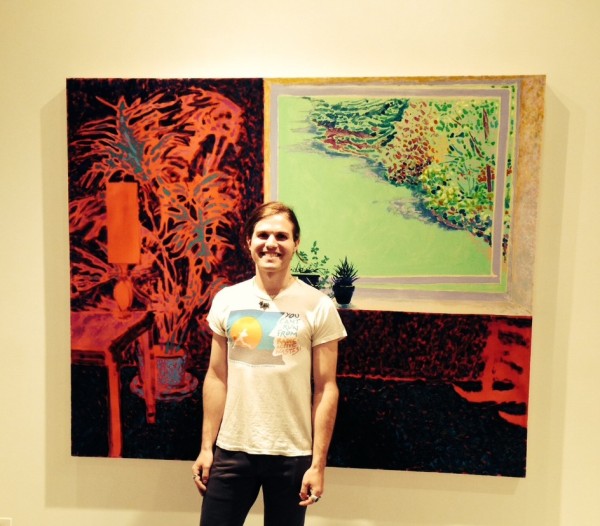
The artist Dylan Vanderhoeck, with "Gibsonia," a 2013 work. (Brooklyn Artisan Photo Pool.)

The artist Dylan Vanderhoeck, with “Gibsonia,” a 2013 work.
(Brooklyn Artisan Photo Pool.)


“I CAN SEE THROUGH MY HANDS’ is what the young artist Dylan Vandenhoeck called the work he was showing Saturday in his @SO WHAT SPACE in Industry City Building B, where he has space B424 (that signifies his room on the 4th floor of Building B in the huge complex that formerly was the Bush Terminal in Sunset Park, Brooklyn).

Yesterday was Industry City’s first Open Studios day. Organized cooperatively between Industry City and some of its creative tenants, the event was an invitation to interested visitors to “get a rare glimpse of works in progress, and discover how each tenant has customized a raw studio space to fit his or her medium and personal style,” its brochure said.

Two contrasting images form a single piece, the real and the after image.

Two contrasting images form a single piece, the real and the after image.

“Gibsonia” is based on a real place remembered, Dylan explained to Brooklyn Artisan. It was done in oil on canvas. The contrast is exaggerated between the dark room and the soft rug with vibrating colors, and the brilliant scene beyond the window sill’s plants.

In “Palm at the End of the Mind/After Image,” right,  a newer work in oil on linen, which appears to be two pieces joined into one, the contrast is as though you stared at the bright palm fronds on the left and then closed your eyes, seeing the after image on your retina and in your mind.

That concept sets a theme for the whole day’s happy experience of wandering from studio to studio, seeing work in progress and talking with the artists, photographers, designers and artisans practicing their craft. Over coming days, Brooklyn Artisan will report on more studios we visited.

Former editor-in-chief of Working Woman magazine and the Art of Simple Living, Anne Mollegen Smith also writes about personal finance for investopedia.com.

Chalking Nicely: It’s always good to be thanked

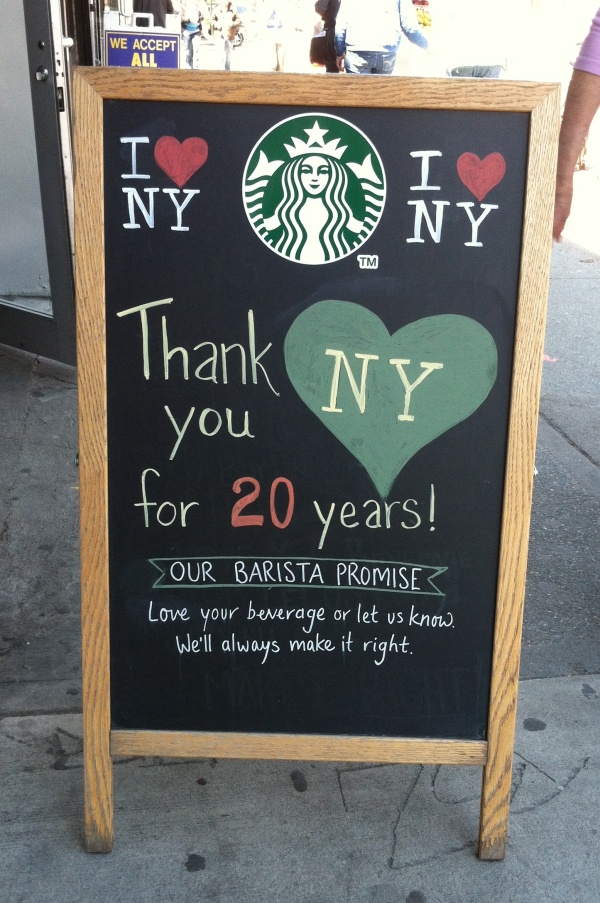
StarbucksThanksChalkOutside the newish Starbucks at the intersection of Park Place, Seventh Avenue and Flatbush Avenue is this message. (Brooklyn Artisan photo pool)

Yum! Ample Hills Creamery Cookbook is Here


Ample Hills Creamery Cookbook

Co-authors Brian Smith and Jackie Cuscuna included Ample Hills’ famous salt crack caramel recipe in the new cookbook, which can be yours for $25.00. (Brooklyn Artisan Photo Pool)

YESTERDAY WAS PUBLICATION DAY for the new Ample Hills Creamery cookbook, and copies were stacked up on the counter at the popular premium ice cream store on the corner of Vanderbilt Avenue and Bergen Street, in Prospect Heights.

Proprietor Brian Smith, right,  was on hand in a front booth to inscribe copies. He confirmed to Brooklyn Artisan thatAmpleHillsBrianSmith the company’s new location in Gowanus is scheduled to open by late June. Ice cream will be made right on site as at the Prospect Heights location.

“Our business is more than an ice cream store, really,” Smith said. “It’s a neighborhood hangout.” The Prospect Heights store has a toddler play area, just visible over Smith’s shoulder.

The familiar Ample Hills ice cream carts will be back out in their locations near playgounds and parks this summer also. Smith co-founded the business with his wife and cookbook co-author,  Jackie Cuscuna.


Kickstarting Brooklyn

Sogoal Zaghardi produces gorgeous, artful and sometimes irreverent cookies and is seeking to expand her Sogi's Bakeshop with the help of a Kickstarter campaign.

Just one of the many Brooklyn projects raising funds on Kickstarter:
Sogoal Zolghadri produces artful and sometimes irreverent cookies
at her Sogi’s Honey Bakeshop.

THE MOST RECENT CREDIT CRUNCH began in 2008 and  reportedly ended this summer. Remember those images of Lehman Brothers staff tossed to the sidewalk with their little boxes of belongings? In the months following, credit dried up and small businesses were starved for the financing needed for growth and hiring, laying the basis for a long grueling recession. But also within those same months—in April 2009—a small startup launched in Manhattan that has become the go-to funder for creative projects: Kickstarter was born. In the four years since its founding, Kickstarter has gone viral and raised pledges of more than $870 million in crowd-sourced funds from more than 5 million backers. (Like any good Internet company, it posts its stats online.)

The premise of Kickstarter is that entrepreneurs, artists, designers, musicians or filmmakers with ideas bigger than their bank accounts can launch a campaign on the Kickstarter site, set funding goals (which can grow over time) and deadlines, provide incentives to investors for various funding levels, and generally plead their case to gain followers (think Facebook “likes” with dollar bills attached). The ideas flourish or languish, gaining financing or not in a mysterious financial Darwinism. Some projects blow past their target budgets by tens of thousands of dollars, while others fizzle out despite their merit.

Given the power of Kickstarter for small creative inventors, makers and producers, Brooklyn Artisan will be covering it as a financial and manufacturing beat, highlighting the notable, successful, hopeful, and even the occasional noble-yet-doomed project. As well, we will provide advice, tips, strategies and tactics to aid in successful campaigns.

Brooklyn is certainly well represented, with more than 2,000 projects currently raising funds, more than double the number of projects coming out of London, for example. To look for promising projects or to make sure your investments stay in borough, Kickstarter provides city-based discovery.

The Brooklyn Brief commuter bag by Owen & Fred of Greenpoint comes with a handy inspirational
quote screen-printed on the inside.

Today, we’re highlighting two projects. The first, by Greenpoint-based Owen & Fred, is a series of bags (above) that is tantalizingly near to reaching the $45,000 campaign goal. The bags are promised to be durable, sustainable, meticulously detailed and U.S. made. One nice touch is the inspirational quotes screen-printed on the inside, for your eyes only.

Sogi’s Honey Bakeshop (picture at top of post) set less ambitious goals: raise $6,500 to buy supplies and a bigger mixer to aid the creation of the hand-painted cookies that have already attracted the attention of Martha Stewart Weddings and are popular on Etsy. Happily, baker Sogoal Zolghadri has raised the money and then some.

It can be a lot of work and planning to produce a campaign that meets or surpasses its goal. Kickstarter itself provides some basic tools and information to get you started. But who knows—next time there is a big shakeup in the financial world, those staffers might be seen shlepping their belongings in one of your Brooklyn-produced duffel bags.

Moving Parts: Brooklyn Furnishings Design at The Factory Floor

SMALL, MEDIUM, AND LARGE: Otherwise, it’s hard to categorize the ingenious designs of Brooklyn makers at The Factory Floor in Industry City in the recent two-weekend show. But starting small, Brooklyn Artisan will do our best, for the record.

Small batch, small scale, big thinking at bhold design: Product development under the eye of Susan Taing, founder, takes certain characteristics from the MakerBot desktop 3D printer used to produce prototypes in the bhold lab. Double-walled thermal saki cups, for instance, with little fingerholds on one side.

Using the MakerBot 3D desktop printer, b-hold can turn around and refine prototypes in a few hours that might take days in traditional development cycles.

Using the MakerBot 3D desktop printer, bhold labs can turn around and refine prototypes in a few hours that might take days in traditional development cycles. (Photo: Brooklyn Artisan Photo Pool/dfs)

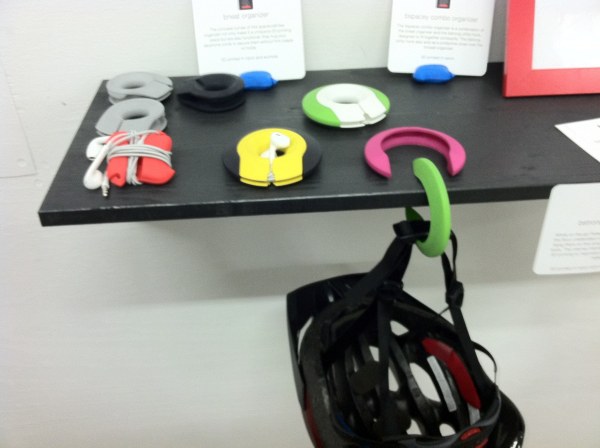
Or—our favorite, above—colorful little two-tone, two-piece objects that separate: the outer C-shape that hangs on the restaurant table and holds your bag or helmet by its handle or chin strap; and the inner part that emerges to wind and store your earbuds tangle free. You can work with the bhold labs on your own designs; contact susan@bholddesign.com. Or like us, you can just stand at a design show and play with the appealing objects fitting them together and taking them apart over and over again as minutes tick by. 

Founder/owner Mark Righter crafted sliding shelves that don't tip, thanks to the sliding dovetail joint.

Founder/owner Mark Righter crafted sliding shelves that don’t tip, thanks to the sliding dovetail joint. (Brooklyn Artisan Photo Pool/ams)

Small detail, big advantage: Cambium Studio is a Brooklyn-based woodworking furniture and design company founded by Mark Righter. From its Greenpoint location, Cambium will create custom designs for clients, and on its website offers a portfolio of pieces of its own design.

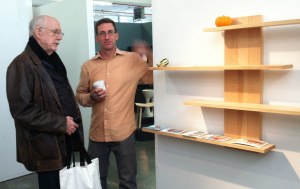
Talking shop with a potential client, Cambium Studio's founder Mark Righter, with coffee, is next to his shelves with sliding dovetails. (Brooklyn Artisan Photo Pool/ams)

Talking shop with a potential client, Cambium Studio’s founder Mark Righter, with coffee, is next to his shelves with sliding dovetails. (Brooklyn Artisan Photo Pool/ams)

What caught our eye at The Factory Floor was deceptively simple but elegant shelving for display of favorite small objects—a place to put the candles, the Japanese vase, the framed photo—that can be adjusted as the array of objects changes. How?

The framework is hung from a secure cleat on the wall, but individual shelves operate on a sliding dovetail joint. The shelves, using bamboo, are beautiful finished and the sliding function gives you an excellent excuse to pat them and fiddle with them for the pleasure of touch.

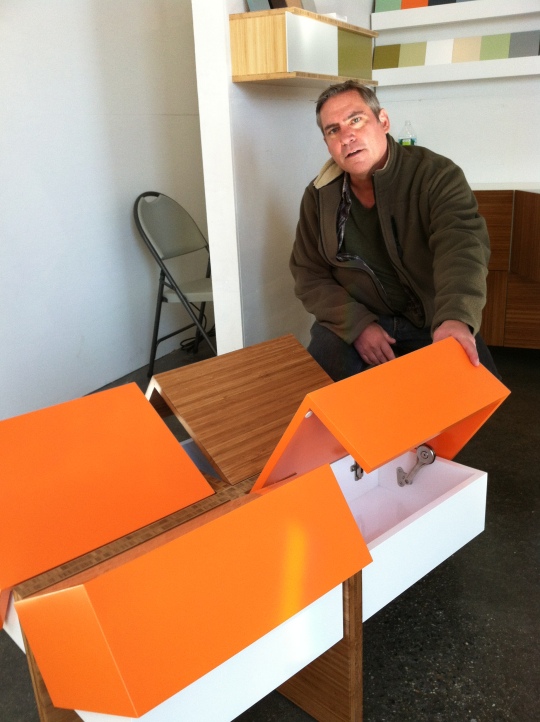
Then there’s the MidCentury-looking coffee table with lift up hinged covers on its four storage compartments. Three of the covers are in a 60s’s orange and one is in bamboo strip laminate. Fittingly it is named Mod Quad by Wonk, its maker.

David Gotl lifts the four cubby covers of the streamlined coffee table,

David Gotl lifts the four cubby covers of the streamlined coffee table,

Other combinations of finishes to suit individual clients are possible, Wonk’s website says.  In fact, since each piece is custom-made for you, you are confronted with swatches and urged to pick from them. Takeaway notion? Wonk if you love finishes.

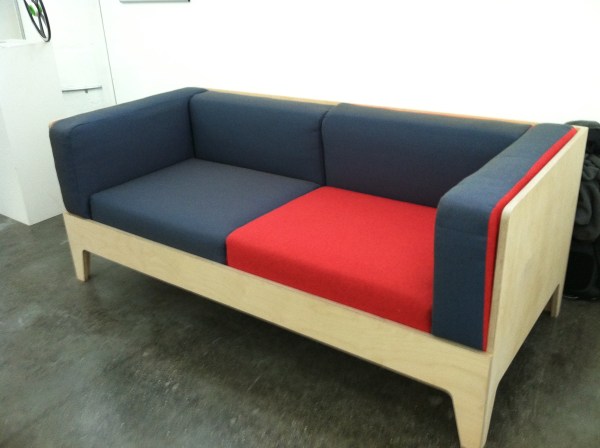
The laminate frame holds the cushions in place; upholstery fits cushions closely.

Pratt grad’s design: The laminate frame holds the cushions; upholstery fits cushions closely.

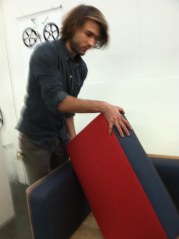
Change the color statement (or hide the pizza drippings) at will.

Change the color statement (or hide the pizza drippings) at will.

Along with others, Pratt Institute was a co-sponsor of the design show at The Factory Floor.  At the Pratt Industrial Design booth—Pratt Institute is, by the way, based in Brooklyn—Brooklyn Artisan was engaged by a very clean-lined yet comfortable loveseat. The foam cushions made it quite sittable. And as its Pratt graduate designer demonstrated, the cushions can be flipped to your choice of color contrasts.

More coverage from the recent Brooklyn design show at The Factory Floor in Industry City, Sunset Park, is to come in the next few days. For Brooklyn Artisan’s prior coverage, follow these links:

Overview by Bruce A. Campbell

Alexandra Ferguson: Done is Better

Sleeping on The Factory Floor

The Art of Sleeping on The Factory Floor

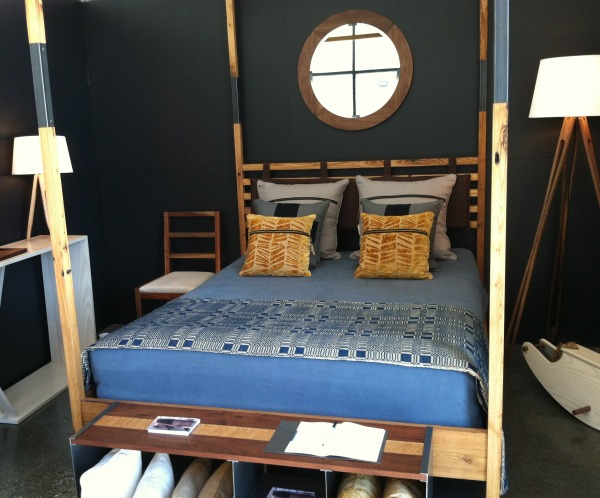
Materia Designs's centerpiece was made of reclaimed chestnut.

Materia Designs’s centerpiece was made of reclaimed chestnut.

AT THE BROOKLYN DESIGN SHOW LAST WEEKEND this beautiful bed was practically a show-stopper for Brooklyn Artisan: We wanted to kick off our boots and lie right down in the calm surround of the Materia Designs booth. Manners prevailed, however, so remaining upright, we talked with owner/designer and craftsman Matthew Enser of Materia Designs.

The accents of black metal wrapping the bedposts made of reclaimed chestnut added a touch of elegance to the spare design with its handsomely mortised lattice headboard. The booth also showed good-looking three legged lamps, a sweet rocking horse, some chairs, an eye-catching striped storage bench, and more. A beautiful complement were the graphic textiles selected and/or designed by Megan Sommerville, Matthew’s partner. The confident metal zippers on the reading pillows came off looking industrially chic rather than scratchy or snaggy.

So…Kerhonkson?, we asked (thinking, Bless you!). Right outside of Kingston, he said, a little ways up the Hudson. Not Brooklyn?, we pushed. “Oh, Materia Designs used to be in Brooklyn,” Matthew assured us, “we love Brooklyn.” Before Brooklyn Artisan could probe about whether cost was a factor in the move, Ensner explained: “We were driving up that way, and—well, we fell in love with a big barn.” Enough said.

More Brooklyn Artisan coverage of the recent show: Alexandra Ferguson profile and The Factory Floor: Meet the Makers, overview by Bruce A. Campbell.  The Factory Floor is part of artisan-friendly Industry City within the Bush Terminal complex in Sunset City, Brooklyn.

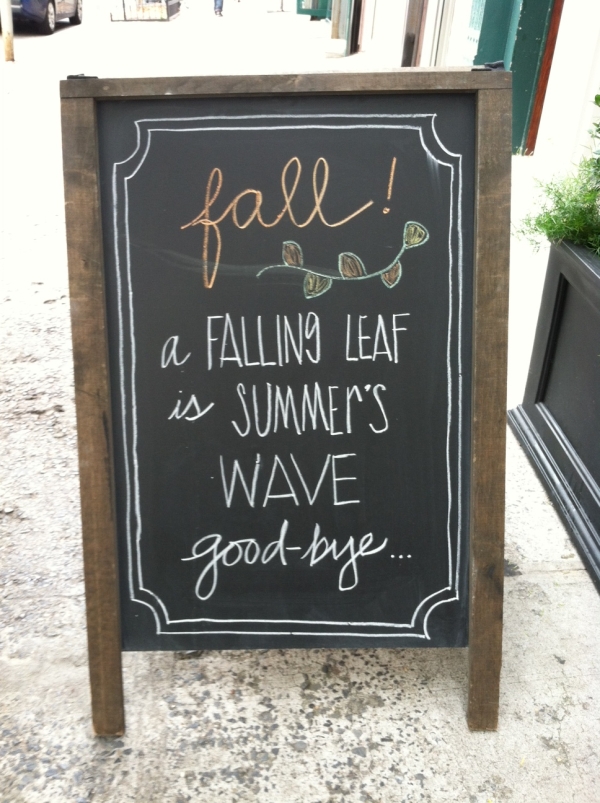
Chalk It Up: A Romantic Notion for Autumn

Seen outside of Poppy at 217 Fifth Avenue in Park Slope. (Brooklyn Artisan Photo Pool).

Seen outside of Poppy at 217 Fifth Avenue in Park Slope. (Brooklyn Artisan Photo Pool).