Help for Businesses Still Struggling to Rebuild After Sandy

New NYC grants program, and a deadline for SBA loan applications

The NYC Department of Small Business Services has announced a new $1 million grant program for small businesses hit by Hurricane Sandy. Funded by Barclays, Citi and UBS, the program will award grants of up to $5,000 for businesses to make physical repairs or replace damaged equipment. “Small Business Assistance Grants will now be available to help businesses that may not qualify for the [city’s emergency] loan [fund],” said Rob Walsh, Commissioner of the NYC Department of Small Business Services. To apply for a grant, call 311 or go to www.nyc.gov/nycbusiness.

Meanwhile, this Monday, January 28, is the deadline for NY businesses to apply for a U.S. Small Business Administration disaster loan. (That’s also the filing deadline for FEMA disaster assistance for individuals.)

The SBA’s Office of Disaster Assistance offers businesses low-interest physical disaster loans up to $2 million to cover repair or replacement of uninsured or under-insured property, equipment, inventory and fixtures and economic injury loans to meet expenses like rent that the business would normally have have been able to cover. Less well known is that the SBA also offers assistance to individuals: Renters and homeowners may borrow up to $40,000 to repair or replace clothing, furniture, cars, appliances, etc. damaged or destroyed in the disaster. Homeowners may apply for up to $200,000 to repair or replace their primary residence to its pre-disaster condition. You can apply for the SBA loans online at sba.gov/disaster, or by calling 800-659-2955. Or e-mail disastercustomerservice@sba.gov for assistance.

Even if you’re missing some information that’s needed on the application form, be sure to send in the application by the deadline, recommends attorney Yisroel Schulman, founder of nonprofit New York Legal Assistance Group, who answered questions about SBA and FEMA applications on The Brian Lehrer Show this week. If the application is rejected for missing info you can always appeal, but the initial application must be in by the deadline.
Thursday’s blogroll, a text-only posting

It is ugly-cold, and I’m pampering the never-ending sniffles by staying inside today. Here’s some of what I’m checking out today, with a nod to my fellow bloggers:

• This chef enjoyed ant larvae tostadas in Mexico City. afar.com

• Could you not have spared me that? newyorker.com

• Opinions noted, don’t totally disagree. Funny site, might bookmark. firstwefeast.com

• Straight out of a seven sisters mag ©1979? The one about a splash of vinegar is new to me. blogs.smithsonianmag.com

• A fictionalized patisserie chef falls in love with typography. cargocollective.com

• Saw this on Saturday @ New York City Ballet. It’s pretty cool, and BKLYN-based! 12ozprophet.com

• Can’t get enough of this typography. king-george.tumblr.com

• Ha Ha Ha. theonion.com

• Life is a pretty photo shoot part one. ldbabrooklyn.com

• Life is a pretty photo shoot part two. cannellevanille.com

• Around the world in 30 blocks (in Outer Brooklyn). jacksonheightseats.com

• Garlic, ginger, honey. food-alovestory.com

Was that feed a fever, starve a cold?

What’s on your blogroll?

Joy’s Best of Brooklyn for January 25, 26, 27

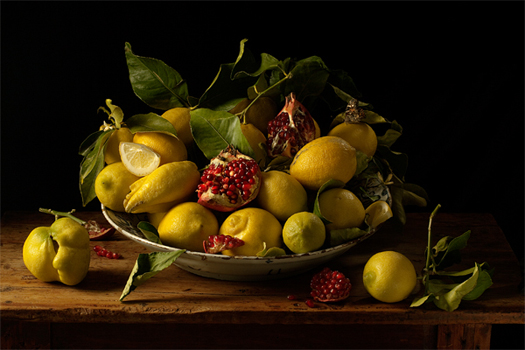
Paulette Tavormina: Natura Morta. Lemons and Pomegranates, after J.V.H., 2010. Robert Mann Gallery

Paulette Tavormina Natura Morta. Lemons and Pomegranates, after J.V.H., 2010.
From her solo exhibition at Robert Mann Gallery.

Too beautiful to pass by: Paulette Tavormina Natura Morta, a solo exhibition of photographs at Robert Mann Gallery. In the manner of Irving Penn and Edward Weston, Tavormina’s work depicts intensely personal images that recall old-master still-life paintings depicting edible objects. Her bio notes that she is an avid collector of butterflies and insects, shells, dried flowers and ceramics, and has worked as a food stylist in Hollywood. Outer Brooklyn—Chelsea, Manhattan. through March 9.

The Reuben is one of over ten typical sandwiches offered daily at Court Street Grocers.

Friday dinners and daily Reubens.

Friday: The next in a series of Friday Night Dinner at Court Street Grocers. According to Serious Eats, this larder-cum-sandwich place is run by “three dudes [who] just want to sell all the seriously good stuff they can find across the country.” And present a monthly BYOB dinner in their side dining room. Friday’s menu of five courses features ingredients such as octopus with caesar vinaigrette, crispy chicken skin and maytag blue cheese, bone marrow and bbq sunchokes. Court Street Grocers’s Red Hook annex was severely damaged by Sandy and owners Eric Finkelstein and Matt Ross are depending on crowdsourced fund-raising through Smallknot to help restore. Carroll Gardens. Reserve—two seatings at 7pm and 9:30pm are sure to fill up fast.

BBG will celebrate the full moon tonight.

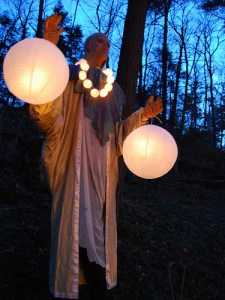
BBG will celebrate Saturday’s full moon with giant puppets and stilt dancers.

Saturday: Winter Cheese Party at The JakeWalk. Under the auspices of Stinky Bklyn, brush up on your knowledge of cheese pairings with wine, beer and cocktails during the cold days of January. After this week’s bitter temps, The JakeWalk’s comfy neighborhood vibe will keep things upbeat and toasty. Carroll Gardens. 1pm.

great for families Saturday and Sunday: Illuminated at Brooklyn Botanic Garden. A series of winter pop-up events done Swedish-style. Featured on Saturday: a handstand class for adults, where lack of coordination is a plus (sign up begins at 10:30am for noon class). Moonlight Lantern Walk with giant puppets and stilt dancers celebrating the full moon at the Cherry Esplanade (6pm-8pm). On Sunday, the Mitten Lounge becomes a clubhouse for 9- to 15-year-olds complete with human pyramids, crafts, an acrobatic mandala and a flashlight tour. (12pm-5pm)

libraryCommons

Beyond research and reading: the new co-working
facility is structured for multi-media use.

bpl_logoAnother reason to keep your library card active: More exciting than the discussions about branding and the new logo is the opening of the Information Commons space at the Central Library at Grand Army Plaza. The Shelby White and Leon Levy Information Commons, located on the first floor, consists of public meeting rooms, a training lab and an open workspace. The workspace is equipped with ten iMacs and two HP design stations for general public use; each is equipped with Adobe CS6 Creative Suite, Audacity, Pro Tools, Office, Final Cut Pro X, and more creative and production software. One of seven meeting rooms—that can be reserved online—doubles as an amateur recording studio for audio and video projects. The room offers a video DSLR camera, microphones, and an iMac editing workstation. It’s wonderful that the Library is encouraging multi-media creativity, as well as being a local workstation source in case your Mac has a kernel panic or otherwise misbehaves.

elbowroom_facebook

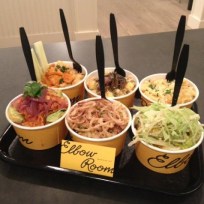
Deceptively small-looking
portions are probably spot-on.

But it’s worth it: I have to thank fellow bloggers at Brooklyn Based for turning me on to a topic that is only slightly less talked about than Michelle’s bangs: Elbow Room’s mac and cheese menu. Located at the Barclays Center, the diet-wrecking selections start with Chef Luis Ulloa’s excellent mac-and-cheese base and add creative toppings. Poutine Mac (short rib gravy, yukon french fries, fresh cheese curds), Brats and Beer (Esposito’s sausage, Bronx Brewery Ale, caramelized onion), Mushroom Mac (crimini mushroom, spinach, Vermont gruyère, crispy shallots) are tempting…even if Lobster Macaroni Salad is more commonplace now. Elbow Room is open during Barclays Center events and to the public during non-event times. To do: bank the points, slip on the Fuel Band, promise to repent and report back. Prospect Heights.

2todoNOTEJoy Makon curates Brooklyn Artisan’s Craft & Design coverage and creates the weekly Best of Brooklyn lists. Send items for listings to brooklynartisan@joymakondesign.com

Cuzin’s Duzin Mini Donuts Aiming to Raise the Dough

Cuzins Duzins Mini DonutsBROOKLYNITE TODD JONES CALLS HIMSELF A “DONUTOLOGIST.” You know, just as archaeologist Heinrich Schliemann studied archaeology, namely the archaeology of ancient Troy, donutologist Jones studies donuts, namely sweet, sticky, delicious mini donuts, each a deep-fried doughy circle. Not Dunkin’ Donut donuts, or Starbucks donuts, but hot, fresh mini donuts. “Glaze will come out of my skin if you cut me,” he says.

He’s not only mini-donuts, either, but popcorn, cookies, custom drinks, etc., etc., etc. While you’re munching on one of his highly addictive donuts, then a second and then a third, you’ll have time to see that he’s one of the most upbeat characters you’ll ever meet. “That’s the only way to be—upbeat,” he tells me. Not too long ago he catered his first million-dollar wedding, put together by famed wedding planner Mindy Weiss at the Hotel Hershey in Hershey, Pennsylvania. She loved his donuts so much that she tweeted her 46,000 followers, he says. From that tweet he has two more affairs to cater, and he’s approaching Puffy. And maybe Oprah. Why not?

But at times his luck has bordered on hellish. He had a 12-year stint going in Brooklyn’s Albee Square Mall until a developer sold the mall for $125 million. The developer took home $100 million and Jones was evicted immediately. He did some street festivals and catered a few weddings and bar mitzvahs until he was offered a place at Dekalb Market. He signed a contract for five years—“I knew it was temporary,” he says—and invested $30,000 in his shop. More developers arrived, and he was evicted again only a year and a half later —not long enough to recoup his investment. So he started working out of his bakery van again, and soon he was offered yet another location. But before he could move in, Superstorm Sandy hit, and the following Monday his van was stolen, along with $60,000 worth of equipment. Oh yeah: He had no insurance.

Sigh.

But now with his recent catering success, Jones is searching for another shop and he also wants to start franchises across the country. He’s started meeting with investors. “That’s what’s on the table. If I can get $250,000 I can put a Cuzin’s Duzin in every Walmart across the country,” he says. “It’s a billion-dollar industry, and we can carve out a niche.

“Once you eat a donut you’re a Cuzin for life.”

Executive Editor Phil Scott is the author of seven books and numerous magazine articles.

The Lively Letters – and Interesting Times – of My Cousin Lillie

By David Fay Smith

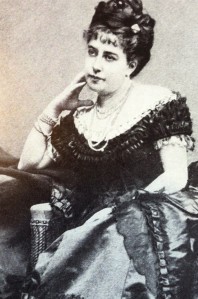
Lillie de Hegermann-Lindencrone's author photo for her first memoir. She studied with the same voice teacher as Jenny Lind and sometimes sang duets with her at private dinners, but Lillie did not want a life upon the stage.

Lillie de Hegermann-Lindencrone’s author photo for her first memoir, taken in about 1908. She studied with the same voice teacher as Jenny Lind had, and sometimes sang duets with her at private dinners, but Lillie did not want a life upon the public stage like Jenny Lind’s.

I RECENTLY OPENED A BOX OF BOOKS that had been in storage  – usually a dubious proposition – and discovered a copy of In the Courts of Memory by Lillie de Hegermann-Lindencrone, a second cousin several generations removed. (Her mother and my great-great-grandmother were first cousins, but only a Hobbit would care.) Lillie Greenough was born into a musical family in Cambridge, Massachusetts, and was well known there at a very young age for her remarkable soprano voice. In 1859, at the age of 15, her mother took her to London so she could be trained by Manuel Garcia, a famous voice teacher of the time.

By 1862 she is living in Paris, married to Charles Moulton, a wealthy American banker, and partying at the Second Empire – as the court of Emperor Napoleon III and Empress Eugénie was known – all the while writing letters to the folks back home, detailing who was there, what they wore, what they did for entertainment, what music was performed, and what she sang, for she was almost always asked to sing. For example, in June 1867, she entertains Franz Liszt, Prince and Princess Metternich (the Austrian ambassador) and 25 other people, including the composers Daniel Auber and Jules Massenet. Auber brought along a manuscript, which Liszt glanced at, “and said ‘C’est très jolie.‘ After dinner, and a cigar in the conservatory, ìhe went to the piano and played the ‘jolie‘ little thing of Auber’s.” From memory!

“He seemed extraordinarily amiable that evening,” she wrote, “for he sat down at the piano without being asked and played a great many of his compositions. One has generally to tease and beg him, and then he refuses. But I think when he heard Massenet improvising at one of the pianos he was inspired, and he put himself at the other (we have two grand pianos), and they played divinely, both of them improvising.”

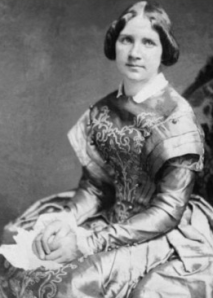
Known as the "Swedish Nightengale," Jenny Lind also was a student of Manuel Garcia and became world-famous for her operatic soprano. P.T. Barnum brought her to tour the US in 1851. Dress and even furniture styles were named for her.

Known as the “Swedish Nightingale,” Jenny Lind studied with Manuel Garcia in 1841, and became world-famous for her operatic soprano. P.T. Barnum brought her to tour the US in 1851, and later she made her own very successful tour circuit. Dress, hair, and even furniture styles were named for her.

Lillie has a sharp eye (and ear) for detail (and for human nature), and provides a vivid, sometimes acerbic image of the life and times of the very, very rich. Imagine Downton Abbey, but with appearances by people like Massenet, Liszt, Gounod, Rossini, Wagner, Jenny Lind (with whom she sings duets), and Sarah Bernhardt – not to mention all the royalty and near-royalty. Lillie is in France during the Franco Prussian War (1870) and in Paris during the Paris Commune (1871), an uprising of anarchists and Marxists who depose Napoleon III and rule the city for 72 days of chaos and bloodshed. A few years after her husband, Charles Moulton, dies, she marries the Danish minister to the United States, and travels with him to diplomatic posts in Stockholm, Rome, Paris, Washington, and Berlin.

My cousin Lillie lived in interesting times, and often had a good vantage to observe the people and events. In the Courts of Memory is only the first volume, covering 1858-1875. The second is The Sunny Side of Diplomatic Life, 1875-1912, which was not in our storage box and I intend to read on my iPad. (Both are available as free e-books at Project Guttenberg.)

Brooklyn Artisan Contributor David Fay Smith is the author of  A Computer Dictionary for Kids and Other Beginners, and a former columnist for Publishers Weekly.

What Makes a Book ‘Rare’ –– And Do You Have One?

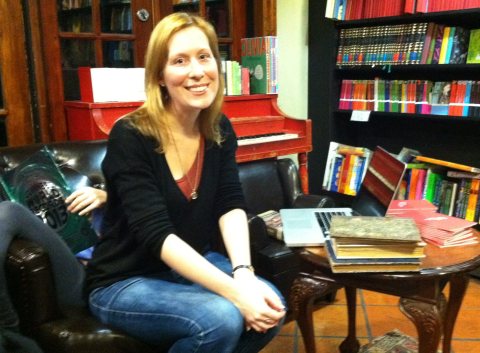
Heather O'Donnell at the Community Bookstore meeting, living-room style. Plenty of social skill goes into face-to-face book evaluations, and the rare book expert never knows what to expect. (Partially visible behind Heather is her young daughter, sitting sideways, absorbed by "The Guiness Book Of Records, 2013."

Rare-book advisor Heather O’Donnell at the Community Bookstore’s living room-style meeting. Plenty of social skill as well as professional knowledge goes into face-to-face book evaluations with the owners. (Partly visible behind Heather is her daughter, absorbed by “The Guiness Book Of Records, 2013.”) (Photograph by Brooklyn Artisan Photo Pool)

ON THURSDAY NIGHT AT THE COMMUNITY BOOKSTORE ON SEVENTH AVENUE, Heather O’Donnell set out to shine a little light on the subject of rare and collectible books for more than a dozen of her Park Slope neighbors. “Rare books are my passion,” she said, and hastened to reassure her listeners sitting with books on their laps that she also enjoyed seeing and evaluating all sorts of interesting or cherished books from personal bookshelves, no matter how modest, and hearing the stories about them. Literature is her specialty: Before founding Honey & Wax Booksellers in 2011, Heather earned a Ph.D. in English literature, taught at Princeton, and then worked for seven years for Bauman Rare Books, on Madison Avenue.

That location was open to the public, she said, and though usually she enjoyed the social contact and always cherished the occasional surprise discovery of a valuable volume, Heather allowed as how yes, as in any business, there were occasional bad days. In her business, a bad day can be opening the doors to “belligerent people with worthless books.” (Chuckles around the room.)

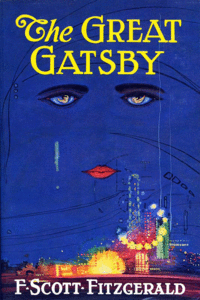
A pristine Gatsby jacket of the first edition,1925, can multiply the value 50 times over.

A pristine Gatsby jacket of the first edition, 1925, can multiply the value 50 times over.

The rarity of a book is determined by its scarcity balanced against its desirability, she said. In general, book collectors look for first printings of books of importance, in good shape and with the dust jacket intact. Ideally there would be no fading, heavy wear or tearing of the book jacket or its binding; no stains or coffee rings, please, especially not on the cover (note to self: buy more coasters); no loose or missing pages, and – god forbid! – no yellow highlighting or disfiguring scribbles on the pages. Daintily penciled notes in the margins okay? It all depends on the collector.

Heather gave the example of a first edition of F. Scott Fitzgerald’s The Great Gatsby: in pristine condition including its dust jacket, it would sell in the neighborhood of $200,000; without the jacket, not so much – in fact, probably around $4000. (A quick glance at nearby laps showed few intact jackets; Brooklyn Artisan felt a little better about the bare-naked books we’d brought.) Authentic author’s autographs may enhance value but don’t guarantee it, we learned, and inscriptions like “Happy birthday to the best boy in the whole world, Love, Grandma,” while certainly not sought after, aren’t necessarily disastrous, either. Again, it all depends.

We got some pointers on research we could do ourselves such as looking at the standard reference works by Allen and Patricia Ahearn and searching on AbeBooks, which a librarian can help with, or even using amazon.com or ebay.com just to begin to get a fix on availability and price. Looking at auction records is better yet; again, the right librarian can coach you. Once you’ve done some homework, if the signs auger well, then you may be ready for the next step: approaching a dealer.

The moment had come to show the books that had been brought. It felt just a little like an audition. There were some nice books: a first edition of The Autobiography of Alice B. Toklas, by Gertrude Stein, still wearing its jacket. [Read more…]

Joy’s Best of Brooklyn, January 17 through 22

Two tons of sugar, truffled polenta, MLK day of service, borscht belt memories, brainiacs and more
Two tons of sugar make up Aude Moreau's Sugar Carpet, on view at Smack Mellon, part of Brooklyn/Montréal Contemporary Art event in DUMBO.

A carpet made up of sugar—two tons of it—is on view at Smack Mellon,
part of Brooklyn/Montréal Contemporary Art event in DUMBO.

logo_bmOngoing through February 2: Brooklyn/Montréal Contemporary Art. Brooklyn and Montréal, both leading centers of contemporary art, have created events and exhibitions that highlight artistic differences and similarities between the two cities. The first half of this event was held in Montréal in late fall. The second half, happening now throughout DUMBO, has eight art venues and 40 artists participating. At Smack Mellon, Montréal artist Aude Moreau’s Sugar Carpet (detail, shown above) is a large-scale installation comprised of 2 tons of refined white sugar that has been meticulously worked to look like a Persian rug. This is the first exhibition installed at Smack Mellon since Sandy flooded their Artist Studio Program and lower-level spaces. Complete programming information and venues are listed on the event website.

From Mediterranean Slow Cooking

Exquisite ingredients, from Michele Scicolone’s newly-released cookbook The Mediterranean Slow Cooker.

logoJanuary 17 • Thursday: Know Your Books: Free consultation with rare bookseller Honey & Wax. Want to find out if your copy of Nancy Drew: The Password to Larkspur Lane is valuable? The Community Bookstore is hosting a talk about contemporary book collecting, along with an Antiques Roadshow-style opportunity to have your old or not-so-old book appraised by Heather O’Donnell, founder of Honey and Wax Booksellers. Park Slope. 7pm.

January 19 • Saturday: Eat, Shop and Learn with author Michele Scicolone at A.L.C. Italian Grocery and Alimentari (featured in Brooklyn Artisan’s 12 Tastes of Brooklyn). Sample truffled polenta made with Italian black truffle butter, from Michele’s newly-released The Mediterranean Slow Cooker. Michele’s best-selling cookbooks receive high marks from notables such as Mario Batali, Dorie Greenspan and Lidia Bastianich. Bay Ridge. 12:30pm-3:30pm.

January 21 • Monday: Martin Luther King Day of Service. Brooklyn residents can join in with others across the country to honor Dr. King’s legacy by participating in local performances and community service activities. Here’s a few suggestions:

Layout 1Long Island University. Screening of We Shall Not Be Moved: Downstate ’63.” Speakers, discussions, performances, followed by an afternoon of service activities in the community. Downtown Brooklyn. 11am-1pm.

Brooklyn Academy of Music. Tribute kicks off with keynote by musician and humanitarian Harry Belafonte, Jr. Performances by Fort Greene/Clinton Hill’s Brooklyn Interdenominational Choir, and R&B duo Kindred the Family Soul. Included is a live simulcast of the inauguration of President Barack Obama. Fort Greene. First-come, first-seated tickets distributed at 8am for 10:30am start.

Hurricane Sandy Relief Kitchen is still out there needing support.

Hurricane Sandy Relief Kitchen is still out there needing support.

Brooklyn Botanic Garden. Usually closed on Mondays, the garden is open with free admission. 10am-4:30pm.

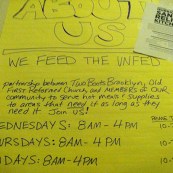
Stating the obvious: lots of organizations have an ongoing need for volunteers and dollars. On our list: Hurricane Sandy Relief Kitchen, an outcome of the around-the-clock food prep efforts at Two Boots; Masbia, a Brooklyn-based network of soup kitchens; CHIPS with a desperate need for men’s winter clothing.

When the dining room was closed, Kutsher’s Coffee Shop was always open, just in case you needed a nosh. (Photograph copyright by filmmakers Caroline Laskow and Ian Rosenberg.)

If the dining room was closed, the coffee shop was usually open…just in case you needed a nosh between meals. (Photograph © by filmmakers Caroline Laskow and Ian Rosenberg.)

January 22 • Tuesday: Screening, filmmaker discussion and tasting. Revisit New York’s last standing Catskill resort, Kutsher’s, with a screening and discussion of the 2012 award-winning documentary Welcome to Kutsher’s. It was in Kutsher’s large, communal dining room that traditional Eastern European Jewish food collided with American abundance. As part of the evening, you’ll taste traditional borscht belt specialities like Herring Salad à la Jenny Grossinger and Aunt Lilly’s Vegetarian Chopped Liver. Then sample some reimagined dishes from über-popular Kutsher’s Tribeca (the owner is fourth-generation Kutsher) such as Duck Breast Pastrami and Roasted Beet Salad with Marinated Goat Cheese, Fingerlings, Greens and Artichokes. Ah, this is not the eat-til-you-burst menu choices of my Grandmother’s days. Part of the Culinary Conversations series at the Tenement Museum, Outer Brooklyn, Manhattan. 6:30pm.

secretscienceJanuary 22 • Tuesday: The paradigm-shifting Secret Science Club meets at The Bell House. Attend 2013’s first monthly meeting with a group of self-proclaimed brainiacs. Astrophysicist Jeremiah Ostriker will explore the Dark Duo of dark matter and dark energy. You’re requested to strap on your rocket pack, bring your smart self, and enjoy energizing talk, a deep, dark cocktail of the night, and brain-boggling Q&A. Park Slope. 8pm.

2todoNOTEJoy Makon curates Brooklyn Artisan’s Craft & Design coverage and creates the weekly Best of Brooklyn lists. Send items for listings to brooklynartisan@joymakondesign.com

Brooklyn Museum Meetup: Four Bourgeois Heroes

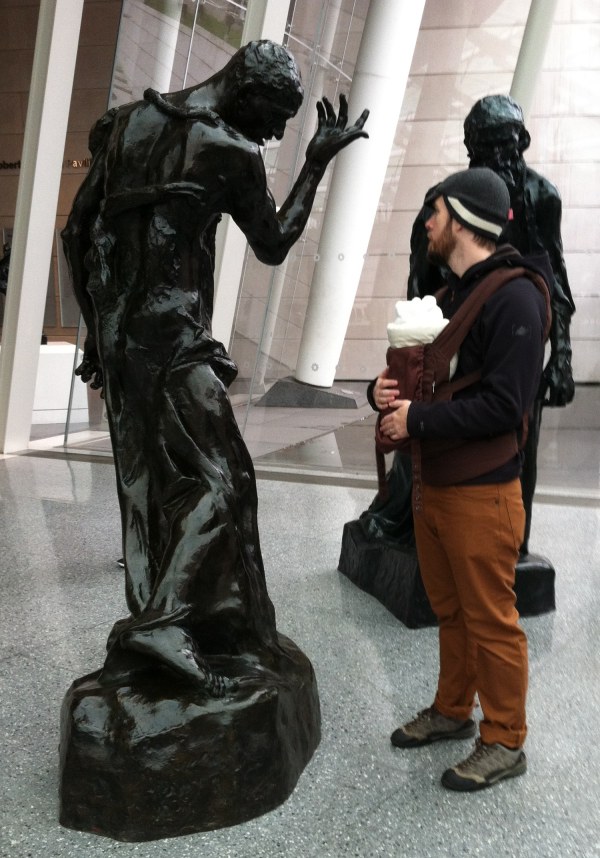
Brooklyn Museum courtyard: Brooklyn chest-pack Dad confronts Rodin statued

“THEY ARE VOLUNTARILY BOUND TO THE SAME SACRIFICE, but each of them plays the role suited to his individuality, his age and position,” Auguste Rodin said about the heroic citizens of Calais; four of his six bronzes of the  “Burghers of Calais” are currently on view in the Brooklyn Museum courtyard. The work was commissioned in 1875 by the Calais town council to commemorate events more than 500 years in the past (see Backstory, below), and Rodin’s winning proposal was solidly within the academic tradition of French Beaux Arts. Also, the story goes, he promised to deliver six statues for the price of one. But, as anyone on any side of the Atlantic Yards development can attest, what you think is approved is not necessarily how it turns out.

As delivered, the work was a major break with traditional Beaux-Arts monumental statuary. (Just a short walk from the Brooklyn Museum, an example of neo-classical Beaux-Arts style sits atop Grand Army Plaza’s Soldiers’ and  Sailors’ Arch, complete with the pyramid-shaped arrangement of figures led by the allegorical figure of Columbia who represented the Nation.) In developing his work, Rodin drew on the account of a contemporary of the historic events in Calais, Jean Froissart, and learned the personal histories and social background of the six men who volunteered as hostages to save their city. Rodin worked from carefully chosen live models – including a descendant of one of the six heroes – and then deliberately oversized the hands and feet to make gestures and stance more expressive. These figures show the suffering, humiliation and humanity of their situation. Greatness has been thrust upon them, and it is agonizing. [Read more…]

ODD CONNECTIONS: ‘Avarice’ at the Brooklyn Museum and ….

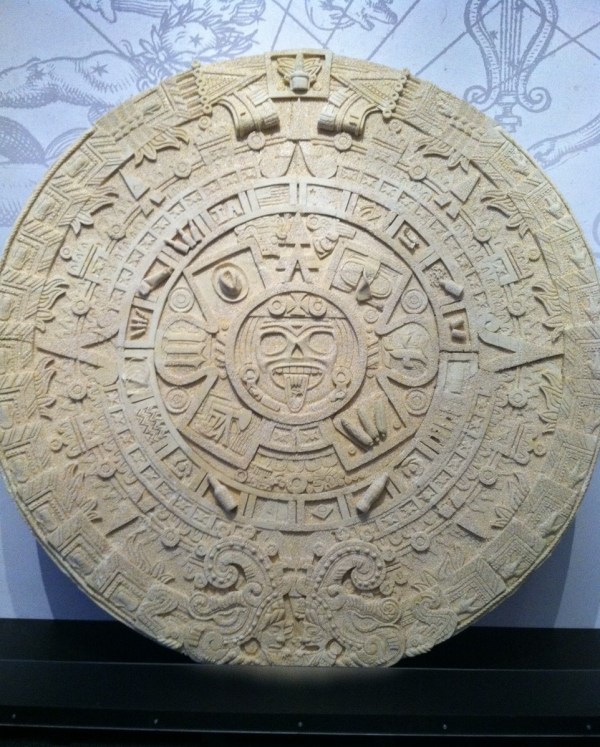
Brooklyn Museum "Avarice" Fernando Mastrangelo 2008IT’S A SHOW-STOPPING GRAND FINALE TO BROOKLYN MUSEUM’S GREAT-HALL EXHIBIT Connecting Cultures: A World in Brooklyn, and no wonder, for the piece is spectacular. To Brooklyn Artisan’s surprise, it’s even more striking in situ than Gaston Lachaise’s monumental “Standing Woman” –  which we’d gone there to have another fond look at. (That, and the bronze foursome from Rodin’s “The Burghers of Calais” who’re standing around in the covered courtyard.)
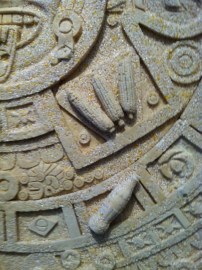
What stunned us – and won us –  is the disc-shaped piece almost ten feet in diameter that’s called “Avarice.” Part of the museum’s collection of contemporary art, it was made in 2008 by Fernando Mastrangelo, who was then 30. Mastrangelo is a Brooklyn-based artist (whose mom lives in Texas, one learns from his Facebook page). As the name suggests, “Avarice” combines art and politics. Its artistic basis is, of course, the circa-1500 Aztec Calendar Stone – which recorded the creation story of the Aztec world – with the face of Tonatiuh, the Sun God, at the center. The political statement is what it’s made of, a wry example of Marshall McCluhan’s dictum that “the medium is the message.” The media in this case are:  White corn, white and yellow corn meal, epoxy, fiberglass, wood, and metal. (And maybe just a small shovelful from the recycling bin?)

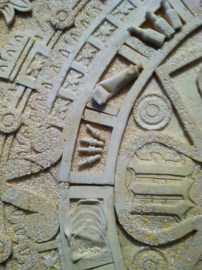
In adjacent panels, some cobs and a Coke. Sounds like a summer snack in Mississippi.

In nearby panels, some cobs and a Coke. Staples of an American summer diet.

Toothpaste, spark plug, sliced lunch meat, see anything else?

Toothpaste, spark plugs, deli sliced meat. (Photos: Brooklyn Artisan Photo Pool.)

The museum sign also tells us, “The depiction of corn-based products draws attention to Mexico’s mass cultivation of corn to meet energy needs (via ethanol) and foreign consumer demands.” The Aztec visual reference brings up the whole sordid story of the Spanish Conquest; the devil in the details, however, is the “avarice” of North American agribusiness and consumer culture. Take a look at these close-ups and the large image at top, and you’ll find some telltale items.

Political art is nothing new for Mastrangelo; his 2010 TED Talk spoke of art as an evolving way to record history, to tell the story and capture the spirit of one’s times, including in today’s digital world. Last year he had a 3-month show in Miami at the Charest-Weinberg Gallery called Black Sculpture. The gallery write-up makes clear this is not about race. “After creating exact molds based on the work of Frank Stella and Ad Reinhardt, Mastrangelo casts his reliefs out of compacted gunpowder. The pieces teeter on the precipice of annihilation.” Yikes, talk about jimmy-crack-corn. “Yet the pieces are not simply bombastic,” the gallery says; “submerged beneath the tense potential for destruction is an elegiac calm. They give form to the Existential angst that inspired their Cold War-era predecessors….The black gunpowder, coupled with the Reinhardt’s cruciform and Stella’s teleological line work, firmly suggests an end of something.” Indeed. One hopes all future shows will be firmly No-Smoking zones.

Brooklyn Artisan came across what seemed to be a clear Brooklyn influence in Mastrangelo’s other discographic work from 2008 (click through to have a look). Though our favorite was composed of “Turquoise Sugar, Red Arbol Chili, Corn, Corn meal” and titled “Xochiquetzal,” we knew at a glance its visual vocabulary was from Brownstone Brooklyn’s   ornate plaster ceiling medallions, including the hole for the chandelier.

Meanwhile, back in the Great Hall: The stated purpose of the Brooklyn Museum exhibit is to “create new ways of looking at art by making connections between cultures as well as objects…. Connecting Cultures: A World in Brooklyn was a joint effort of the Brooklyn Museum’s curators, organized by Kevin Stayton, Chief Curator. The installation was designed by Matthew Yokobosky, Chief Designer at the Brooklyn Museum” and financial support for the long-term installation came from Lisa and Dick Cashin. Brooklyn Artisan salutes them all, but as much as we enjoyed working the room, we do admire this comment shown on the museum’s own web site: “it’s a strange collection that doesn’t seem to sync with each other. reminds me more of a victorian living room than a museum exhibit.” — Posted by Tameka G.

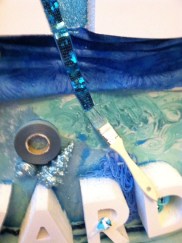
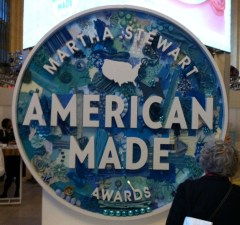
From totally outside the museum scope, there was one more odd cultural connection we couldn’t help making. Last fall Brooklyn Artisan visited another great hall exhibit, “American Made,” put on in Vanderbilt Hall at Grand Central Station by Martha Stewart. In our photos made at the time, take a look at the sign and its detail.

Painter's tape, sparkly braid and bating brush.

Painter tape, sequin braid, brush.

From the exhibit in Grand Central's Vanderbilt Hall.

From Grand Central’s Vanderbilt Hall.