
Is it for the birds? Or the bees? No, it’s a super-small library.
WITH BROOKLYN LATELY ABUZZ ABOUT BEEKEEPING, at first I thought this was a hive mounted on a post. Then I read the signs and was charmed [Read more…]
A team blog created for and about artisanal small businesses
Is it for the birds? Or the bees? No, it’s a super-small library.
WITH BROOKLYN LATELY ABUZZ ABOUT BEEKEEPING, at first I thought this was a hive mounted on a post. Then I read the signs and was charmed [Read more…]
WORLD MAKER FAIRE is a West Coast import that is becoming a huge event here every September. Now in its third annual appearance, the Faire this weekend drew massive crowds and it seems to have hit the city just at the crest of the “artisan” phenomenon.
Much of it is best described as “Geekstock,” with booth after booth of electronics gear and gadgets that whir, flash, beep, scuttle, fly, and roll. There were so many robot and science teams from MIT, Columbia, City Tech and other colleges and science high schools as well as random software and hardware aficionados packed into Flushing Meadow Park that for a few hours the average IQ per square foot must have spiked enormously. There were also squadrons of environmental activists, artists and craftspeople, and families dragging their kids around in hopes that enough science, math and engineering will seep in to improve the chance of admission in 12 years to the previously-mentioned elite schools.
Brooklyn was well represented among exhibitors and visitors, making it the ideal event for kicking off coverage of this very exciting part of the artisan movement, the convergence of science, engineering, art, and manufacturing that is best categorized as the “maker” movement.
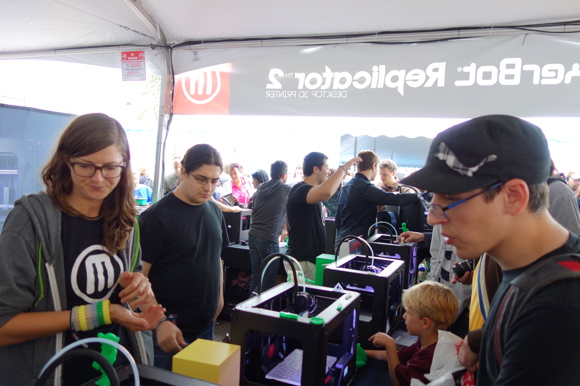
The booth for Makerbot Industries of Brooklyn was mobbed with visitors evaluating the latest version of the 3D printing machine that is on the wish list for nearly everyone.
3D printing is the hot technology right now, garnering extensive interest at the Makerbot space and at many other booths showing competing printers as well as materials, software and creative output. Bre Pettis, CEO of Makerbot and coverboy of Wired magazine’s current issue, was a star attraction at the Faire.
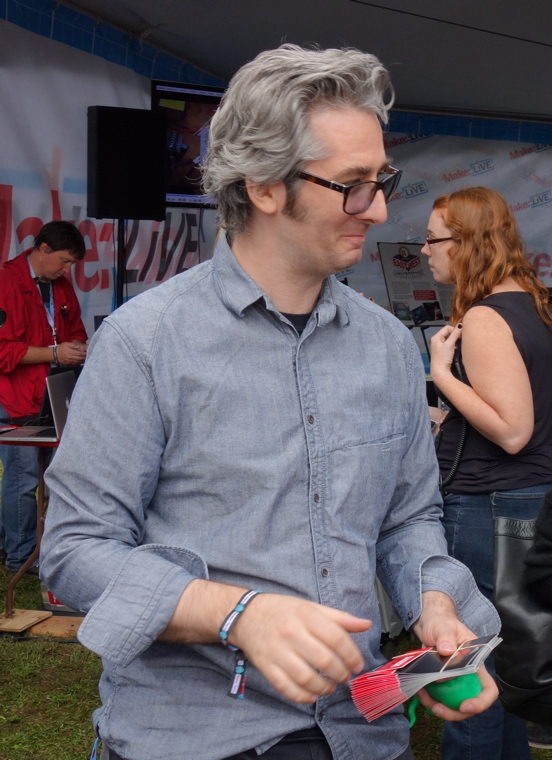
Bre Pettis, CEO of Makerbot, presented show awards.
In coming months, Brooklyn Artisan will be covering 3D printing often as these products gain wider acceptance. At the Faire, there were clear signs that 3D has moved from the hobbyist stage. A few exhibitors in the craft area showed jewelry, small plastic vases, and even an espresso cup created using clay laid down in a printer and then fired in a kiln.
3D printing may be the cutting edge, but there were plenty of maker projects applying tech to old technologies. Brooklyn design consultancy Pensawas demonstrating a computer-driven wire bender they have been developing and releasing into the public domain. I would love some personalized wire coathangers!
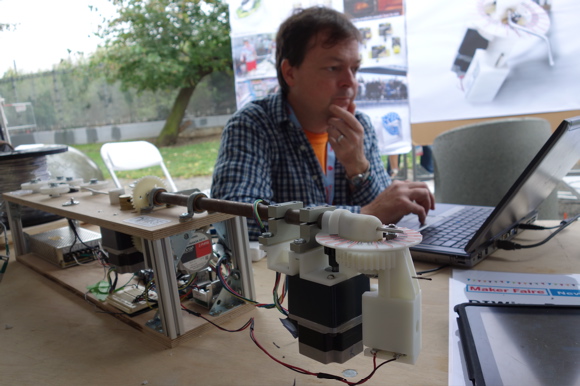
The DIWire Bender bending.
Watch for more of my coverage of interesting high-, middle- and low-tech from World Maker Faire coming soon.
EVER NOTICE HOW some people can smuggle an AK-47 in their checked luggage but you can’t sneak a can of shaving cream past alert Transportation Security Agents without them tossing that and your toothpaste in a large plastic garbage can? Well, I have. Also, and this is more important, I’m so cheap I won’t even pay attention.
That’s why, after wasting my third can or so in the TSA trash, I’ve taken to shaving with the old-fashioned brush and shaving soap. Not only have I never been wrestled to the ground and handcuffed by alert agents trying to confiscate my beaver-hair shaving brush, but past the initial investment I’m pretty much home free.
Plus – and this is a big plus – I’ve found it gets my day off to the proper artisanal start, taking this time to work with my hands. So here’s how you pull off that close shave the authentic, old-fashioned way.

The man seen shaving here is not Phil Scott, nor does he play him on TV.
1. You’re going to need a shaving brush, a ceramic mug of some sort, and a bar of soap. I prefer a thick china mug with an old Air Force logo, but you can maybe find one with a Brooklyn Dodgers logo or a Yogi Berra quote. Whatever you choose, the majority of the mug must be a light color.
And don’t forget the razor. That’s really the most important part, the razor. I prefer the triple-blade types. Disposables blow. Straight razors are dangerous and scary and you’ll never get one through an airport anyway.
2. Place the soap inside the mug somehow. I prefer to nuke the combination in the microwave (no need to carry this authenticity thing too far) for maybe 20 seconds until the soap gets a little soft, then flatten it with my thumbs into what is called a soap puck. You’ll have to do this each time you add a new bar of soap, which means maybe twice a year. (See, it’s already less expensive than canned shaving cream.)
Even toss in soap scraps from the sink or shower. If your mug’s dark (see no 1. above) it will block the magic hot rays that are supposed to turn the soap into a soft goo. Same with metallic elements, like gold rims. I’m not sure why, just take my word for it.
Now you’re ready to shave! Fill the mug to the top with hot water, and work up a lather with the brush. Brush the lather all over the area destined for shaving. Really work it in there, too – coating those whiskers makes for a smooth shave.
3. It is not strictly necessary to don long pants, a dirty wifebeater, and suspenders that you can drop off your shoulders while you lather up, like in those early episodes of Mad Men. Today you can do this in boxers, briefs, boxer-briefs, or a towel, or less.
4. Scrape all the soap lather off with the razor. And there you have it! You’re done! And your face is smoother than if you’d used shaving cream, or an electric razor.
NOTE: A styptic pencil is what you need to control the bleeding.
Executive Editor Phil Scott has written seven book and numerous articles for national magazines.
Find a brief rundown of choices on Mediabistro’s AppNewser blog. This framework gives you a starting point to collect info. It matters what kind of phone you have, for one thing. Though it’s said the piper must be paid, LevelUp promises a way around those pesky credit card charges. Hmm. What is your experience? (Use the Contact Us page to answer.)
DESSERT CAME FIRST. And why wouldn’t it? Last Saturday’s beautiful weather was a perfect excuse to hop on the NY Waterway East River Ferry and explore Smorgasburg in North Williamsburg. I’d made plans to spend some time talking with Giuseppe Maione of Alchemy Creamery, and of course had to sample some of his potions. It was easy to (temporarily) ignore all of the meaty, savory aromas that is Smorgasburg and dig in to the cup of creamy sweetness that Giuseppe offered me.
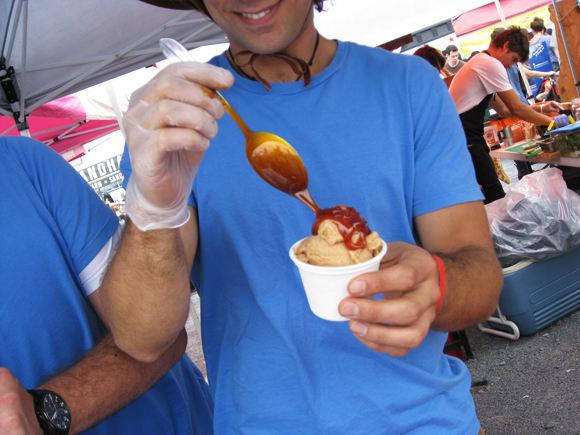
Caramel Sauce topping Apple Cinnamon,
from Alchemy Creamery
Alchemy Creamery, started in April 2012, is a small-batch, non-dairy ice cream, sold through Smorgasburg and select retail locations in New York City. All-natural coconut cream, unrefined sugars, and natural plant extracts go into the product, along with locally sourced flavorings. On Saturday, I sampled Apple Cinnamon topped with caramel sauce, along with Fixation—a dark chocolate chai. These flavors are developed, tested and produced at Organic Food Incubator in Long Island City in a leased, professional kitchen space used exclusively by Alchemy Creamery. The selections change based on season and ingredient availability. Currently 15 to 18 gallons are produced weekly by Maione and his two Alcreamist partners JD Gross and Jesse Goldman. Maione’s got the fantasy wish that he could clone himself, but until then, he considers his partners crucial to bounce ideas off of. He borrows his father’s pick-up truck to transport and deliver to Smorgasburg and retail locations.
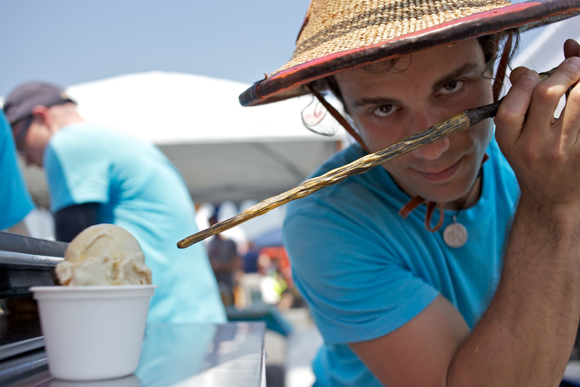
Giuseppe at Smorgasburg.
Photograph by Vlad Weinstein
Giuseppe, 28, has found that getting to know and work with other Smorgasburg producers has helped showcase and grow his product. He prefers to source flavorings from his fellow vendors. The chocolate in Saturday’s Fixation came from Raaka Chocolate. Currently there are no plans for a brick and mortar storefront, as Giuseppe wants to market and sell through other sources, like Champs Family Bakery. He likes the idea of small-batch deliveries to other like-minded food stores, as well as picking up the occasional catering gig. He’d love to have a chance to create one-of-a-kind flavors for someone’s wedding. “Twitter and Instagram have been amazing marketing tools. The foodie culture is migrating to sharing what you enjoy,” says Maione.
Alchemy Creamery is no casual endeavor on Giuseppe’s part. It’s an outcome of a lifetime of learning about food and restaurants from his father and the family’s restaurants. Using dependable suppliers and resources, developing aesthetics, pricing the product, working with staff and customers—Maione encountered all of this working in the family’s restaurants, where he was the head waiter for 11 years. “Food is complex and multi-layered,” says Maione. “On one hand, it’s about nutrition, but it’s also about comfort and pleasure.” And with that, Alchemy Creamery is being developed to keep health in mind (non-dairy) but also fun. One ice cream flavor, or two, is not enough. Maione experiments to create unique flavor mixes, so that one tastes one flavor at first, and then another, and perhaps yet another. Additions like caramel, or chocolate balsamic sauce, or salted walnuts—displayed in chemistry beakers—work to add texture and flavor.
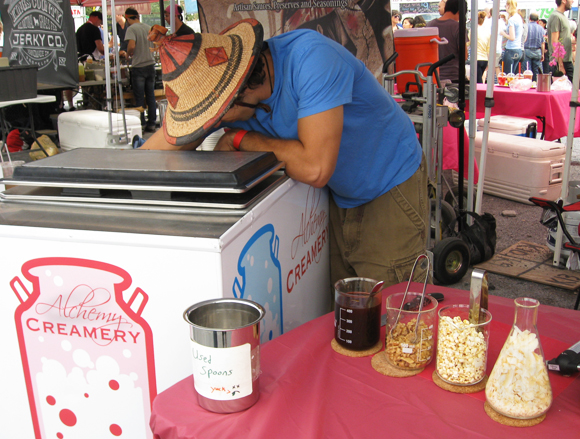
Toppings, made from ingredients from fellow vendors, add flavor and texture to the weekly “potions.”
Giuseppe and I are colleagues at a retail store; like so many of us lately, he works part time to earn some money to fund the other interests in his life. He’s an incredibly warm, friendly person and takes pleasure when a customer smiles after tasting the flavor mixtures—potions—he crafts. At work, he’s known for bringing in tastings to the employee lounge, and we’ve gotten to taste Stone of Jupiter (a roasted red pepper chocolate chili powder ice cream) and Heart of Mars (Rooibos Red Tea). I’m waiting to taste Saturday Morning Cartoon (Fruity Pebble Tea). It won’t last long.
Taking advantage of this beautiful day to put some of the Brooklyn Backyard garden to sleep for the winter. Spent two hours gently digging up and separating and cleaning small oxalis bulbs. A very labor-intensive, though (for me) satisfying task that I do every fall. Repetitive, solitary, quiet with birds and rustling leaves.
And later on I intend to sit quietly and knit for an hour or two before Yom Kippur arrives this evening.
I think of those who use their hands and lovingly create amazing things for all to admire, use, taste, share.

RECENTLY BROOKLYN ARTISAN sent a New York Times article by Adam Davidson about artisanal pickle making and the rebirth of a craft economy to an old friend writing here as the Skeptic from Boston.
SfB: You bait me… I bite. Theoretically a craft product is made by hand and involves skill. I don’t think making a “craft cocktail,” even if the bartender has an untrimmed beard and a stingy brim, requires so much skill that it is worth $12.00. I recently read about a couple with wheat and gluten allergies starting a business to package “natural” artisanal wheat-like foods without wheat. Let’s hope they didn’t quit their day jobs to do it.
The economy in Boston is okay but not great, so there are some underemployed smart young people looking for high returns in niche markets. For example, last year there were two recent college graduates at the Cambridgeport Farmers Market locations with a folding table and a set of brochures for organically grown oyster mushrooms, but no mushrooms. The mushrooms were nearing harvest somewhere on Cape Cod, they said, so they were selling impregnated do-it-yourself mushroom logs, but no mushrooms. They showed up for six weeks straight, May to June, and talked to people about their plans, conceived in their dorm room, supported by a business plan and product descriptions, but no mushrooms. Then they disappeared. The other farmers figured they moved to Brooklyn.
BA: True, many artisanal entrepreneurs here are starting micro businesses for lifestyle reasons – some to supplement their unemployment checks or because their jobs have stagnated in large corporations or they’re selling coffee at Starbucks. They’re frustrated by this economy and trying to create their own jobs. Or they’re the stay-at-home spouse whose child is old enough now for nursery school. They need to make money, they seek some creative satisfactions, they enjoy the sport of a start-up, and they like to feel some control.
Also, they welcome a chance to express their values—very likely they believe in fair trade, organic farming, local foods, reclaimed or sustainable materials, non-polluting and natural ingredients, high quality, and putting their hearts into their work. These ideas are not empty clichés. Many artisanal entrepreneurs are hoping to create soul-satisfying livelihoods. Yoga teaches its disciples to live the change they believe in, to be the change. It’s a very similar impulse.
SfB: Yada, yada. I wanted mushrooms, not mushroom marketing. It is difficult to make really good bread, cheese and pasta. They take years of training and practice. Good bakers take years to “find their own bread.”
Some old Boston-area warehouse and factory buildings have been converted to artists’ workspaces. I visit the Radcliffe and Mudflat pottery shows every year. They are doing okay. Mostly part-timers and hobbyists. It may be quite some time before we see the beginning of a new Arts and Crafts movement with significant impact on the economy.
The Boston Globe has been paying more attention to good food, but we don’t have many centralized specialty markets here. I usually have to drive to Brighton, Watertown or Somerville to check in on the craft food makers. Only the hard cases, like European educated bakers, seem to be making real money. We have few craft butchers left in the city, but some of the farmers are offering humanely raised, good-quality meats from coolers during the summer months. It is not easy work and they have supply problems because there are not enough small slaughterhouses in Massachusetts anymore. Most of the work is done in N.Y., N.H. and Vermont. Kate from Stillman’s Turkey Farm was thinking aloud last week, about what it would take to open her own small USDA facility: proposals, architectural plans, grant writing and spread sheets. Then finding someone to build the facility, and local workers with slaughterhouse and custom butchering skills. My grandfather was a small butcher in Minnesota because being a butcher was easier than working in the mines. But it is killing work in many ways and my father moved to Detroit to work in factory as soon as he could. I think when people say the word artisanal, they conjure painting and sculpture and poetry. Unless they grew up on a small farm, they don’t know the 12-hour days, the stench or the insecurity of running a nonindustrial food operation. It will take a while to bring it back.
Real craft is taught by journeymen, raised in a craft tradition, to apprentices. If you grow up doing a craft, you are used to it and can sustain it, particularly when you don’t have alternatives. But now we are highly mobile. The families and whole towns which made great hams and sausages, specialty breads and pastries, have vanished, wandered off to easier jobs. Starting new, skilled craft operations is doubly difficult because we don’t have the traditions or the concentration of people with multiple skills that fuel and support a living craft.
BA: Many of these urban artisanal entrepreneurs are working out ways to give community support and market guarantees to the small farms and the sustainable fisheries, to preserve the traditional ways and honor the skills as well as shorten the distribution chain in order to get superior goods. These are serious people.
As for the mushroomers you described: Are they wrong to dream and explore? Perhaps after harvest, they discovered they didn’t enjoy mushrooms, or they landed big-bucks Wall Street jobs, or they moved on to some land of bigger basements with a better mushroom-growing climate. False starts are nothing to be ashamed of.
SfB: I see some hope in the people who are developing new supply chains with the remaining small fishermen and farmers (who are hardly making it). And I am desperate for their products. I want those mushrooms. But there is only a small market for premium-priced, high-quality, true-artisanal products in Boston. Yankees don’t spend money on food or clothes.
And I’m happy the gluten-allergy people are selling alternatives. Some of my friends need to find carbohydrate and dairy substitutes or they will end up like holy anorexics from the Middle Ages. But I don’t know how well that business can scale up.
What fires my skepticism most are the trendy charlatans calling their various products natural, artisanal-life affirming, authentic. Am I to believe in Domino’s artisan pizza? I am looking for skillfully made, anchored-in-a-tradition, sustainable products. I don’t want them over elucidated and over packaged. That does not give me warm feelings of authenticity. So, I worry about the good people of Brooklyn like I worried about the blissed out hippies who occupied San Francisco: This may not end well.
To show you I am not just a cranky old guy talking to an empty chair, I am not blind to Brooklyn restaurant life. Somehow you guys have managed to attain a critical mass of cooks and epicures. If life is a table you have at least two good legs.
The Skeptic from Boston is expected to be contributing to this team blog from time to time.
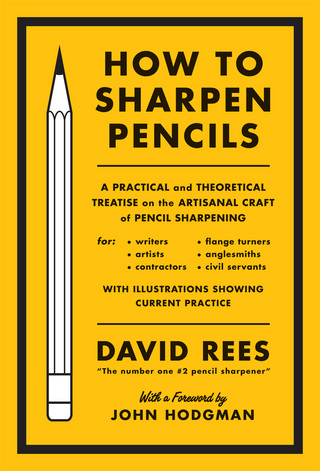 AUTHOR DAVID REES promised Brooklyn Artisan that he will hold forth on “artisanal everything” when he’s interviewed by Sam Anderson of the New York Times this Sunday, September 23, at 11 am on the Brooklyn Book Festival’s Main Stage. Recently published by Brooklyn-based Melville House, Rees’s book How to Sharpen Pencils was admiringly covered by the New Yorker after an excerpt appeared in Dumbo-based Etsy.com’s blog. Etsy referred respectfully to the book by its full title: How To Sharpen Pencils: A Practical & Theoretical Treatise on the Artisanal Craft of Pencil Sharpening for Writers, Artists, Contractors, Flange Turners, Anglesmiths, & Civil Servants.
Check below for a Brooklyn Artisan guest blogger’s response to Etsy.com’s excerpt.
by John J. Kochevar
I WROTE MY DISSERTATION with a wooden pencil. Or, rather, many wooden pencils. We rented a summer cottage in Effort, Pennsylvania where, every morning, I carefully sharpened every pencil in my collection before sitting down to write. I think I read somewhere it was Ernest Hemingway’s custom each morning to sharpen all his pencils before writing his 500 words. Or maybe it was just a warm-up exercise.
The smell of cedar shavings still reminds me of Effort and writing in the morning those high summer days. My father used a knife to sharpen his pencils, even his drawing pencils, but I did not have the patience. I had a tiny plastic box sharpener. Twisting the pencil created shavings like scabs and lopsided leads. When I left my research job on East 28th street I stole a box of pencils, a ream of yellow foolscap pads, and a mechanical pencil sharpener. My desk was a piece of plywood laid on two saw horses. After a month or so I screwed the mechanical pencil sharpener to the corner of the desk. I pitched the hand sharpener and progress was more rapid. Pencils in a row, equally sharp, no more excuses….

Elegant Dunhill lighter
While I wrote, I painstakingly erased my errors, much as I correct my mistakes while I type now. Eraser crumbs piled up at my wrist and elbow. Pencils were ground down to eraserless stubs. I had the occasional satisfaction of emptying a sharpener full of cedar shavings and graphite. A soft eraser does not give as much pleasure as a sharp #2. I thought sometimes about how much better writing would be if the pencils were precisely sharp. It would be like smoking a Sherman lit by a Dunhill. It would be like having a specialist roll your joints, always tight and the same size.
So when I read the review of David Rees’s pencil sharpening book, I was drawn to the fancy. Does he use fine sandpaper for the finish? What happens if you do two? How do you ensure they are both the same size? I think about David Rees and his custom sharpened pencils. Do I want a really fine sharp pencil? Could it be used to write one, really fine haiku? Or, would I find myself like Calvino’s Mr. Palomar in front of the cheese counter, unable to make up my mind about goat cheeses?
There is a fine line between love of craft and obsession.
John J. Kochevar, PhD, is a guest contributor to Brooklyn Artisan.

IN THE SINGULAR ECOSYSTEM that is Kickstarter, one will encounter many evolutionary dead ends—projects, visions and dreams that wither away unfunded. Then there are the mysterious campaigns that don’t just meet their targets, they blow by them and reach double, triple or stratospherically higher funding results. Why and how do these hyperachievers succeed, and can we learn any […]

WHAT COLOR WAS BOGEY’S FEDORA? Tough question. Brown? Gray? I’ve always envisioned Humphrey Bogart wearing a brown fedora in any of his fedora-wearing good-guy movies like Casablanca. The movie was released in black-and-white, but in the scandalously colorized version from the ‘80s his suit is muddy brown, Ingrid Bergman’s silky dress is muddy yellow, and […]
“Ready, Aim, Fire” or “Done is Better Than Perfect”? WHY DONE IS BETTER THAN PERFECT, says the Etsy Blog title for the June 20, 2013 entry by Alexandra Ferguson. And then the art shows a cute cushion with the message, Ready, Fire, Aim. As the originator of “‘Done’ is better than ‘perfect’” (explained in an addendum […]

BUSINESS OWNERS SHANE WELCH, FOUNDER OF SIXPOINT BREWERY in Red Hook, Matthew Tilden, founder of SCRATCHbread in Bed-Stuy and Charlie Sahadi, proprietor of Sahadi Importing Co. in Brooklyn Heights, showed their business scars and shared some hard-earned wisdom at a recent Brooklyn Public Library conversation, “Fantastic Food,” led by photographer Randy Duchaine, whose “Created in […]

Created in Brooklyn: Food and Drink Entrepreneurs Talk Shop ANY BUDDING ARTISANS IN THE AUDIENCE at a recent Brooklyn Public Library panel, “Fantastic Food,” would come away both sobered and heartened. Three business owners—Shane Welch, founder of Sixpoint Brewery, Matthew Tilden, founder of SCRATCHbread and Charlie Sahadi, proprietor of Sahadi Importing Co.—all shared disaster stories and […]

OUR BROOKLYN MUSEUM’S SHOW OF NEARLY 100 WATERCOLORS BY JOHN SINGER SARGENT, created jointly with Boston’s Museum of Fine Arts — pooling art from both collections and wisdom from both museums’ curators and conservators — is every bit as good as you’ve probably read and heard by now. Good coverage is on the museum site and […]

SOME YEARS I JUST CAN’T BE THE VALENTINE GIVER I’D LIKE TO BE. Flu, deadlines, house guests, or no excuses, it just happens. So this year, on the way home from the Q train, I’m skidding into Natural Land on Flatbush Avenue to pick up some chocolate I’ve been eyeing from time to time. The flavors sound […]

BROOKLYNITE TODD JONES CALLS HIMSELF A “DONUTOLOGIST.” You know, just as archaeologist Heinrich Schliemann studied archaeology, namely the archaeology of ancient Troy, donutologist Jones studies donuts, namely sweet, sticky, delicious mini donuts, each a deep-fried doughy circle. Not Dunkin’ Donut donuts, or Starbucks donuts, but hot, fresh mini donuts. “Glaze will come out of my […]

ON THURSDAY NIGHT AT THE COMMUNITY BOOKSTORE ON SEVENTH AVENUE, Heather O’Donnell set out to shine a little light on the subject of rare and collectible books for more than a dozen of her Park Slope neighbors. “Rare books are my passion,” she said, and hastened to reassure her listeners sitting with books on their […]
Yesterday was Kitty Hawk Day, which provoked this reminiscence. THE WRIGHT BROTHERS NEVER TRUDGED UP THIS DUNE BAREFOOT. That’s what I’m thinking last spring as I try to negotiate the wings of a 1902 Wright glider up a sandy winding trail carved out of Jockey’s Ridge with Kitty Hawk Kites’ clean-cut manager Bruce Weber and assistant recreation manager […]

Day Eleven • 12 Tastes of Brooklyn I WAS INVITED TO MY FIRST COOKIE-EXCHANGE holiday party this year, but alas, now it’s been cancelled and all motivation to cover myself in flour and sugar has gone out the window. Luckily, Brooklyn is rich in cookies—beautiful ones made by hand with the finest ingredients by the most […]

Day Nine • 12 Sips of Brooklyn TAXONOMY, CLADISTICS, SYSTEMATICS, PHYLOGENETICS—so many ways to group and divide living things. Darwin famously sundered the world into “lumpers and splitters”: those who are happy with the general gist, and those who are obsessed with specifics. The tea trade is one where splitters can run riot: green or […]

For Swedish espresso aficionados, or the merely curious, Konditori in Prospect Heights is on Washington Avenue between St. Marks and Prospect, where it projects a friendly attitude. “Keep calm and stay Swedish” is the message of the day. Cardomom Brod is a featured menu item. Or you could choose the hairy calorie bomb, aka the […]

OF COURSE THE WEATHER TURNED FREAKISHLY WARM a few days after this sign was put out by Fleishers, the artisanal butcher on Fifth Avenue in Park Slope that specializes in grass fed, organic meats. But a timely menu suggestion has been made. Dust off the trusty stew pot or set out to acquire one, for […]

READ PHIL SCOTT'S LIVELY ACCOUNT TO FIND OUT




 Brooklyn Artisan
You must be logged in to post a comment.