Brooklyn Makes It…to Queens at World Maker Faire 2012

WORLD MAKER FAIRE is a West Coast import that is becoming a huge event here every September. Now in its third annual appearance, the Faire this weekend drew massive crowds and it seems to have hit the city just at the crest of the “artisan” phenomenon.

Much of it is best described as “Geekstock,” with booth after booth of electronics gear and gadgets that whir, flash, beep, scuttle, fly, and roll. There were so many robot and science teams from MIT, Columbia, City Tech and other colleges and science high schools as well as random software and hardware aficionados packed into Flushing Meadow Park that for a few hours the average IQ per square foot must have spiked enormously. There were also squadrons of environmental activists, artists and craftspeople, and families dragging their kids around in hopes that enough science, math and engineering will seep in to improve the chance of admission in 12 years to the previously-mentioned elite schools.

Brooklyn was well represented among exhibitors and visitors, making it the ideal event for kicking off coverage of this very exciting part of the artisan movement, the convergence of science, engineering, art, and manufacturing that is best categorized as the “maker” movement.
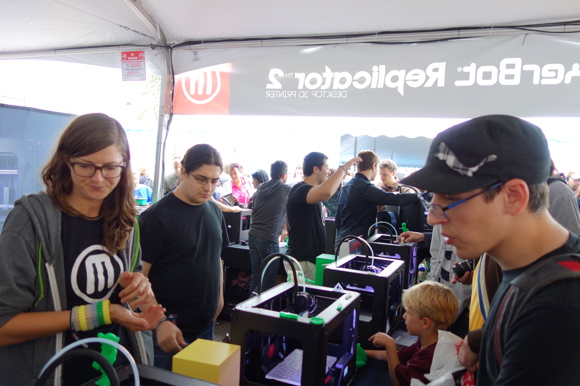
The booth for Makerbot Industries of Brooklyn was mobbed with visitors evaluating the latest version of the 3D printing machine that is on the wish list for nearly everyone.

3D printing is the hot technology right now, garnering extensive interest at the Makerbot space and at many other booths showing competing printers as well as materials, software and creative output. Bre Pettis, CEO of Makerbot and coverboy of Wired magazine’s current issue, was a star attraction at the Faire.
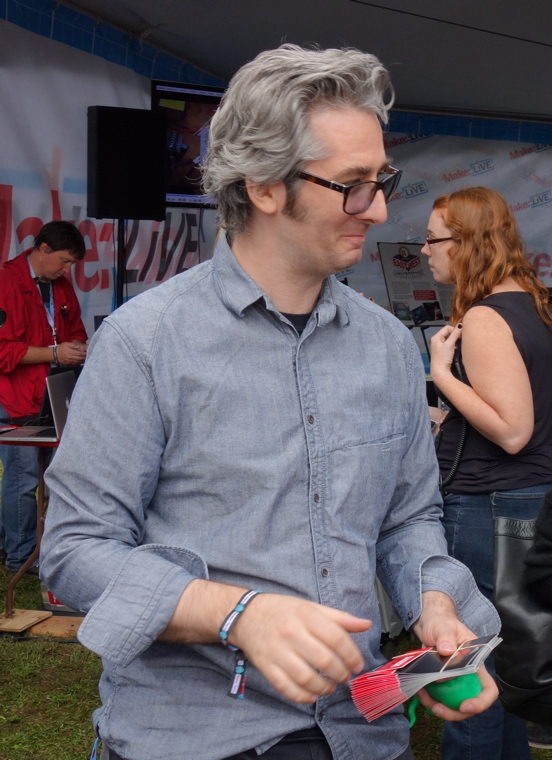
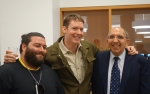
Bre Pettis, CEO of Makerbot, presented show awards.

In coming months, Brooklyn Artisan will be covering 3D printing often as these products gain wider acceptance. At the Faire, there were clear signs that 3D has moved from the hobbyist stage. A few exhibitors in the craft area showed jewelry, small plastic vases, and even an espresso cup created using clay laid down in a printer and then fired in a kiln.

3D printing may be the cutting edge, but there were plenty of maker projects applying tech to old technologies. Brooklyn design consultancy Pensawas demonstrating a computer-driven wire bender they have been developing and releasing into the public domain. I would love some personalized wire coathangers!
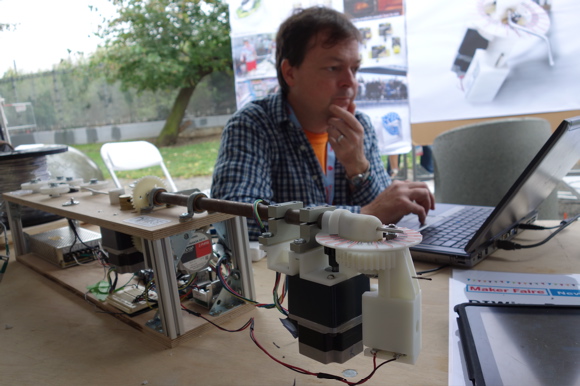
The DIWire Bender bending.

Watch for more of my coverage of interesting high-, middle- and low-tech from World Maker Faire coming soon.
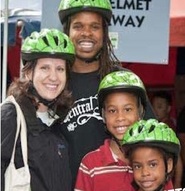
Atlantic Antic Take-away: Not Just Memories, Free Bike Helmets!

Helmets for everyone.

KUDOS TO COUNCIL MEMBER STEPHEN LEVIN and the NYC Department of Transportation for the bike helmet giveaway Sunday, putting a safety spin on the exhuberant rain-or-shine fair.

Expert fittings and how-to helmet info went with the free helmets for kids and grownups – advance prep for the ambitious bike share system. Citi Bike launch is now set for March, 2013, when 7000 of the eventual 10,000 bikes are to be deployed to 420 stations. It’s to cover parts of Manhattan, Long Island City and Brooklyn, and will run with solar-powered circuit boards and software.

Hot Time at the Brooklyn Botanic’s Chile Pepper Fiesta

Brooklyn Botanic Garden Sept 29, 2012GRAY SKIES, WHO CARES?  That was the attitude of the crowd at the Brooklyn Botanic Garden‘s 20th Chile Pepper Fiesta today.

At lunchtime the Kulu Mele African Dance and Drum ensemble played under a tent on the Cherry Esplanade; visitors sat inside or out under the cherry trees, and children hopped and danced around. It was good laid-back Saturday time for couples, friends and families.

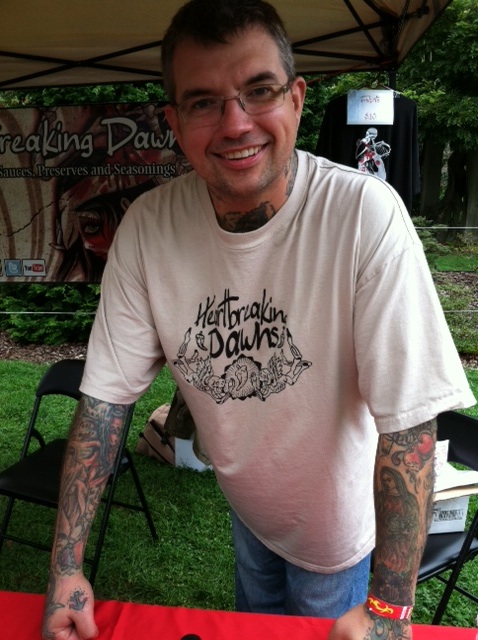
Co-chef Johnny Mclaughlin of Heartbreaking Dawns.

Strangely, “Chocolate Debauchery” had me enthralled up in the Osbourne Garden just when Hazmat Modine – billed as “dueling harmonicas, funk tuba, and eclectic blues” – was scheduled to take the stage at 2:15. On the grassy Osbourne plaza there was plenty of vendor action not only with spicy samples to taste, but picklers and sauciers to chat with and learn from. Nearly 50 tents in all.

Everyone has a story, it seems, about how or why they started their artisanal businesses. Some have been in business for decades, like Grace Foods, which boasts of “quality since 1922.” With its Jamaican roots through Grace, Kennedy, & Co., there’s plenty of history (about 9 pages on the web site, for instance), but most are much younger businesses. Sour Puss Pickles, for instance, had a born-yesterday hopefulness about it; a his-and-her company, it was founded in 2009.

Another his-and-her company provided the most intriguing story of the day, however, though one not fully told, only hinted at. I talked with Johnny Mclaughlin about his wares and his generously offered recipes, and then asked how the Hudson Valley company he developed with Nicole Ramsperger came to be called Heartbreaking Dawns. “It’s from the poem,” he said. “By Rimbaud.”

Uh, “Season from Hell” sprang to mind; was it by that Rimbaud, the dissipated symboliste poet of perpetual adolescence? My questioning got a shrug and a smile. (Once home, I looked it up; it’s from “The Drunken Boat,” a longish poem and much admired, that Rimbaud wrote when he was 16. The passage translates as, “But, truly, I have wept too much! The Dawns are heartbreaking. Every moon is atrocious and every sun bitter.” Hmm.)

All in all, the “hot” chocolate spiciness was the real discovery of the day for me. I came away from the Chile Pepper Fiesta with a tingling tongue, a messenger bag clicking and clanking with jars and bottles, a sheaf of recipes and brochures, and a bunch of new ideas about peppers.

Are We Ready for a Craft Economy?

RECENTLY BROOKLYN ARTISAN sent a New York Times article by Adam Davidson about artisanal pickle making and the rebirth of a craft economy  to an old friend writing here as the Skeptic from Boston.

SfB: You bait me… I bite.  Theoretically a craft product is made by hand and involves skill.  I don’t think making a “craft cocktail,” even if the bartender has an untrimmed beard and a stingy brim, requires so much skill that it is worth $12.00.  I recently read about a couple with wheat and gluten allergies  starting a business to package “natural” artisanal wheat-like foods without wheat. Let’s hope they didn’t quit their day jobs to do it.

The economy in Boston is okay but not great, so there are some underemployed smart young people looking for high returns in niche markets. For example, last year there were two recent college graduates at the Cambridgeport Farmers Market locations with a folding table and a set of brochures for organically grown oyster mushrooms, but no mushrooms. The mushrooms were nearing harvest somewhere on Cape Cod, they said, so they were selling impregnated do-it-yourself mushroom logs, but no mushrooms. They showed up for six weeks straight, May to June, and talked to people about their plans, conceived in their dorm room, supported by a business plan and product descriptions, but no mushrooms. Then they disappeared.  The other farmers figured they moved to Brooklyn.

BA: True, many artisanal entrepreneurs here are starting micro businesses for lifestyle reasons – some to supplement their unemployment checks or because their jobs have stagnated in large corporations or they’re selling coffee at Starbucks. They’re frustrated by this economy and trying to create their own jobs. Or they’re the stay-at-home spouse whose child is old enough now for nursery school. They need to make money, they seek some creative satisfactions, they enjoy the sport of a start-up, and they like to feel some control.

Also, they welcome a chance to express their values—very likely they believe in fair trade, organic farming, local foods, reclaimed or sustainable materials, non-polluting and natural ingredients, high quality, and putting their hearts into their work. These ideas are not empty clichés. Many artisanal entrepreneurs are hoping to create soul-satisfying livelihoods. Yoga teaches its disciples to live the change they believe in, to be the change. It’s a very similar impulse.

SfB:  Yada, yada.  I wanted mushrooms, not mushroom marketing.  It is difficult to make really good bread, cheese and pasta. They take years of training and practice. Good bakers take years to “find their own bread.”

Some old Boston-area warehouse and factory buildings have been converted to artists’ workspaces. I visit the Radcliffe and Mudflat pottery shows every year. They are doing okay. Mostly part-timers and hobbyists. It may be quite some time before we see the beginning of a new Arts and Crafts movement with significant impact on the economy.

The Boston Globe has been paying more attention to good food, but we don’t have many centralized specialty markets here. I usually have to drive to Brighton, Watertown or Somerville to check in on the craft food makers. Only the hard cases, like European educated bakers, seem to be making real money.  We have few craft butchers left in the city, but some of the farmers are offering humanely raised, good-quality meats from coolers during the summer months. It is not easy work and they have supply problems because there are not enough small slaughterhouses in Massachusetts anymore. Most of the work is done in N.Y., N.H. and Vermont. Kate from Stillman’s Turkey Farm was thinking aloud last week, about what it would take to open her own small USDA facility: proposals, architectural plans, grant writing and spread sheets. Then finding someone to build the facility, and local workers with slaughterhouse and custom butchering skills. My grandfather was a small butcher in Minnesota because being a butcher was easier than working in the mines. But it is killing work in many ways and my father moved to Detroit to work in factory as soon as he could. I think when people say the word artisanal, they conjure painting and sculpture and poetry. Unless they grew up on a small farm, they don’t know the 12-hour days, the stench or the insecurity of running a nonindustrial food operation. It will take a while to bring it back.

Real craft is taught by journeymen, raised in a craft tradition, to apprentices. If you grow up doing a craft, you are used to it and can sustain it, particularly when you don’t have alternatives. But now we are highly mobile. The families and whole towns which made great hams and sausages, specialty breads and pastries, have vanished, wandered off to easier jobs. Starting new, skilled craft operations is doubly difficult because we don’t have the traditions or the concentration of people with multiple skills that fuel and support a living craft.

BA: Many of these urban artisanal entrepreneurs are working out ways to give community support and market guarantees to the small farms and the sustainable fisheries, to preserve the traditional ways and honor the skills as well as shorten the distribution chain in order to get superior goods. These are serious people.

As for the mushroomers you described: Are they wrong to dream and explore? Perhaps after harvest, they discovered they didn’t enjoy mushrooms, or they landed big-bucks Wall Street jobs, or they moved on to some land of bigger basements with a better mushroom-growing climate. False starts are nothing to be ashamed of.

SfB: I see some hope in the people who are developing new supply chains with the remaining small fishermen and farmers (who are hardly making it). And I am desperate for their products. I want those mushrooms. But there is only a small market for premium-priced, high-quality, true-artisanal products in Boston. Yankees don’t spend money on food or clothes.

And I’m happy the gluten-allergy people are selling alternatives. Some of my friends need to find carbohydrate and dairy substitutes or they will end up like holy anorexics from the Middle Ages. But I don’t know how well that business can scale up.

What fires my skepticism most are the trendy charlatans calling their various products natural, artisanal-life affirming, authentic. Am I to believe in Domino’s artisan pizza? I am looking for skillfully made, anchored-in-a-tradition, sustainable products. I don’t want them over elucidated and over packaged. That does not give me warm feelings of authenticity. So, I worry about the good people of Brooklyn like I worried about the blissed out hippies who occupied San Francisco: This may not end well.

To show you I am not just a cranky old guy talking to an empty chair, I am not blind to Brooklyn restaurant life.  Somehow you guys have managed to attain a critical mass of cooks and epicures. If life is a table you have at least two good legs.

The Skeptic from Boston is expected to be contributing to this team blog from time to time.

Brooklyn Is Not Just a Brand, It’s a State of Mind

BROOKLYN INDUSTRIES, Brooklyn Bagels, Brooklyn this, Brooklyn that, it’s everywhere–so big a brand that it subdivides. (SmorgasburgThe Gowanus Yacht ClubProspect Park West.) New York Magazine calls Brooklyn’s artisanal foods movement “The Twee Party.” The New York Times writes more respectfully about Brooklyn’s “unique food culture.”

Blogs spring up with names using almost every conceivable spelling of the borough’s name, from the antique-sounding Breuckelen to Brewklyn to Brokelyn.

Individual neighborhoods, even those districted by real estate brokers’ marketing magic, develop enduring public images that perpetuate behaviors and styles and unify a local culture. The stroller moms and chest-pack dads of Park Slope need services and stores that create clusters that attract more young families that need the same things. Playground conversations foster a distinct ethos that endorses fair trade, local, organic, artisanal foods and opposes bottle feeding and certain chain stores.

In the same way, the creative and artisanal businesses of Brooklyn need co-working spaces, fairs to show their wares, and suppliers of their materials — whether CSA partnerships or locally grown plants for natural dyes for fabrics for crafts and fashions. Or rehearsal spaces in Williamsburg. Or film-editing facilities in Greenpoint. Sitting in the middle of all this Brooklyn buzz is pretty exciting.

There’s a baby or a business born here every minute, but it’s definitely not true that what happens in Brooklyn stays in Brooklyn. Up the Hudson Valley, Cold Spring is full of Park Slope ex-pats, and some quaint local wares are Brooklyn exports. Similarly, the seeds of green-mindedness were blown here from other places. Episodes of Portlandia might as well’ve been shot here.

From time to time, Brooklyn Artisan will cover people, events, ideas, products in such places as Portland, OR, Cold Spring, NY, Poultney, VT, Appalachia. You’ll find them slugged “Outer Brooklyn.”