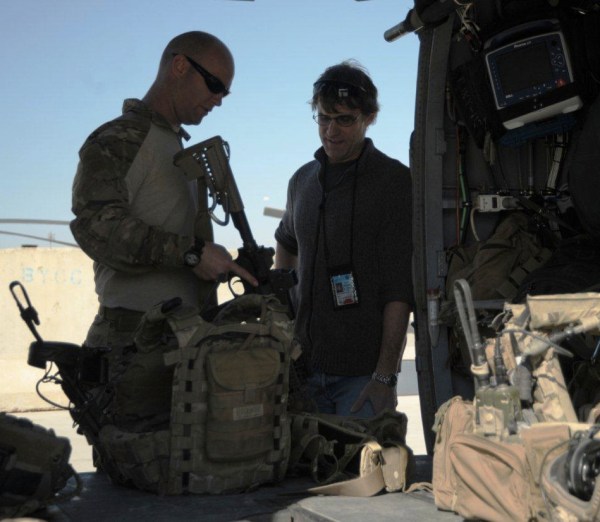
MY BUDDY JET LAG. YOU CAN’T FLY FROM AFGHANISTAN to Brooklyn without him waiting for you. We took the medevac transport from Bagram Air Base in Afghanistan to Ramstein, Germany, and from Ramstein to Andrews Air Force Base, where the wounded were carried to Walter Reed by an old white school bus painted with red crosses. Nearly everyone on board the flight had some sort of leg injury. One patient – likely Special Forces because he, like nearly all the Special Forces types I saw at Kandahar and Bagram, wore a beard – was missing his right foot. His left foot was bandaged, and I think he was missing some toes.
In Kandahar: Dreaming of Egg Creams
A Tale of Two Libraries
INSPIRED BY A NEWLY ISSUED LIBRARY CARD from the Brooklyn Public Library and by a tip from Madeleine Appell, an instructor at Kingsborough Community College, I went to visit two branch libraries to look at the architecture and design of the buildings.
As new as it gets
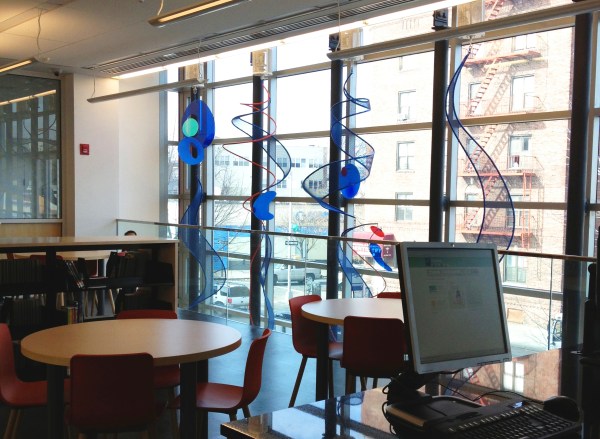
The Kensington Library branch opened on November 15 in a newly built, LEED-certified green, sustainable and fully ADA-compliant building. The new building replaces an older location that was a few blocks away in a former catering hall from the 1960s. This light-filled open space is cool as can be, yet warm and appealing, even as it stands out from the surrounding residential neighborhood of traditional-looking low-rise homes and mish-mash storefronts. I love the daylight that streams in from the glass walls and skylit atrium, along with the arty Calder-like mobiles suspended from the second floor. This would be a fun, cheery place to spend a few hours reading or surfing the web.


Sustainable features of lighting, heating and cooling systems, and thoughtfully-selected materials and finishes are invisible in such a well-designed and people-friendly space. The Kensington branch has been one of Brooklyn’s most active library locations with over 100,000 items in circulation. It’s hoped that this beautiful new space will provide an energy-efficient and healthier environment for users and staff. Unfortunately, according to the Daily News, this may be the last branch built from scratch. Due to budget realities, the Brooklyn Public Library is considering preexisting storefront locations for new branches.
Retrofit plus
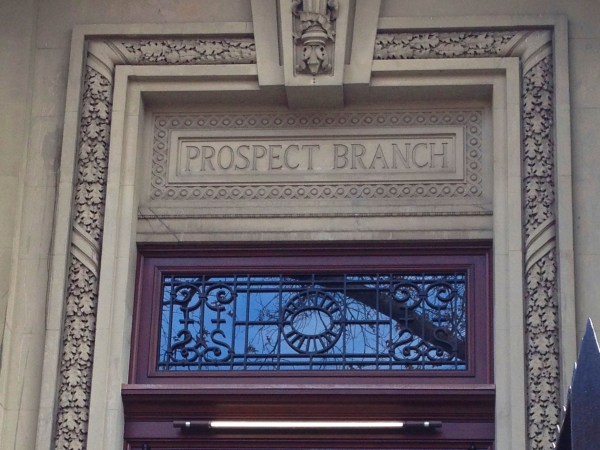
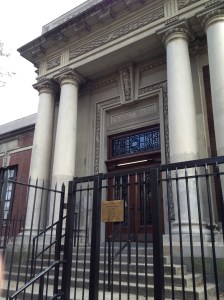
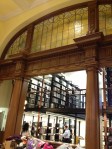
Back in Brownstone Brooklyn, the Park Slope Library, known as “Prospect Branch,” reopened in September after nearly three years of renovations. As befits the neighborhood, this building is replete with the columns, paned-glass, and details found in the landmarked homes surrounding it. Renovation has brought new lighting, technology, climate control, and accessibility to this 1906 building that was part of Andrew Carnegie’s legacy. It was all in use when I visited this afternoon—kids, parents, caretakers, and the occasional grown-up, all gently engaged with books and computers, in comfy, well-lit spaces. A row of strollers were parked neatly by the entrance.


City Councilman Brad Lander notes that libraries routinely provide internet access and computers to the 50% of New York households without high-speed internet, as duly noted by the activity I observed in both branches today.

Kensington Library. F train to 18th Avenue. Kensington/Boro Park
<< Nearby: Korn’s Bakery and Cafe K
Park Slope Library. F/G train to 7th Avenue; R train to 9th Street. Park Slope
Nearby: Colson Patisserie >>
Joy Makon curates Brooklyn Artisan’s Craft & Design coverage and creates the weekend to-do lists.
In Appreciation
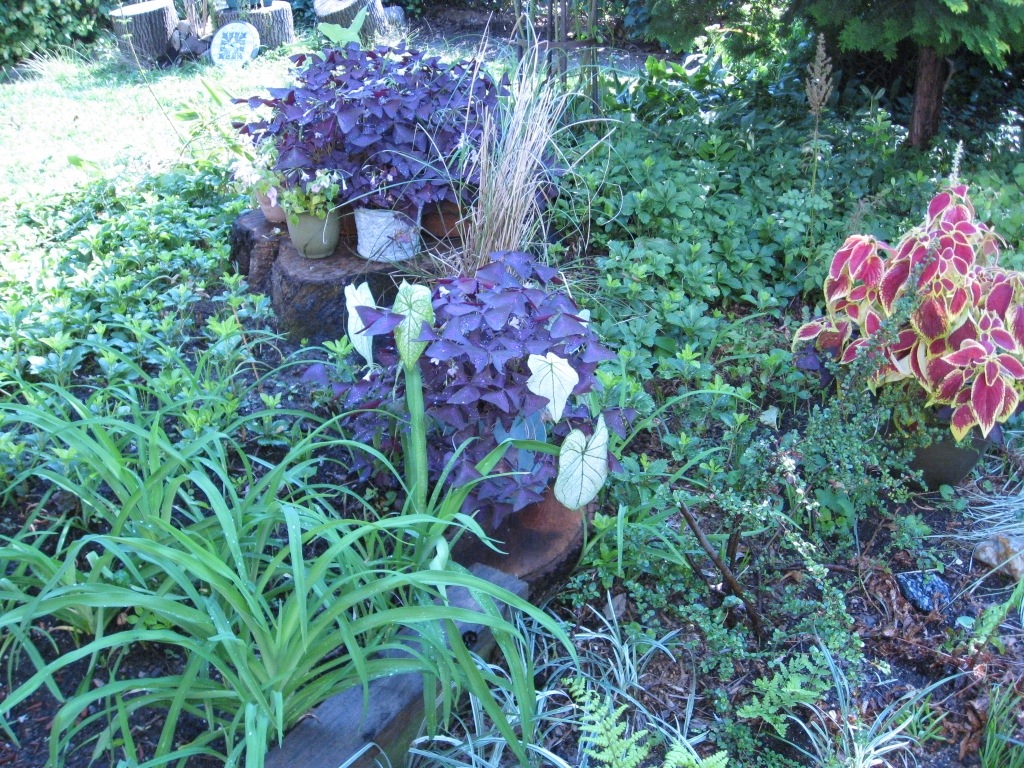
Taking advantage of this beautiful day to put some of the Brooklyn Backyard garden to sleep for the winter. Spent two hours gently digging up and separating and cleaning small oxalis bulbs. A very labor-intensive, though (for me) satisfying task that I do every fall. Repetitive, solitary, quiet with birds and rustling leaves.
And later on I intend to sit quietly and knit for an hour or two before Yom Kippur arrives this evening.
I think of those who use their hands and lovingly create amazing things for all to admire, use, taste, share.
Are We Ready for a Craft Economy?
RECENTLY BROOKLYN ARTISAN sent a New York Times article by Adam Davidson about artisanal pickle making and the rebirth of a craft economy to an old friend writing here as the Skeptic from Boston.
SfB: You bait me… I bite. Theoretically a craft product is made by hand and involves skill. I don’t think making a “craft cocktail,” even if the bartender has an untrimmed beard and a stingy brim, requires so much skill that it is worth $12.00. I recently read about a couple with wheat and gluten allergies starting a business to package “natural” artisanal wheat-like foods without wheat. Let’s hope they didn’t quit their day jobs to do it.
The economy in Boston is okay but not great, so there are some underemployed smart young people looking for high returns in niche markets. For example, last year there were two recent college graduates at the Cambridgeport Farmers Market locations with a folding table and a set of brochures for organically grown oyster mushrooms, but no mushrooms. The mushrooms were nearing harvest somewhere on Cape Cod, they said, so they were selling impregnated do-it-yourself mushroom logs, but no mushrooms. They showed up for six weeks straight, May to June, and talked to people about their plans, conceived in their dorm room, supported by a business plan and product descriptions, but no mushrooms. Then they disappeared. The other farmers figured they moved to Brooklyn.
BA: True, many artisanal entrepreneurs here are starting micro businesses for lifestyle reasons – some to supplement their unemployment checks or because their jobs have stagnated in large corporations or they’re selling coffee at Starbucks. They’re frustrated by this economy and trying to create their own jobs. Or they’re the stay-at-home spouse whose child is old enough now for nursery school. They need to make money, they seek some creative satisfactions, they enjoy the sport of a start-up, and they like to feel some control.
Also, they welcome a chance to express their values—very likely they believe in fair trade, organic farming, local foods, reclaimed or sustainable materials, non-polluting and natural ingredients, high quality, and putting their hearts into their work. These ideas are not empty clichés. Many artisanal entrepreneurs are hoping to create soul-satisfying livelihoods. Yoga teaches its disciples to live the change they believe in, to be the change. It’s a very similar impulse.
SfB: Yada, yada. I wanted mushrooms, not mushroom marketing. It is difficult to make really good bread, cheese and pasta. They take years of training and practice. Good bakers take years to “find their own bread.”
Some old Boston-area warehouse and factory buildings have been converted to artists’ workspaces. I visit the Radcliffe and Mudflat pottery shows every year. They are doing okay. Mostly part-timers and hobbyists. It may be quite some time before we see the beginning of a new Arts and Crafts movement with significant impact on the economy.
The Boston Globe has been paying more attention to good food, but we don’t have many centralized specialty markets here. I usually have to drive to Brighton, Watertown or Somerville to check in on the craft food makers. Only the hard cases, like European educated bakers, seem to be making real money. We have few craft butchers left in the city, but some of the farmers are offering humanely raised, good-quality meats from coolers during the summer months. It is not easy work and they have supply problems because there are not enough small slaughterhouses in Massachusetts anymore. Most of the work is done in N.Y., N.H. and Vermont. Kate from Stillman’s Turkey Farm was thinking aloud last week, about what it would take to open her own small USDA facility: proposals, architectural plans, grant writing and spread sheets. Then finding someone to build the facility, and local workers with slaughterhouse and custom butchering skills. My grandfather was a small butcher in Minnesota because being a butcher was easier than working in the mines. But it is killing work in many ways and my father moved to Detroit to work in factory as soon as he could. I think when people say the word artisanal, they conjure painting and sculpture and poetry. Unless they grew up on a small farm, they don’t know the 12-hour days, the stench or the insecurity of running a nonindustrial food operation. It will take a while to bring it back.
Real craft is taught by journeymen, raised in a craft tradition, to apprentices. If you grow up doing a craft, you are used to it and can sustain it, particularly when you don’t have alternatives. But now we are highly mobile. The families and whole towns which made great hams and sausages, specialty breads and pastries, have vanished, wandered off to easier jobs. Starting new, skilled craft operations is doubly difficult because we don’t have the traditions or the concentration of people with multiple skills that fuel and support a living craft.
BA: Many of these urban artisanal entrepreneurs are working out ways to give community support and market guarantees to the small farms and the sustainable fisheries, to preserve the traditional ways and honor the skills as well as shorten the distribution chain in order to get superior goods. These are serious people.
As for the mushroomers you described: Are they wrong to dream and explore? Perhaps after harvest, they discovered they didn’t enjoy mushrooms, or they landed big-bucks Wall Street jobs, or they moved on to some land of bigger basements with a better mushroom-growing climate. False starts are nothing to be ashamed of.
SfB: I see some hope in the people who are developing new supply chains with the remaining small fishermen and farmers (who are hardly making it). And I am desperate for their products. I want those mushrooms. But there is only a small market for premium-priced, high-quality, true-artisanal products in Boston. Yankees don’t spend money on food or clothes.
And I’m happy the gluten-allergy people are selling alternatives. Some of my friends need to find carbohydrate and dairy substitutes or they will end up like holy anorexics from the Middle Ages. But I don’t know how well that business can scale up.
What fires my skepticism most are the trendy charlatans calling their various products natural, artisanal-life affirming, authentic. Am I to believe in Domino’s artisan pizza? I am looking for skillfully made, anchored-in-a-tradition, sustainable products. I don’t want them over elucidated and over packaged. That does not give me warm feelings of authenticity. So, I worry about the good people of Brooklyn like I worried about the blissed out hippies who occupied San Francisco: This may not end well.
To show you I am not just a cranky old guy talking to an empty chair, I am not blind to Brooklyn restaurant life. Somehow you guys have managed to attain a critical mass of cooks and epicures. If life is a table you have at least two good legs.
The Skeptic from Boston is expected to be contributing to this team blog from time to time.
An Artisanal Author Confronts His Pencils
by John J. Kochevar
I WROTE MY DISSERTATION with a wooden pencil. Or, rather, many wooden pencils. We rented a summer cottage in Effort, Pennsylvania where, every morning, I carefully sharpened every pencil in my collection before sitting down to write. I think I read somewhere it was Ernest Hemingway’s custom each morning to sharpen all his pencils before writing his 500 words. Or maybe it was just a warm-up exercise.
The smell of cedar shavings still reminds me of Effort and writing in the morning those high summer days. My father used a knife to sharpen his pencils, even his drawing pencils, but I did not have the patience. I had a tiny plastic box sharpener. Twisting the pencil created shavings like scabs and lopsided leads. When I left my research job on East 28th street I stole a box of pencils, a ream of yellow foolscap pads, and a mechanical pencil sharpener. My desk was a piece of plywood laid on two saw horses. After a month or so I screwed the mechanical pencil sharpener to the corner of the desk. I pitched the hand sharpener and progress was more rapid. Pencils in a row, equally sharp, no more excuses….

Elegant Dunhill lighter
While I wrote, I painstakingly erased my errors, much as I correct my mistakes while I type now. Eraser crumbs piled up at my wrist and elbow. Pencils were ground down to eraserless stubs. I had the occasional satisfaction of emptying a sharpener full of cedar shavings and graphite. A soft eraser does not give as much pleasure as a sharp #2. I thought sometimes about how much better writing would be if the pencils were precisely sharp. It would be like smoking a Sherman lit by a Dunhill. It would be like having a specialist roll your joints, always tight and the same size.
So when I read the review of David Rees’s pencil sharpening book, I was drawn to the fancy. Does he use fine sandpaper for the finish? What happens if you do two? How do you ensure they are both the same size? I think about David Rees and his custom sharpened pencils. Do I want a really fine sharp pencil? Could it be used to write one, really fine haiku? Or, would I find myself like Calvino’s Mr. Palomar in front of the cheese counter, unable to make up my mind about goat cheeses?
There is a fine line between love of craft and obsession.
John J. Kochevar, PhD, is a guest contributor to Brooklyn Artisan.
Brooklyn Is Not Just a Brand, It’s a State of Mind
BROOKLYN INDUSTRIES, Brooklyn Bagels, Brooklyn this, Brooklyn that, it’s everywhere–so big a brand that it subdivides. (Smorgasburg, The Gowanus Yacht Club, Prospect Park West.) New York Magazine calls Brooklyn’s artisanal foods movement “The Twee Party.” The New York Times writes more respectfully about Brooklyn’s “unique food culture.”
Blogs spring up with names using almost every conceivable spelling of the borough’s name, from the antique-sounding Breuckelen to Brewklyn to Brokelyn.
Individual neighborhoods, even those districted by real estate brokers’ marketing magic, develop enduring public images that perpetuate behaviors and styles and unify a local culture. The stroller moms and chest-pack dads of Park Slope need services and stores that create clusters that attract more young families that need the same things. Playground conversations foster a distinct ethos that endorses fair trade, local, organic, artisanal foods and opposes bottle feeding and certain chain stores.
In the same way, the creative and artisanal businesses of Brooklyn need co-working spaces, fairs to show their wares, and suppliers of their materials — whether CSA partnerships or locally grown plants for natural dyes for fabrics for crafts and fashions. Or rehearsal spaces in Williamsburg. Or film-editing facilities in Greenpoint. Sitting in the middle of all this Brooklyn buzz is pretty exciting.
There’s a baby or a business born here every minute, but it’s definitely not true that what happens in Brooklyn stays in Brooklyn. Up the Hudson Valley, Cold Spring is full of Park Slope ex-pats, and some quaint local wares are Brooklyn exports. Similarly, the seeds of green-mindedness were blown here from other places. Episodes of Portlandia might as well’ve been shot here.
From time to time, Brooklyn Artisan will cover people, events, ideas, products in such places as Portland, OR, Cold Spring, NY, Poultney, VT, Appalachia. You’ll find them slugged “Outer Brooklyn.”
How Brooklyn Artisan Got Its Name
I KNOW WHAT A STRUGGLE it can be to name your business. When we named the parent company of Brooklyn Artisan, our first project – producing A Computer Dictionary for Kids and Other Beginners for Ballantine Books – was already well underway. Many clever, engaging, adorable, double-takeable, quotable and otherwise wonderful company names occurred to us. But when we searched trademarks, of course the best were taken. Hmm, what to do. Finally we called the company after that number-one project by using the first letters in the computer keyboard: Qwerty Communications, Inc. Although a little cute, it was a natural name for a creator of books and magazines and, very soon, online content creation, too.
We quickly learned that the titles fastest out of the gate didn’t have to be explained, they explained themselves. The Brides Guide, New York Lawyer, the Art of Simple Living, Target Family Health — examples from our magazine and web work for such notables as Scientific American, Parents, aarp.org, Consumer Reports, New York Law Journal, space.com, Storey Books, Scholastic, Opryland, Ms. and Family Circle. A literal, even prosaic, name gains strength from being clear what it’s about. Sturdiest of all is for the title to be the name of the market.
As a blog name Brooklyn Artisan passed on both scores. It is both for and about the creators of small and micro businesses. We tell their stories and showcase their products in news and features. On the business side, we tackle the thorny problems common to artisanal businesses, practicing our favorite brand of service journalism for the community here and artisanal cousins elsewhere.
There are exceptions to the Literal Name Rule, of course. The author of that original Qwerty computer dictionary, Brooklyn Artisan contributor David Fay Smith, is also a woodworker. He makes dovetailed Shaker-style stepstools with personalized labels as wedding gifts for special friends. Many urge him to go into business selling the handsome and useful stools. If he does – as Joy Makon, who edits the Crafts & Design segment of Brooklyn Artisan, points out with a smile – he’ll need a creative rather than a literal name for his business, since he really shouldn’t call it…David’s Stools.
– Anne Mollegen Smith, Editor & Publisher
What’s Better Than “Perfect”?
IF GROWING THIS BLOG were modeled on “Jack and the Beanstalk,” we are at the point of the story where I have traded the family cow for three little beans. I have confidence in the growth potential of those three little beans, but the current stage feels a bit awkward.
Rather than hold out for polished perfection, though, we’re committed to publish and learn as we go.
I once earned 15 seconds of fame (appearing on a tote bag, in a quote-a-day calendar, at least one graduation speech, and a flurry of online quotes lists) when my advice to procrastinators went viral. ‘Done’ is better than ‘perfect.’
I hope I don’t have to eat those words.
–Anne Mollegen Smith, Founding Editor
UPDATE: Ever-alert Brooklyn Artisan contributor Bruce A. Campbell sent me a link to a new piece from Fast Company called: The Truth About Being “Done” Versus Being “Perfect” What do they mean, the truth? Is this the beginning of the hottest controversy in an inkpot since Reinhold Niebuhr’s authorship of “The Serenity Prayer” was challenged?
Here is the backstory: how I came to proclaim this long ago (decades before Facebook existed), and how I came to be known for it. The latter may be useful to you.
First: Often what makes an aphorism work is not the newness of the idea, but the particular formulation of it. “What is so rare as a day in June? Then, if ever, come perfect days.” Those are the opening lines of a James Russell Lowell poem that’s probably better known than he is. Compare that to the same content put this way: “June has unusually nice weather, don’t you think? Pretty much as good as it gets.”
Next: I first said this in an editorial context. I was managing editor of Redbook magazine (1978-81). As m.e. I managed copy flow, which always bunched at the last production minute and swamped the copy department. At the time, the award-winning magazine had the best-educated mass women’s magazine audience ever. Typos and dumb-o’s were frowned upon. Stress on the copyeditors was immense; probably their health and certainly their dispositions suffered from it. I had to get the high-achieving editors to Let Go of Their Stuff on schedule. I wrote a memo making a little joke: Nothing’s better than perfect, of course – except at a certain point in producing an issue when “done” is better than “perfect.” In short form, I used it often.
Most important: If you’re going to say something sorta’ smart and get quoted for it, it helps to say it in front of wordsmiths and scribes. The Redbook staff soon had “done is better than perfect” coming out of their ears, of course, and so did writers I worked with later at other publications.
I said it to Jane O’Reilly (author of The Girl I Left Behind and co-founder of the Getting It Gazette in 1992) when trying to extract a piece from her. At times plagued by writer’s block, she found it helpful. When speaking to the Women’s Media Group, she cited this. Editor/writer Betsy Wade of the New York Times, a former copy editor, was struck by it. She was on the board of JAWS (Journalism and Women Symposium). JAWS produced a tote bag for their annual conference. Soon, I found myself in the best company imaginable: side-by-side on a tote bag with, oh, Frederick Douglas, and Emma Goldman, and…and….
I said it some more – a lot more, actually – during the early days of HER NEW YORK, a daily-turned-weekly tabloid for women started by the later-jailed Steven Hoffenberg. I was hired as consultant/executive editor for six weeks to get it launched. Whether it was a good idea or not, it was – let’s say, financially under-powered. But we got the thing in print and onto newsstands on the designated day! A writer on that staff, Tonice Sgrignoli, put together a women’s quote-a-day calendar a few years later, and OMG, there I was, Ms. February 9th!.
And when the World Wide Web was young, there I was, among my betters again on lots of different quotes lists. My favorite quote spot is where I come just after Thomas Edison and William Shakespeare in the “Mantras of Famous People” list. Edison says, “Opportunity is missed by most people because it is dressed in overalls and looks like work.” And Will? “To thine own self be true.” Now, that I wish I had said. ––AMS


You must be logged in to post a comment.