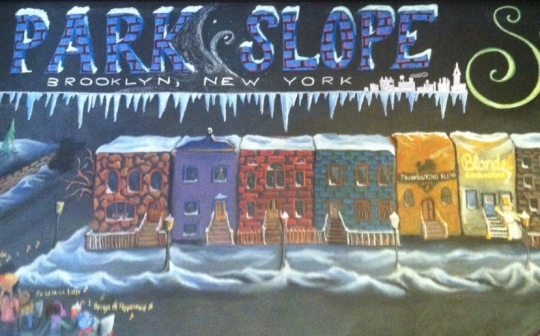
DOUBLETAKE: Before coffee, waiting in line, staring at the chalkboard in the
Slope Starbucks, it took me a full minute to see that among the brownstones were
two house-brand coffee bricks. (Photograph by Brooklyn Artisan Photo Pool)
A team blog created for and about artisanal small businesses
DOUBLETAKE: Before coffee, waiting in line, staring at the chalkboard in the
Slope Starbucks, it took me a full minute to see that among the brownstones were
two house-brand coffee bricks. (Photograph by Brooklyn Artisan Photo Pool)
To welcome 2013, some dazzle’s the thing, so we added this bit of skeuomorphic bling.
‘Twas the week before Christmas, and all over the place,
Brooklyn artisans were producing at a furious pace.
The labels were ready, as nice as you please,
Santa’s sack stood open, for packing with ease.
Distribution was simple, down the chimney’s a breeze!
We thank the farm markets, the Smorg’ and the Fleas
For bringing us tasters of pickles and cheese,
And honor all sippers of egg creams and brews
Not to mention our local distillers’ own booze.
We salute thee, St. Fedex and brave UPS,
Whose overnight services make us feel blessed,
And Avery Labels so our products look dressed!
With letter-press greetings and paperless mail,
Arduinos, 3D printers and the newest craft cocktail,
The New Year’s exciting, but first – time to rest!
Latest word: Brooklyn-artisan.net will be back in action January 3.
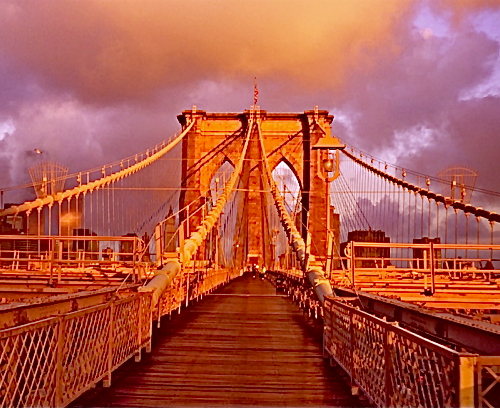
More bridge views, see Who’s Who
 IN 1883, THE FIRST PERSON OFFICIALLY TO CROSS the completed East River Bridge connecting the cities of Brooklyn and New York was Emily Warren Roebling. She crossed in a carriage, carrying a live rooster – a symbol of victory – and really, she had plenty to crow about. More than any other person, she had made this bridge happen. The seemingly ill-fated bridge construction had first taken the life of her father-in-law, John, who’d designed and “sold” it to investors and to the two cities, and then it robbed the health of her husband, John’s son Washington, who had become Chief Engineer.
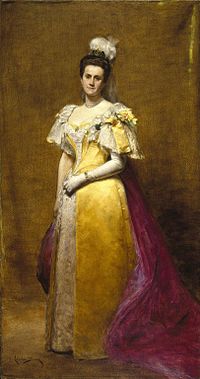
Emily Roebling’s portrait, Brooklyn Museum
An intelligent and educated woman, Emily had been at his elbow while he studied and then extended his father’s plans and ideas. But soon her husband’s impairment – caused by decompression sickness while installing caissons at the site – left her to oversee the bridge building day to day, and then year after year. Washington followed the construction of the bridge by spy glass from his infirmary perch in Brooklyn Heights, it was believed, and relayed his instructions from there; in reality, however, for about a dozen years, he was seeing no one face-to-face but his nurses and his wife.
Emily Roebling proved able in the supervisory role for the next 14 years, even facing down challengers from the worlds of politics, engineering and investment, to keep the project in her and her husband’s hands. Did she go on to accomplish more civil engineering wonders in her own name? No. But in 1899, at age 56, she got a law degree from New York University. She died in 1903 of stomach cancer.
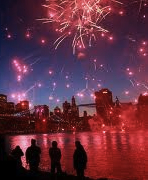
125th anniversary fireworks in 2008
Washington Roebling’s medical treatment may have used the addictive drugs of the day. On the day the bridge opened, Roebling did not attend the opening ceremony and at the family’s reception, he was able to stand for only a few minutes and reportedly he showed no emotion; that was left to his wife. But Roebling’s health improved some time after the bridge was completed, at least enough so that he remarried after Emily’s death, and even took the reins of John A. Roebling’s Sons, the family engineering company, at age 80. He had outlived his younger brothers and their sons. In spite of continuing pain from decompression sickness, he ran the company successfully until his own death in 1926 at age 89. In 1915, the East River Bridge was officially renamed the Brooklyn Bridge.
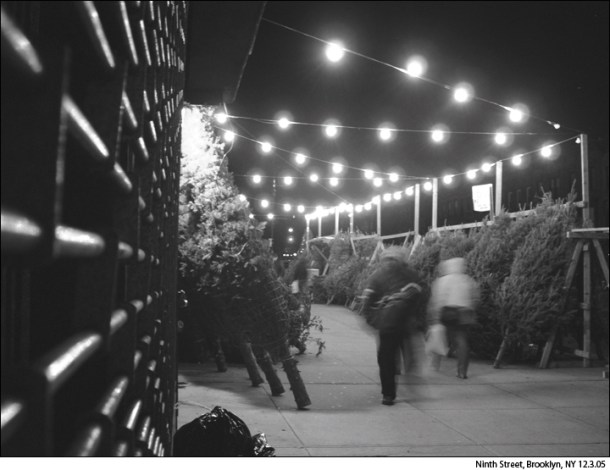
Photograph by Joseph Caserto. See Who’s Who.
 IT HAPPENS SO SUDDENLY. ONE DAY YOU TURN A FAMILIAR CORNER and – voilà! there you are in the midst of an evergreen forest! The pine scent is intense, the prickly branches reach out to you, it’s heady and exciting: Christmastime, Christmastime! Soon you realize your brain is being bathed in or battered by holiday music. O Tannenbaum jostles Rudolph the Red….Leonard Cohen’s Hallelujah (preferably sung by k. d. lang) co-exists with Handel’s Messiah (preferably one you can sing along with in a church). You’ve shopped and staggered home to wrap. The tree lights are on. Who’s got the tape? Grandmother makes her annual joke: No packing in the peekages! Stockings are hung by the fire or maybe just draped over the back of the couch. When emotion overtakes you, it often comes by stealth – at the midnight service when a pure young voice sings the first notes of O Holy Night, or after the stockings have been emptied and the wrappings are in tatters and the family holds hands to give thanks over the turkey dinner. Or maybe it’s private, when you step outside to remember childhood celebrations and the people who loved you who now are gone and you silently thank them for the year you got the bike of your dreams and forgive them for the Christmas of the Scratchy Socks and Really Stupid Sweater. Take a deep breath, smell the pine wreath, give in to it all – and laugh a little as Grandma Got Run Over by a Reindeer from a car passing in the slushy street chimes in with your iPod, “Good King Wenceslas looked out/On the feast of Stephen/When the snow lay round about/Deep and crisp and even….” Here’s to 2012 and another fine Christmas.

From the Brooklyn Roasting Phog. See Who’s Who
 IT’S FUN TO MONITOR THE REAL-ESTATE MONIKERS for neighborhoods – especially the Edsels among them, like the failed attempt to brand WesChe. It conjured up English dog breeds or stinky cheese rather than the intended Chelsea-beyond-Tenth-Avenue. Some say it all started in the late ’60s with WestBeth, the early West-of-Bethune Street loft conversion for artists’ residential use. But it came to sound like a Laugh-In rerun, as if Dan Rowan has crossed the East River into Outer Brooklyn and is trying to orient himself with a broker’s map. Rowan: Wait, Soho, isn’t that in England? Dick Martin: No, it’s SOuth of HOuston. Rowan: Houston, isn’t that in Texas? Martin: No, say HOWston, don’t say HEWston. R: Well, then, for NoHo, shouldn’t that be NoHow? M: No way. R: Tribeca, was that a Native tribe like our Canarsie and Gowanus? M: No, TriBeCA is the Triangle Below Canal. And besides, Gowanus wasn’t a tribe, it was the name of the sachem of the Canarsees, the local group of the Lenape. (Long pause.) R: You Manhattanites make up stuff just to confuse people. In Brooklyn, our neighborhood names have history and dignity: Brooklyn Heights, Cobble Hill, Vinegar Hill, Park Slope, Prospect Heights, Crown Heights. M: With all those hills and heights, you Brooklyns must (rolling eyes) really like being high. Maybe that explains why you have a neighborhood called – heh heh –Dumbo. R: That’s an acronym for Down Under the Manhattan Bridge Overpass, a historic district that recognizes Brooklyn’s hard-working industrial past. Martin, holding hands beside his head and flapping them like wings, annoyingly: Nothing to do with Walt Disney’s 1941 movie? Rowan stares, shakes head and exits stage left to the R train, proud to be a bridge-and-tunnel person.
 BROOKLYN OBSERVES KAWANZAA IN MANY WAYS, both public and private. Since interest in the new celebration peaked in the 1990s, it remains a part of Brooklyn’s holiday season. Starting Dec. 26, many Brooklyn families set out a special table at home and light the kinsara candles to commemorate the seven principles of Kwanzaa.
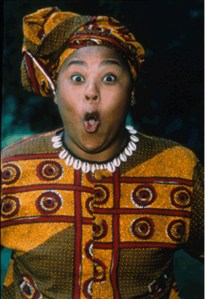
Professional storyteller Queen Nur
On Monday, Dec.17, at Long Island University’s Kumble Theater, in morning and afternoon programs master storyteller Queen Nur will take her audiences on a journey through the seven principles of Kwanzaa in story, song, call and response, dance and drumming. Queen Nur (that is her professional name: privately, she is Karen Abdul-Malik) has practiced her storytelling arts at the Kennedy Center in Washington, D.C., in the New York City parks programs, and many places around the country, including the Walt Whitman Cultural Arts Center in Camden, NJ. She received her B.S.from Northeastern University and has taken post-graduate courses in African-American Studies and Folklore at Temple University and the University of Pennsylvania. She now teaches Storytelling at Rutgers Camden’s Artist/Teacher Institute.
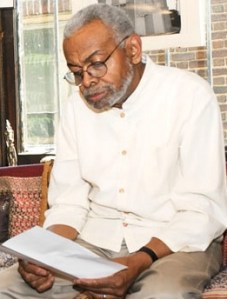
The Black Candle Kwanzaa documentary
Kwanzaa, a secular celebration of African heritage intended to codify and strengthen values for the American black community, was established in 1966 by Maulana Karenga, a black nationalist activist-turned-scholar who earned a Ph.D. from the University of California/Los Angeles, with a dissertation titled Maat, the Moral Ideal in Ancient Egypt: A Study in Classical African Ethics. Dr. Karenga now chairs the Africana Studies Department at California State University, in Long Beach.
Karenga figures in The Black Candle, a documentary about the origins of Kwanzaa narrated by Maya Angelou that was premiered last month on the Starz channel (on-demand TV) and will be shown again on Dec. 26 and 30.
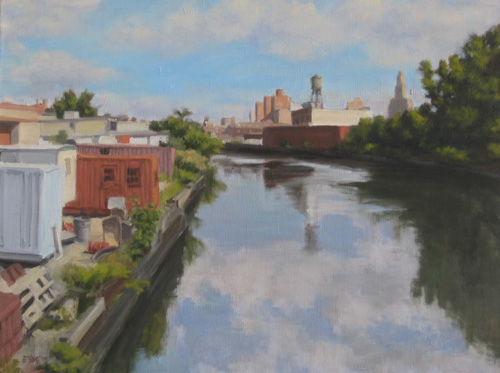
Painting by Ella Yang. See Who’s Who
 TWO KEY WORDS ASSOCIATED WITH THE GOWANUS CREEK CANAL are “toxic” and “sky.” Extra emphasis on the first came with reports of the woman’s body pulled out of the canal on Tuesday and immediately whisked off to Methodist Hospital, no more said about her condition. News accounts recapped the well-deserved EPA Superfund rating of one of the nation’s most extensively contaminated water bodies. True, all true, enough to make you gag . But the – literally – upside of our canal is the amount of open sky over both the waterway and the low-rise, mostly industrial buildings that line it. That is just how the light over the old downtown (in what we call Outer Brooklyn) Gansevoort Meatpacking District used to be, before high-rise development began to – again, literally – cast its shadows over what had become a “hot” area. The eternal urban tradeoff. While the debate over canal clean-up continues, it’s good to take some time before change comes to Gowanus to admire the big sky and its reflections. The landmarked Carroll Street bridge is a possible vantage. Help in seeing what you’re looking at comes from Ella Yang, whose painting is surely one of the most appealing representations of a Gowanus water scene since Henry Gritten‘s in 1851.
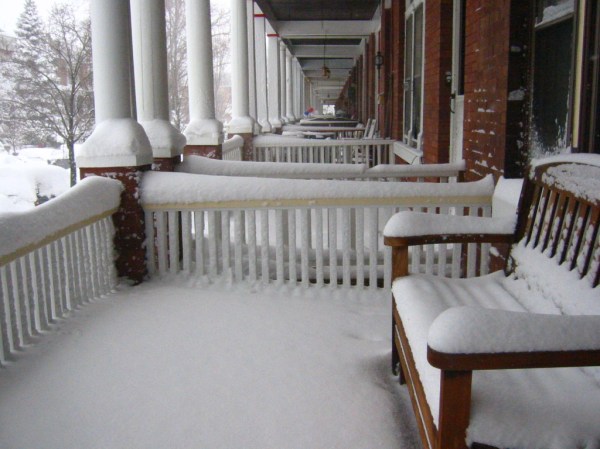
Photograph by Joy Makon. See Who’s Who.
 BROWNSTONE BROOKLYN, PEOPLE SAY – never mind that some of the rowhouses are brick or limestone, or interrupted by modern condos of concrete, glass and steel and the occasional larger pre-war apartment buildings. In mind’s eye, the long blocks between avenues have a rhythm or regularity that overcomes the variations. One can call the roll of neighborhoods: Albemarle Place, Bedford-Stuyvesant, Brooklyn Heights, Carroll Gardens, Cobble Hill, Clinton Hill, Crown Heights…all the way up the alphabet past Prospect Park South and Sunset Park to Windsor Terrace, where among the low-rise blocks are two jewels: Howard Place and, seen here, Fuller Place. Thanks to careful stewardship by the Fuller Place homeowners, the line of contiguous front porches is as pristine as this new-fallen snow.
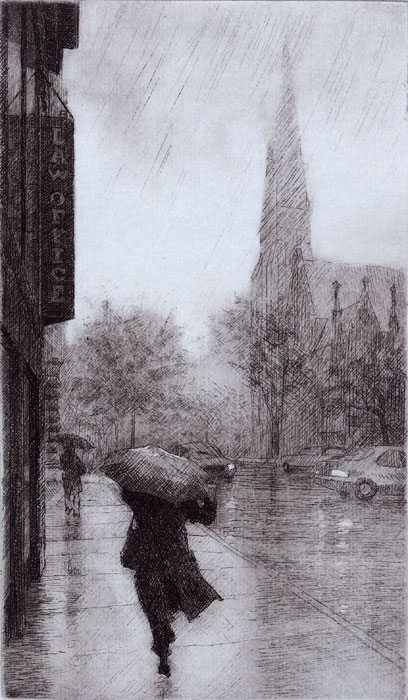
Etching by Eric March. Edition of 25, at the Park Slope Gallery.
 OF COURSE THE STEEPLE IS FAMILIAR. If you’ve ever commuted out of Brooklyn and back to the Seventh Avenue stop on the B/Q line, then you know this view looking south on the avenue. But it takes the artist’s eye and the etcher’s touch of Eric March to show the delicate beauty of a moment when you or I would likely be preoccupied by wet shoes. Even if this particular spire is not on your route home, then almost surely you have one of your own, or two, for Brooklyn lives its nickname as “the city of churches.” How horrifying when the tornado of 2010 attacked not just our trees but our steeples, shaking their bricks and stones, rattling their slate roofs, shackling them to scaffolds for months and months. A few were even removed rather than rebuilt – like yanking a tooth – and still others were humiliatingly reduced. Of course we personalize these losses: Thrilling as the new towers of downtown Brooklyn may be, we know in our souls they are impersonal, godless, compared to our neighborhood steeples. (See Who’s Who.)

IN THE SINGULAR ECOSYSTEM that is Kickstarter, one will encounter many evolutionary dead ends—projects, visions and dreams that wither away unfunded. Then there are the mysterious campaigns that don’t just meet their targets, they blow by them and reach double, triple or stratospherically higher funding results. Why and how do these hyperachievers succeed, and can we learn any […]

WHAT COLOR WAS BOGEY’S FEDORA? Tough question. Brown? Gray? I’ve always envisioned Humphrey Bogart wearing a brown fedora in any of his fedora-wearing good-guy movies like Casablanca. The movie was released in black-and-white, but in the scandalously colorized version from the ‘80s his suit is muddy brown, Ingrid Bergman’s silky dress is muddy yellow, and […]
“Ready, Aim, Fire” or “Done is Better Than Perfect”? WHY DONE IS BETTER THAN PERFECT, says the Etsy Blog title for the June 20, 2013 entry by Alexandra Ferguson. And then the art shows a cute cushion with the message, Ready, Fire, Aim. As the originator of “‘Done’ is better than ‘perfect’” (explained in an addendum […]

BUSINESS OWNERS SHANE WELCH, FOUNDER OF SIXPOINT BREWERY in Red Hook, Matthew Tilden, founder of SCRATCHbread in Bed-Stuy and Charlie Sahadi, proprietor of Sahadi Importing Co. in Brooklyn Heights, showed their business scars and shared some hard-earned wisdom at a recent Brooklyn Public Library conversation, “Fantastic Food,” led by photographer Randy Duchaine, whose “Created in […]
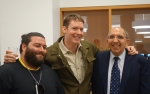
Created in Brooklyn: Food and Drink Entrepreneurs Talk Shop ANY BUDDING ARTISANS IN THE AUDIENCE at a recent Brooklyn Public Library panel, “Fantastic Food,” would come away both sobered and heartened. Three business owners—Shane Welch, founder of Sixpoint Brewery, Matthew Tilden, founder of SCRATCHbread and Charlie Sahadi, proprietor of Sahadi Importing Co.—all shared disaster stories and […]

OUR BROOKLYN MUSEUM’S SHOW OF NEARLY 100 WATERCOLORS BY JOHN SINGER SARGENT, created jointly with Boston’s Museum of Fine Arts — pooling art from both collections and wisdom from both museums’ curators and conservators — is every bit as good as you’ve probably read and heard by now. Good coverage is on the museum site and […]

SOME YEARS I JUST CAN’T BE THE VALENTINE GIVER I’D LIKE TO BE. Flu, deadlines, house guests, or no excuses, it just happens. So this year, on the way home from the Q train, I’m skidding into Natural Land on Flatbush Avenue to pick up some chocolate I’ve been eyeing from time to time. The flavors sound […]

BROOKLYNITE TODD JONES CALLS HIMSELF A “DONUTOLOGIST.” You know, just as archaeologist Heinrich Schliemann studied archaeology, namely the archaeology of ancient Troy, donutologist Jones studies donuts, namely sweet, sticky, delicious mini donuts, each a deep-fried doughy circle. Not Dunkin’ Donut donuts, or Starbucks donuts, but hot, fresh mini donuts. “Glaze will come out of my […]

ON THURSDAY NIGHT AT THE COMMUNITY BOOKSTORE ON SEVENTH AVENUE, Heather O’Donnell set out to shine a little light on the subject of rare and collectible books for more than a dozen of her Park Slope neighbors. “Rare books are my passion,” she said, and hastened to reassure her listeners sitting with books on their […]
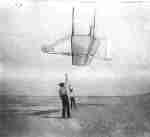
Yesterday was Kitty Hawk Day, which provoked this reminiscence. THE WRIGHT BROTHERS NEVER TRUDGED UP THIS DUNE BAREFOOT. That’s what I’m thinking last spring as I try to negotiate the wings of a 1902 Wright glider up a sandy winding trail carved out of Jockey’s Ridge with Kitty Hawk Kites’ clean-cut manager Bruce Weber and assistant recreation manager […]

Day Eleven • 12 Tastes of Brooklyn I WAS INVITED TO MY FIRST COOKIE-EXCHANGE holiday party this year, but alas, now it’s been cancelled and all motivation to cover myself in flour and sugar has gone out the window. Luckily, Brooklyn is rich in cookies—beautiful ones made by hand with the finest ingredients by the most […]

Day Nine • 12 Sips of Brooklyn TAXONOMY, CLADISTICS, SYSTEMATICS, PHYLOGENETICS—so many ways to group and divide living things. Darwin famously sundered the world into “lumpers and splitters”: those who are happy with the general gist, and those who are obsessed with specifics. The tea trade is one where splitters can run riot: green or […]

For Swedish espresso aficionados, or the merely curious, Konditori in Prospect Heights is on Washington Avenue between St. Marks and Prospect, where it projects a friendly attitude. “Keep calm and stay Swedish” is the message of the day. Cardomom Brod is a featured menu item. Or you could choose the hairy calorie bomb, aka the […]
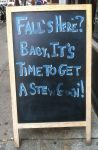
OF COURSE THE WEATHER TURNED FREAKISHLY WARM a few days after this sign was put out by Fleishers, the artisanal butcher on Fifth Avenue in Park Slope that specializes in grass fed, organic meats. But a timely menu suggestion has been made. Dust off the trusty stew pot or set out to acquire one, for […]

READ PHIL SCOTT'S LIVELY ACCOUNT TO FIND OUT




 Brooklyn Artisan
You must be logged in to post a comment.