Here’s to Orville and Wilbur: The Makers and Flyers

Yesterday was Kitty Hawk Day, which provoked this reminiscence.

THE WRIGHT BROTHERS NEVER TRUDGED UP THIS DUNE BAREFOOT. That’s what I’m thinking last spring as I try to negotiate the wings of a 1902 Wright glider up a sandy winding trail carved out of Jockey’s Ridge with Kitty Hawk Kites’ clean-cut manager Bruce Weber and assistant recreation manager Andy Torrington. This exact replica was hand-built in 2002 by renown Wrightist Ken Hyde and The Discovery of Flight Foundation–sort of an artisanal business for the aviation set. This glider’s heavy—about 150 pounds—and bulky—302 square foot of flexible, yellowing canvas wing built just like the original—the same ash and spruce and weatherbeaten,  cross-stitched canvas.
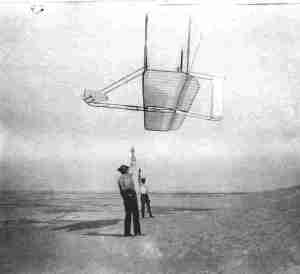
Speaking of kites: Wright Brothers 1902 glider

Speaking of kites: Wright Brothers 1902 glider

The Wright brothers, Orville and Wilbur, were tinkerers; they came along before mass-production. They were the kind of guys who today would be found at the Makers Faire and the 3rd Ward or taking their kids over to the Robot Foundry in Gowanus. While the closest they ever got to flying in Brooklyn was Governor’s Island, they did own a small bicycle shop in Dayton, Ohio, a city that produced more than its share of earth-shattering inventions. (The cash register? Yup, that was born in Dayton.) Everything the brothers did was hand-crafted, from their bicycles to their first powered airplane.  If there’s anything to learn about growing an artisanal business, just read a biography of the Wrights.

So far as the ’02 replica goes, fewer than 30 people had ever flown it, but last year Hyde loaned it to Kitty Hawk Kites.  It looks fragile, it flexes, creaks, but it always bounces back into shape. It’s tougher than it looks. [Read more…]

Wednesday Night at the Movies: Soda Fountain Series

OUR GANGNEIGHBORHOOD MOVIES DISAPPEARED FROM THE BIG APPLE in the 90s, bankrupted by mega-Loews showing this week’s poorly acted action films in eye-splitting 3D. Forget about finding old-timey silent movies that have stood the test of time and reached across language  barriers, except late at night on Turner Movie Classics. And except at the Brooklyn Farmacy & Soda Fountain.

Strange? Maybe not. Ben Model, silent film curator and accompanist and the evening’s host, says the earliest movie theaters were converted storefronts like the wonderfully preserved turn-of-the-last-century Farmacy. Wednesday night was the last in the Farmacy’s 2012 soda-fountain film festival, and by the time the show was about to begin, the place was packed with people in their 20s, begging one another for their tables’ empty chairs, sitting on the step where the almighty pharmacist used to hold court, leaning against the soda fountain, and slurping down their famous chocolate egg creams and hot chocolate.

The show Model assembled consisted of four comedy shorts, each 20 minutes in length (or 2 reels long), each converted from flammable acetate to 16 millimeter film (which, he explained, once were mailed to private homes, shown in parlors, then returned—a service much like Netflix). Then decades later each was converted from 16 millimeters to DVDs like the kind sent out by Netflix, and exactly what we would be watching. Before the movies started the Farmacy’s Gia Giasullo warned everyone that fountain service would be suspended during the movies, and then the lights went down.

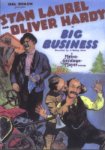
big business posterCharlie Chaplin’s silent short Behind the Screen kicked off the festival. The print, crisp and clear, shows the hero’s antics as an assistant at a movie production company, with typical Chaplin slapstick. The next, Buster Keaton—the Human Medicine Ball, Model labeled him—was up with The Goat, featuring a mistaken identity and police chases galore. Then it was Good Cheer, a sentimental Hal Roach comedy featuring The Gang (sort of a prototype of Our Gang), an archetypical bunch of tenement-dwelling kids who wonder if Santa Claus really exists. This print was poor, but it was a lesson in film preservation, and how acetate film stock decays when the original is not copied to a more permanent material. A huge percentage of silent films have been lost, mostly because there’s no profit motive. (By the way, according to Good Cheer, Santa’s the real deal.) The last on the bill was arguably the most hilarious: Big Business, a rare Laurel and Hardy silent two-reeler (most of their movies were talkies), and a portrayal of Reciprocal Destruction: The pair’s attempt to sell a Christmas tree starts with an irate would-be customer clipping the tree’s top and ends with his house and their car reduced to rubble.

After the show Model took a couple of questions from the audience, and said that like most accompanists back in the day, he doesn’t play by a score. Fascinating stuff for the film buff, and a cheap date for the twentysomethings: the night at the movies was free. If you’re lucky, you can get to go next year.

Executive Editor Phil Scott often writes about travel and aviation.

In Kandahar: Dreaming of Egg Creams

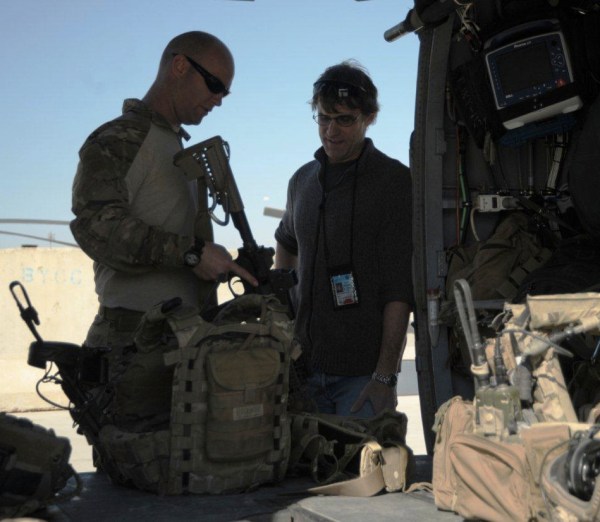
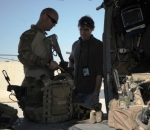
A pararescue soldier holding an M4 discusses gear with Phil Scott as the helicopter is loaded.

Pararescue soldier with Phil Scott beside medevac helicopter.

MY BUDDY JET LAG.  YOU CAN’T FLY FROM AFGHANISTAN to Brooklyn without him waiting for you. We took the medevac transport from Bagram Air Base in Afghanistan to Ramstein, Germany, and from Ramstein to Andrews Air Force Base, where the wounded were carried to Walter Reed by an old white school bus painted with red crosses. Nearly everyone on board the flight had some sort of leg injury. One patient – likely Special Forces because he, like nearly all the Special Forces types I saw at Kandahar and Bagram, wore a beard – was missing his right foot. His left foot was bandaged, and I think he was missing some toes.

Then, alone, I rode an Amtrak train to New York’s Penn Station and took the subway to my home base, Brooklyn. After more than 24 hours of travel carrying 80 pounds of gear on my back, I walked through the front door, up the stairs, dropped the backpack on the floor and kicked off my shoes. I crawled into bed and slept for nearly a day and a half.
 
I’ve reported from nearly 20 countries around the world, and the loneliest place was Thanksgiving in Kandahar. We stood in line for a meal of turkey roll, instant mashed potatoes and deep-fried stuffing balls dished out on a cardboard plate, and then we trekked to a distant hut to listen in to an airman talk to President Obama over the phone. After that a White House aide called the airman’s wife and transferred the call. The airman choked up, and that’s when the loneliness hit me. I missed Brooklyn, its egg creams, its bridges and steeples, its flea markets and food fairs. And I vowed to enjoy all of those in the coming days between my homecoming and Christmas. 
Executive Editor Phil Scott’s latest book is Then & Now: How Airplanes Got This Way.
◊ ◊ ◊
Starting here Thursday, December 6

12 Days of Brooklyn

Brooklyn Artisan’s own collection of 

captured views, native tastes and special sips  

that make our borough like nowhere else.

◊ ◊ ◊

How to Eat Those Veggies No Matter What

When your power’s out for who knows how long, you start to appreciate some of life’s simpler things. You realize that canning is civilization’s third-greatest invention, right behind 10-speed bicycles and grandma’s knitted sweaters. Artisanal, DIY types might have Ball jars full of home-grown preserves in their well-stocked pantries, but if you’re me you head directly to the canned-green-bean aisle at Key Food.

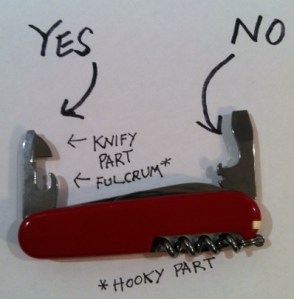
How to recognize the can opener on your Swiss Army KnifeOpening a can without power is no problem to me these days. When my electric can opener shot craps—it was during the Great New York City Blackout of ’02 or ’03 when it suddenly stopped working—I trashed it and devolved to the manual one with the butterfly handles that turn the circular blade that presses against the gear that presses against the can’s lip.

Then I discovered one on my Swiss Army Knife. Within a few minutes and a couple of failed tries that resulted in minor wounds, I figured out how it works—and simultaneously realized that this is undoubtedly how people did it in the old, old early days of American canning. And now I’m passing on that wisdom to you.

Better pay attention: I hear a nor’easter is headed our way on Thursday.   [Read more…]

A Guys’ Guy’s First Step Down the Slippery Slope to …

…CANNING CLASS.

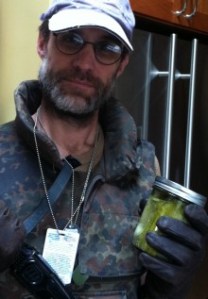
Author Phil Scott in disguide as survivalist

“New York Magazine may think artisanal pickles are ‘twee,’ but I don’t. Not one little bit.”
(Photo: Mollie Ann Smith)

I’m a five-foot-eleven-inch, 175-pound manly male, comfortable climbing Kilimanjaro or sleeping on the cold metal floor of a transport headed to or from Afghanistan, comfortable surviving on MREs. I once tried to have The Food Channel removed from my cable package and replaced with The Manly Adventure Channel. Last time I stepped foot in a kitchen was to nuke a couple of hot dogs. Otherwise it’s the room I have to cross through to get from my bedroom to the bathroom. And now because I’m always looking to cut costs, I’m signed up for what could be one of the most complex operations known to cooking kind—canning. And I’m the only guy in the class.

Catherine, who’s teaching the canning class at the Brooklyn Society for Ethical Culture, explains that it’s been a part of her life for her whole life. Her grandmother’s last words were, “Well girls, I guess we won’t be canning this year.” At the beginning of the two-hour class she says that anything can be pickled, from green beans to eggs. Yeah, eggs. They taste gross, but they’re still pickleable. That’s probably why they’re usually only found in bars.

Us novices, we’re going to start with green beans. Not a big fan of green beans.

Catherine really emphasizes exactitude. This whole canning business isn’t so much an art as a precise chemistry problem. “Follow directions,” she says. “It’s really easy to get botulism.” For those who haven’t had botulism, or botulitis, or whatever it’s called, the stuff’s pretty toxic. [Read more…]

Understanding the Hollywood Smoke

I WAS REMINDED by John J. Kochevar’s comments in An Artisanal Author Confronts His Pencils of how many traditional skills are fast disappearing these days. Here is another.

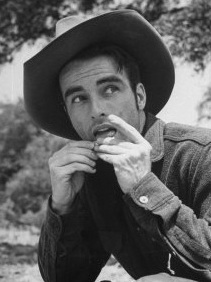
Montgomery Clift shows the classic cowboy roll on the set of Red River.

How to Roll a – uh, a Cigarette like a Pro.

The intent here is not to skirt Mayor Bloomberg’s efforts to ban public smoking in New York City , but rather to address the high cost of a pack of cigarettes as well as record some ways of working with one’s hands once glamorized by Hollywood. 

Rolling  a smoke is a two-handed operation (see inset). Remove the cigarette rolling paper from its pack. Gently spread the paper horizontally,  and delicately grasp it between the tips of both index fingers and thumbs, roughly at the paper’s midpoint. The gummy strip should run along the top facing you. Carefully—yet  confidently—roll the paper back and forth three or four times with your thumbs and index fingers until it forms a U, with the gummy strip higher than the un-gummy side.

Gently now, gently, very gently, grasp the paper by one end. Remove one hand and take a pinch of tobacco. The tobacco should not be lumpy (and chewing tobacco should not be substituted. Nor should hamster food or your grandmother’s loose black tea—you will be discovered and publicly humiliated). [Read more…]

How to Shave with a Brush and Soap in Today’s World

EVER NOTICE HOW some people can smuggle an AK-47 in their checked luggage but you can’t sneak a can of shaving cream past alert Transportation Security Agents without them tossing that and your toothpaste in a large plastic garbage can? Well, I have. Also, and this is more important, I’m so cheap I won’t even pay attention.

That’s why, after wasting my third can or so in the TSA trash, I’ve taken to shaving with the old-fashioned brush and shaving soap. Not only have I never been wrestled to the ground and handcuffed by alert agents trying to confiscate my beaver-hair shaving brush, but past the initial investment I’m pretty much home free.

Plus – and this is a big plus – I’ve found it gets my day off to the proper artisanal start, taking this time to work with my hands. So here’s how you pull off that close shave the authentic, old-fashioned way.

BB00 96.tif

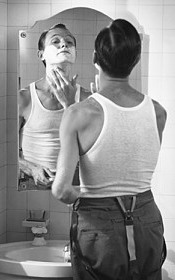
The man seen shaving here is not Phil Scott, nor does he play him on TV.

1. You’re going to need a shaving brush, a ceramic mug of some sort, and a bar of soap. I prefer a thick china mug with an old Air Force logo, but you can maybe find one with a Brooklyn Dodgers logo or a Yogi Berra quote. Whatever you choose, the majority of the mug must be a light color.

And don’t forget the razor. That’s really the most important part, the razor. I prefer the triple-blade types. Disposables blow. Straight razors are dangerous and scary and you’ll never get one through an airport anyway.

2. Place the soap inside the mug somehow. I prefer to nuke the combination in the microwave (no need to carry this authenticity thing too far) for maybe 20 seconds until the soap gets a little soft, then flatten it with my thumbs into what is called a soap puck. You’ll have to do this each time you add a new bar of soap, which means maybe twice a year. (See, it’s already less expensive than canned shaving cream.)

Even toss in soap scraps from the sink or shower. If your mug’s dark (see no 1. above) it will block the magic hot rays that are supposed to turn the soap into a soft goo. Same with metallic elements, like gold rims. I’m not sure why, just take my word for it.

Now you’re ready to shave! Fill the mug to the top with hot water, and work up a lather with the brush. Brush the lather all over the area destined for shaving. Really work it in there, too – coating those whiskers makes for a smooth shave.

3. It is not strictly necessary to don long pants, a dirty wifebeater, and suspenders that you can drop off your shoulders while you lather up, like in those early episodes of Mad Men. Today you can do this in boxers, briefs, boxer-briefs, or a towel, or less.

4. Scrape all the soap lather off with the razor. And there you have it! You’re done! And your face is smoother than if you’d used shaving cream, or an electric razor.

NOTE: A styptic pencil is what you need to control the bleeding.

Executive Editor Phil Scott has written seven book and numerous articles for national magazines.

Just Try Holding That iPhone to Your Ear While You Type

FROM BROOKLYN’S COMMUNITY OF ARTISANS I’ve learned how important it is that skills with traditional tools should not become lost arts. At first it was hard to apply this insight to my own work, for I am a journalist. But reading John J. Kochevar’s recent piece on artisanal writing with pencils inspired me.

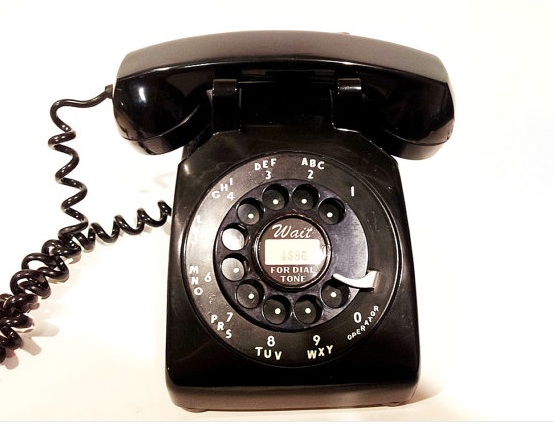
This vintage rotary in working order sells in the neighborhood of $50 at Etsy.com.

Here is the missing manual for another traditional reporter’s tool. Master this, and you step into a stream of greatness: Edward R. Murrow, Woodward and Bernstein, Lois and Clark.

How to Dial a Rotary Telephone

Before keypads, telephones used to come equipped with dials. Thus the expression, “dial the telephone.”

1. The dial is the round object in the center of the phone at right, with a series of evenly spaced holes running along the perimeter of the disc.

2. Insert your index finger into the hole that corresponds to the number or letter you wish to “dial.”

3. Move the finger in a clockwise fashion until it rests against a thin stop, usually located on the right side of the dial. Remove your finger, and the dial automatically  returns to its original position.

4. Perform the same operation for the subsequent numbers that you wish to dial until you‘ve completed dialing the entire number. Once connected to your party, remember to keep your fingers a safe distance away from the dial to avoid service interruptions.

Note: A rotary dial telephone can not be used for texting.